A balloon of mass $m$ contains water of mass $M$ . If it is completely immersed in water, find the apparent mass of the balloon with water in it
Easy


Download our appand get started for free
Experience the future of education. Simply download our apps or reach out to us for more information. Let's shape the future of learning together!No signup needed.*
Similar Questions
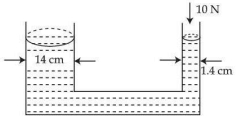
- 1A hydraulic press containing water has two arms with diameters as mentioned in the figure. A force of $10 \mathrm{~N}$ is applied on the surface of water in the thinner arm. The force required to be applied on the surface of water in the thicker arm to maintain equilibrium of water is_________.${N}$.View Solution
- 2Water is moving with a speed of $5.0\,m/s$ through a pipe of cross sectional area $4.0\,cm^2$ . The water gradually descends $10\,m$ as the pipe increase in area to $8.0\,cm^2$ . If the pressure at the upper level is $1.5 \times 10^5\,Pa$ , the pressure at lower level will beView Solution
- 3A cylindrical block of wood of base area $30\ cm^2$ , floats in a liquid of density $900\ kg/m^3$ . The block is depressed lightly and then released. The time period of the resulting oscillations of the block is equal to that of spring with block of same mass, then spring constant is equal to ........ $N/m$View Solution
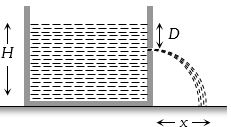
- 4A tank is filled with water up to a height $H$. Water is allowed to come out of a hole $ P$ in one of the walls at a depth $ D $ below the surface of water. Express the horizontal distance $x$ in terms of $ H $ and $D$View Solution
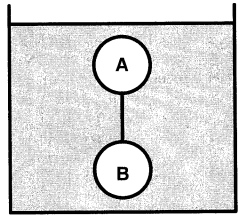
- 5Two solid spheres $A$ and $B$ of equal volumes but of different densities $d_A$ and $d_B$ are connected by a string. They are fully immersed in a fluid of density $d_F$. They get arranged into an equilibrium state as shown in the figure with a tension in the string. The arrangement is possible only ifView Solution
$(A)$ $d_Ad_F$ $(B)$ $d_B > d_F$ $(C)$ $d_A>d_F$ $(D)$ $d_A+d_B=2 d_F$
- 6View SolutionThe height to which a cylindrical vessel be filled with a homogeneous liquid, to make the average force with which the liquid presses the side of the vessel equal to the force exerted by the liquid on the bottom of the vessel, is equal to
- 7$A U-$ tube having horizontal arm of length $20$ $cm$, has uniform cross-sectional area $=1\ cm^2$. It is filled with water of volume $60$ $cc$. What volume of a liquid of density $4$ $g/cc$ should be poured from one side into the $U -$ tube so that no water is left in the horizontal arm of the tube ........ $cc$ ?View Solution
- 8$Assertion :$ In a pressure cooker the water is brought to boil. The cooker is then remove from the stove. Now on removing the lid of the pressure cooker, the water starts boiling against.View Solution
$Reason :$ The impurities in water bring down its boiling point - 9A cube of edge length $10 \,cm$ is just balanced at the interface of two liquids $A$ and $B$ as shown in figure. If $A$ and $B$ has specific gravity $0.6$ and $0.4$ respectively, then mass of cube is ................ $g$View Solution

- 10A solid metallic sphere of radius $r$ is allowed to fall freely through air. If the frictional resistance due to air is proportional to the cross-sectional area and to the square of the velocity, then the terminal velocity of the sphere is proportional to which of the following?View Solution