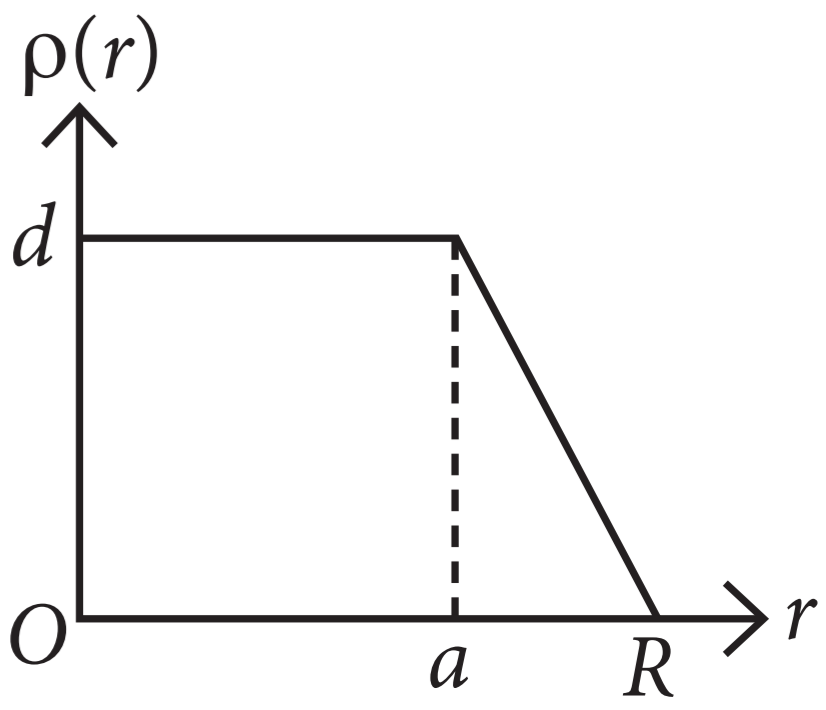
Question
A stationary charge produces only an electrostatic field while a charge in uniform motion produces a magnetic field, that does not change with time. An oscillating charge is an example of accelerating charge. It produces an oscillating magnetic field, which in turn produces an oscillating electric fields and so on. The oscillating electric and magnetic fields regenerate each other as a wave which propagates through space.

Magnetic field in a plane electromagnetic wave is given by $\vec{\text{B}}=\text{B}_0\sin(\text{kx}+\omega\text{t}) \hat{\text{j}}\text{T}.$
  1. Expression for corresponding electric field will be $($Where $c$ is speed of light$)$.
  1. $\vec{\text{E}}=-\text{B}_0\text{c}\sin(\text{kx}+\omega\text{t}) \hat{\text{k}}\frac{\text{V}}{\text{m}}$
  2. $\vec{\text{E}}=\text{B}_0\text{c}\sin(\text{kx}-\omega\text{t}) \hat{\text{k}}\frac{\text{V}}{\text{m}}$
  3. $\vec{\text{E}}=\frac{\text{B}_0}{\text{c}}\sin(\text{kx}+\omega\text{t}) \hat{\text{k}}\frac{\text{V}}{\text{m}}$
  4. $\vec{\text{E}}=\text{B}_0\text{c}\sin(\text{kx}+\omega\text{t}) \hat{\text{k}}\frac{\text{V}}{\text{m}}$
  1. The electric field component ofa monochromatic radiation is given by $\vec{\text{E}} = 2\epsilon_0\hat{\text{i}}\cos\text{kz}\cos\omega\text{t}.$ Its magnetic field $\vec{\text{B}}$ is then given by:
  1. $\frac{2\epsilon_0}{\text{c}}\hat{\text{j}}\cos\text{kz}\cos\omega\text{t}$
  2. $\frac{2\epsilon_0}{\text{c}}\hat{\text{j}}\sin\text{kz}\cos\omega\text{t}$
  3. $\frac{2\epsilon_0}{\text{c}}\hat{\text{j}}\sin\text{kz}\sin\omega\text{t}$
  4. $-\frac{2\epsilon_0}{\text{c}}\hat{\text{j}}\sin\text{kz}\sin\omega\text{t}$
  1. A plane em wave of frequency $25MHz$ travels in a free space along $x-$ direction. At a particular point in space and time, $\text{E}=(6.3\ \hat{\text{j}})\frac{\text{V}}{\text{m}}.$ What is magnetic field at that time?
  1. $0.095\mu\text{T}$
  2. $0.124\mu\text{T}$
  3. $0.089\mu\text{T}$
  4. $0.021\mu\text{T}$
  1. A plane electromagnetic wave travelling along the $x-$ direction has a wavelength of $3\ mm$. The variation in the electric field occurs in the $y-$ direction with an amplitude $66Vm^1$. The equations for the electric and magnetic fields as a function of $x$ and tare respectively.
  1. $\text{E}_\text{y}=33\cos\pi\times10^{11}\Big(\text{t}-\frac{\text{x}}{\text{c}}\Big),$
    $\text{B}_\text{z}=1.1\times10^{-7}\cos\pi\times10^{11}\Big(\text{t}-\frac{\text{x}}{\text{c}}\Big)$
  2. $\text{E}_\text{y}=11\cos2\pi\times10^{11}\Big(\text{t}-\frac{\text{x}}{\text{c}}\Big),$
    $\text{B}_\text{y}=11\times10^{-7}\cos2\pi\times10^{11}\Big(\text{t}-\frac{\text{x}}{\text{c}}\Big)$
  3. $\text{E}_\text{x}=33\cos\pi\times10^{11}\Big(\text{t}-\frac{\text{x}}{\text{c}}\Big),$
    $\text{B}_\text{x}=11\times10^{-7}\cos\pi\times10^{11}\Big(\text{t}-\frac{\text{x}}{\text{c}}\Big)$
  4. $\text{E}_\text{y}=66\cos2\pi\times10^{11}\Big(\text{t}-\frac{\text{x}}{\text{c}}\Big),$
    $\text{B}_\text{z}=2.2\times10^{-7}\cos2\pi\times10^{11}\Big(\text{t}-\frac{\text{x}}{\text{c}}\Big)$
  1. A plane electromagnetic wave travels in free space along $x-$ axis. At a particular point in space, the electric field along $y-$ axis is $9.3Vm^{-1.}$ The magnetic induction $(B)$ along $z-$ axis is:
  1. $3.1 \times 10^{-8}T$
  2. $3 \times 10^{-5}T$
  3. $3 \times 10^{-6}T$
  4. $9.3 \times 10^{-6}T$

Answer

  1. $(d)\ \vec{\text{E}}=\text{B}_0\text{c}\sin(\text{Kx}+\omega\text{t}) \hat{\text{k}}\frac{\text{V}}{\text{m}}$
Given : $\vec{\text{B}}=\text{B}_0\text{c}\sin(\text{Kx}+\omega\text{t}) \hat{\text{k}}\frac{\text{V}}{\text{m}}$
The relation between electric and magnetic field is,
$\text{c}=\frac{\text{E}}{\text{B}}$ or $E = cB$
The electric $6$ eld component is perpendicular to the direction of propagation and the direction of magnetic field.
Therefore, the electric field component along $z-$ axis is obtained as $\vec{\text{E}}=\text{cB}_0\sin(\text{kx}+\omega\text{t}) \hat{\text{k}}\frac{\text{V}}{\text{m}}.$
  1. $(c)\ \frac{2\epsilon_0}{\text{c}}\hat{\text{j}}\sin\text{kz}\sin\omega\text{t}$
$\frac{\text{dE}}{\text{dz}}=-\frac{\text{dB}}{\text{dt}}$
$\frac{\text{dE}}{\text{dz}}=-2\text{E}_0\text{k}\sin\text{kz}\cos\omega\text{t}=-\frac{\text{dB}}{\text{dt}}$
${\text{dB}}=+2\text{E}_0\text{k}\sin\text{kz}\cos\omega\text{t}{\text{dt}}$
${\text{B}}=+2\text{E}_0\text{k}\sin\text{kz}\int\cos\omega\text{t}{\text{dt}}$
$=+2\text{E}_0\frac{\text{k}}{\omega}\sin\text{kz}\sin\omega\text{t}$
$\frac{\text{E}_0}{\text{B}_0}=\frac{\omega}{\text{k}}=\text{c}$
$\text{B}=\frac{2\text{E}_0}{\text{c}}\sin\text{kz}\sin\omega\text{t}$
$\therefore\text{B}=\frac{2\text{E}_0}{\text{c}}\sin\text{kz}\sin\omega\text{t}\hat{\text{j}}$
$E$ is along $y-$ direction and the wave propagates along $x-$ axis.
$\therefore B$ should be in a direction perpendicular to both $x$ and $y-$ axis.
  1. $(d)\ 0.021\mu\text{T}$
Here, $\vec{\text{E}}=6.3\hat{\text{j}};\text{c}=3\times10^8\frac{\text{m}}{\text{s}}$
The magnitude of $B$ is:
${\text{Bz}}=\frac{\text{E}}{\text{c}}=\frac{6.3}{3\times10^8}$
$=2.1\times10^8\ \text{T}=0.021\mu\text{T}$
  1. $(d) \ \text{E}_\text{y}=66\cos2\pi\times10^{11}\Big(\text{t}-\frac{\text{x}}{\text{c}}\Big),\text{B}_\text{z}=2.2\times10^{-7}\cos2\pi\times10^{11}\Big(\text{t}-\frac{\text{x}}{\text{c}}\Big)$
Here : $\text{E}_0=66\text{Vm}^{-1},\text{E}_\text{y}=66\cos\omega\Big(\text{t}-\frac{\text{x}}{\text{c}}\Big),$
$\lambda=3\text{ mm}=3\times10^{-3}\text{m},\text{k}=\frac{2\pi}{\lambda}$
$\frac{\omega}{\text{k}}=\text{c}$
$\Rightarrow\omega=\text{ck}=3\times10^8\times\frac{2\pi}{3\times10^{-3}}$
or $\omega=2\pi\times10^{11}$
$\therefore\text{E}_\text{y}=66\cos2\pi\times10^{11}\Big(\text{t}-\frac{\text{x}}{\text{c}}\Big)$
${\text{Bz}}=\frac{\text{E}_\text{y}}{\text{c}}=\Big(\frac{66}{3\times10^8}\Big)\cos2\pi\times10^{11}\Big(\text{t}-\frac{\text{x}}{\text{c}}\Big)$
$=2.2\times10^{-7}\cos2\pi\times10^{11}\Big(\text{t}-\frac{\text{x}}{\text{c}}\Big)$
  1. $(a)\ 3.1 \times 10^{-8}T$
At a particular point $ , E = 9.3Vm^{-1}$​​​​​​​
$\therefore$ Magnetic field at the same point $=\frac{9.3}{3\times10^8}$
$= 3.1 \times 10^{-8}T$

Need a full question paper?

Generate a complete, print-ready paper with questions like this in minutes — across 16+ boards, with answer keys.

Start Generating Free

Similar questions

A silver ball of radius $4.8\ cm$ is suspended by a thread in a vacuum chamber. Ultraviolet light of wavelength $200$ run is incident on the ball for some time during which a total light energy of $1.0 \times 10^{-7}J$ falls on the surface. Assuming that on the average one photon out of every ten thousand is able to eject a photoelectron, find the electric potential et the surface of the bell assuming zero potential at infinity. What is the potential at the centre of the bell?
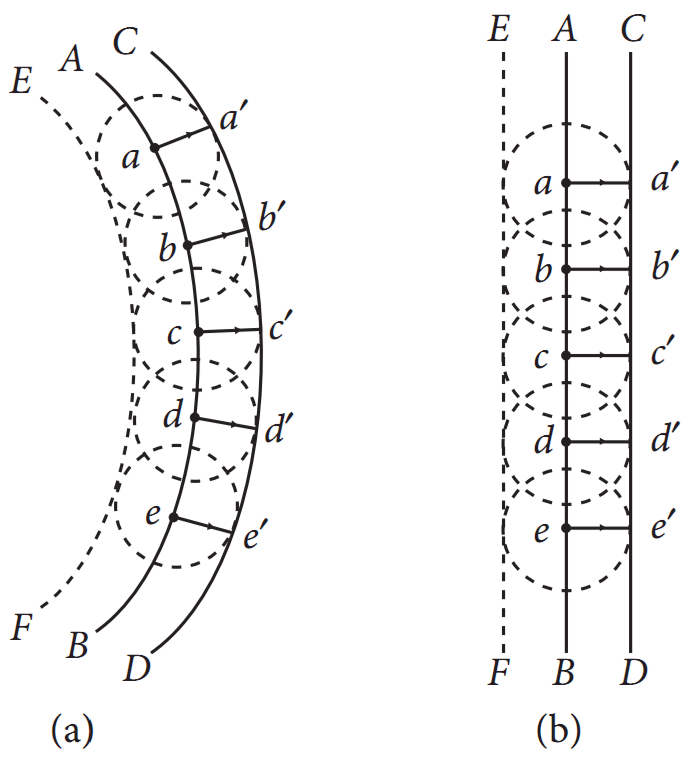
Huygen's principle is the basis of wave theory of light. Each point on a wavefront acts as a fresh source of new disturbance, called secondary waves or wavelets. The secondary wavelets spread out in all directions with the speed light in the given medium.
An initially parallel cylindrical beam travels in a medium of refractive index $\mu(\text{I})=\mu_0+\mu_2\text{I}$, where $\mu_0$ and $\mu_2$ are positive constants and I is the intensity of the light beam. The intensity of the beam is decreasing with increasing radius.
  1. The initial shape of the wavefront of the beam is:
  1. Planar.
  2. Convex.
  3. Concave.
  4. Convex near the axis and concave near the periphery.
  1. According to Huygens Principle, the surface of constant phase is:
  1. Called an optical ray.
  2. Called a wave.
  3. Called a wavefront.
  4. Always linear in shape.
  1. As the beam enters the medium, it will:
  1. Travel as a cylindrical beam.
  2. Diverge.
  3. Converge.
  4. Diverge near the axis and converge near the periphery.
  1. Two plane wavefronts oflight, one incident on a thin convex lens and another on the refracting face of a thin prism. After refraction at them, the emerging wavefronts respectively become.
  1. Plane wavefront and plane wavefront.
  2. Plane wavefront and spherical wavefront.
  3. Spherical wavefront and plane wavefront.
  4. Spherical wavefront and spherical wavefront.
  1. Which of the following phenomena support the wave theory of light?
  1. Scattering.
  2. Interference.
  3. Diffraction.
  4. Velocity of light in a denser medium is less than the velocity of light in the rarer medium.
  1. 1, 2, 3
  2. 1, 2, 4
  3. 2, 3, 4
  4. 1, 3, 4
Distance between two successive bright or dark fringes is called fringe width.
$\beta=\text{Y}_\text{n+1}-\text{Y}_\text{n}=\frac{(\text{n}+1)\lambda\text{D}}{\text{d}}-\frac{\text{n}\lambda\text{D}}{\text{d}}=\frac{\lambda\text{D}}{\text{d}}$
Fringe width is independent of the order of the maxima. If whole apparatus is immersed in liquid of refractive index $\mu$ then $\beta=\frac{\lambda\text{D}}{\mu\text{d}} \ ($fringe width decreases$)$. Angular fringe width $(\theta)$ is the angular separation between two consecutive maxima or minima
$\theta=\frac{\beta}{\text{D}}=\frac{\lambda}{\text{d}}$
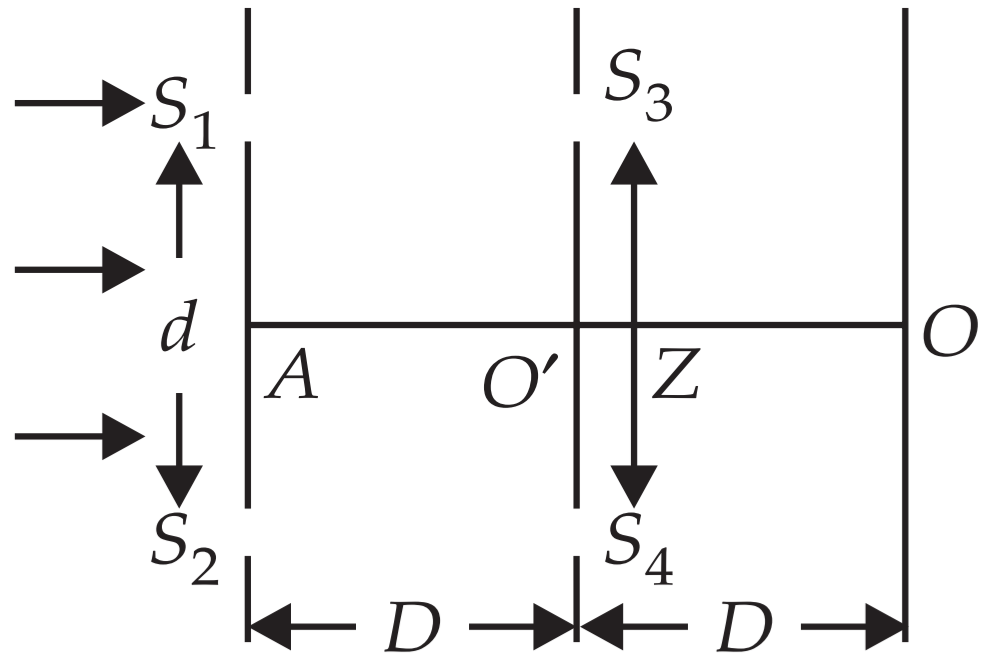
ln the arrangement shown in figure, slit $S_3$ and $S_4 $ are having a variable separation $Z$. Point $O$ on the screen is at the common perpendicular bisector of $S_1,S_2$ and $S_3,S_4.$
  1. The maximum number of possible interference maxima for slit separation equal to twice the wavelength in Young's double $-$ slit experiment, is:
  1. Does not move at all.
  2. Gets displaced from its earlier position.
  3. Becomes coloured.
  4. Disappears.
  5. ln a two slit experiment with white light, a white fringe is observed on a screen kept behind the slits. When the screen is moved away by $0.05m,$ this white fringe.
  6. Remain unaltered.
  7. Become wider.
  8. Become narrower.
  9. Disappear.
  10. When the complete Young's double slit experiment is immersed in water, the fringes.
  11. Unchanged
  12. Halved
  13. Doubled
  14. Quadrupled
  15. ln Young's double slit experiment, if the separation between the slits is halved and the distance between the slits and the screen is doubled, then the fringe width compared to the unchanged one will be.
  16. Wider
  17. Brighter
  18. Narrower
  19. Darker
  20. ln Young's double $- $ slit experiment if yellow light is replaced by blue light, the interference fringes become.
  21. Infinite
  22. Five
  23. Three
  24. Zero
The radius of a thin hollow metal sphere (spherical shell) is 30 cm . And there is a charge of 500 $\mu C$ on that spherical shell. Find the electric field intensity at a distance.(i) 1 meter, (ii) 30 cm , (iii) 10 cm , from the centre of the cell.
Two point charges $+3.2 \times 10^{-19}$ Coulomb and $-3.2 \times 10^{-19}$ Coulomb are kept at a distance of 2.4 $\times 10^{-10}$ meters from each other. This dipole is placed at an angle of $30^{\circ}$ to the field direction in a uniform field of intensity of $3 \times 10^4$ Newton/Coulomb. Find the value of the moment of the couple acting on it. What will be the maximum value of this torque?
A metallic loop is placed in a nonuniform magnetic field. Will an emf be induced in the loop?
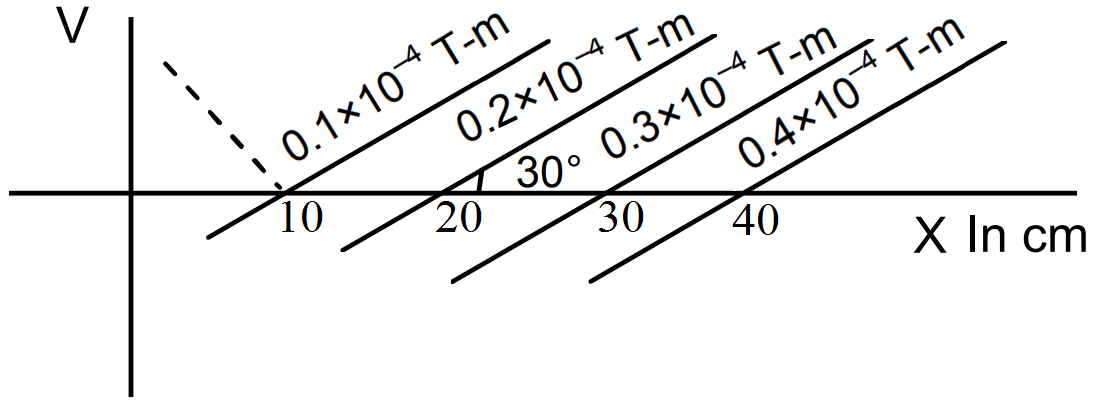
Figure shows some of the quipotential surfaces of the magnetic scalar potential. Fmd the magnetic field $B$ at a point in the region.
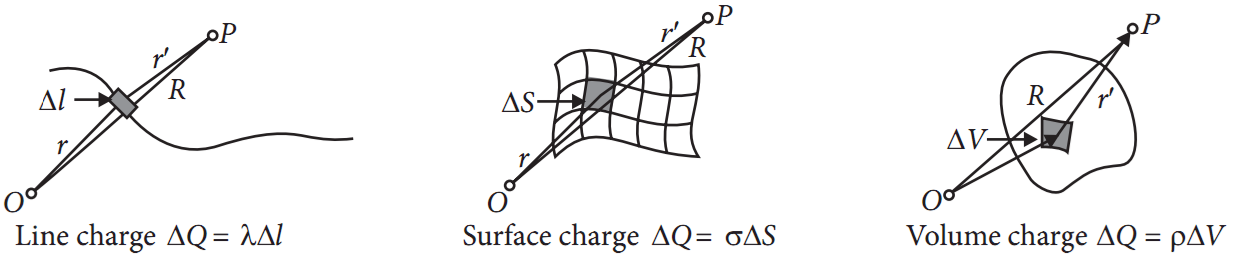
ln practice, we deal with charges much greater in magnitude than the charge on an electron, so we can ignore the quantum nature of charges and imagine that the charge is spread in a region in a continuous manner. Such a charge distribution is known as continuous charge distribution. There are three types of continuous charge distribution : $(i)$ Line charge distribution $(ii)$ Surface charge distribution $(iii)$ Volume charge distribution as shown in figure.
  1. Statement $1$ : Gauss's law can't be used to calculate an electric field near an electric dipole.
Statement $2$ : Electric dipole don't have symmetrical charge distribution.
  1. Statement $1$ and statement $2$ are true.
  2. Statement $1$ is false but statement $2$ is true.
  3. Statement $1$ is true but statement $2$ is false.
  4. Both statements are false.
  1. An electric charge of $8.85 \times 10^{-13}C$ is placed at the centre of a sphere of radius $1m$. The electric flux through the sphere is:
  1. $0.2NC^{-1} m^2$
  2. $0.1NC^{-1} m^2$
  3. $0.3NC^{-1} m^2$
  4. $0.01NC^{-1} m^2$
  1. The electric field within the nucleus is generally observed to be linearly dependent on $r$. So,
  1. $a = 0$
  2. $\text{a}=\frac{\text{R}}{2}$
  3. $a = R$
  4. $\text{a}=\frac{\text{2R}}{3}$
  1. What charge would be required to electrify a sphere of radius $25\ cm$ so as to get a surface charge density of $\frac{3}{\pi}\text{Cm}^{-2}?$
  1. $0.75C$
  2. $7.5C$
  3. $75C$
  4. Zero
  1. The $\text{SI}$ unit of linear charge density is :
  1. $Cm$
  2. $Cm^{-1}$
  3. $Cm^{-2}$
  4. $Cm^{-3}$
A magnetic dipole of magnetic moment $0.72A-m^2$ is placed horizontally with the north pole pointing towards bsouth. Find the position of the neutral point if the horizontal component of the earth's magnetic field is $18\mu\text{T.}$
A metal rod is placed along the axis of a solenoid carrying a high-freqμency alternating current. It is found that the rod gets heated. Explain why the rod gets heated.