MCQ
The wavefront of a distant source of unknown shape is approximately
  • A
    Spherical
  • B
    Cylindrical
  • C
    Elliptical
  • Plane

Answer

Correct option: D.
Plane
d
When the point source or linear source of light is at very large distance, a small portion of spherical or cylindrical wavefront appears to be plane. Such a wavefront is plane wavefront.

Need a full question paper?

Generate a complete, print-ready paper with questions like this in minutes — across 16+ boards, with answer keys.

Start Generating Free

Similar questions

The minimum kinetic energy needed by an alpha particle to cause the nuclear reaction ${ }_7^{16} N +{ }_2^4 He \rightarrow{ }_1^1 H +{ }_8^{19} O$ in a laboratory frame is $n$ (in $MeV$. Assume that ${ }_7^{16} N$ is at rest in the laboratory frame. The masses of ${ }_7^{16} N ,{ }_2^4 He ,{ }_1^1 H$ and ${ }_8^{19} O$ can be taken to be $16.006 u, 4.003 u$, $1.008 u$ and $19.003 u$, respectively, where $1 u=930 MeVc ^{-2}$. The value of $n$ is. . . . .
Two capacitors of capacities ${C_1}$ and ${C_2}$ are charged to voltages ${V_1}$ and ${V_2}$ respectively. There will be no exchange of energy in connecting them in parallel, if
The resultant magnetic moment of neon atom will be
Light enters from air into a given medium at an angle of $45^{\circ}$ with interface of the air-medium surface. After refraction, the light ray is deviated through an angle of $15^{\circ}$ from its original direction. The refractive index of the medium is.
$\frac{x}{x+4}$ is the ratio of energies of photons produced due to transition of an electron of hydrogen atom from its

$(i)$ third permitted energy level to the second level and $(ii)$ the highest permitted energy level to the second permitted level. The value of $x$ will be.
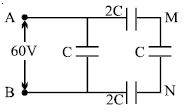
In the circuit shown, a potential difference of $60\,V$ is applied across $AB$. The potential difference between the point $M$ and $N$ is.....$V$
Einstein got Nobel prize on which of the following works:
The half-life of a sample of a radioactive substance is $1$ hour. If $8 \times {10^{10}}$ atoms are present at $t = 0$, then the number of atoms decayed in the duration $t = 2$ hour to $t = 4$ hour will be
A convex lens of focal length f produces an image $\frac{1}{ n }$ times than that of the size of the object. The distance of the object from the lens is
The charge on a hole is equal to the charge of