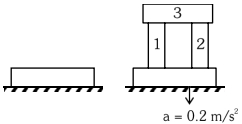
A steel block of $10\, {kg}$ rests on a horizontal floor as shown. When three iron cylinders are placed on it as shown, the block and cylinders go down with an acceleration $0.2\, {m} / {s}^{2}$. The normal reaction ${R}$ by the floor if mass of the iron cylinders are equal and of $20\, {kg}$ each, is .....$N.$ [Take ${g}=10\, {m} / {s}^{2}$ and $\mu_{{s}}=0.2$ ]
JEE MAIN 2021, Difficult
Download our app for free and get started
Writing force equation in vertical direction
${Mg}-{N}={Ma}$
$\Rightarrow 70 {g}-{N}=70 \times 0.2$
$\Rightarrow {N}=70[\,{g}-0.2]=70 \times 9.8$
$\therefore {N}=686\, \text { Newton }$
Note : Since there is no compressive normal from the sides, hence friction will not act.

Download our appand get started for free
Experience the future of education. Simply download our apps or reach out to us for more information. Let's shape the future of learning together!No signup needed.*
Similar Questions
- 1A block of mass $M$ slides down on a rough inclined plane with constant velocity. The angle made by the incline plane with horizontal is $\theta$. The magnitude of the contact force will be.View Solution
- 2A block of mass $10 \,kg$ is held at rest against a rough vertical wall $[\mu=0.5]$ under the action a force $F$ as shown in figure. The minimum value of $F$ required for it is ............ $N$ $\left(g=10 \,m / s ^2\right)$View Solution
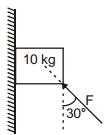
- 3A block of mass $m$ slides along a floor while a force of magnitude $F$ is applied to it at an angle $\theta$ as shown in figure. The coefficient of kinetic friction is $\mu_{ K }$. Then, the block's acceleration $'a'$ is given by: ($g$ is acceleration due to gravity)View Solution

- 4A wooden block of mass $M$ resting on a rough horizontal surface is pulled with a force $F$ at an angle $\phi $ with the horizontal. If $\mu $ is the coefficient of kinetic friction between the block and the surface, then acceleration of the block isView Solution
- 5The normal reaction $'{N}^{\prime}$ for a vehicle of $800\, {kg}$ mass, negotiating a turn on a $30^{\circ}$ banked road at maximum possible speed without skidding is $...\,\times 10^{3}\, {kg} {m} / {s}^{2}$ [Given $\left.\cos 30^{\circ}=0.87, \mu_{{s}}=0.2\right]$View Solution
- 6A block of mass $m$ is stationary on a rough plane of mass $M$ inclined at an angle $\theta$ to the horizontal, while the whole set up is accelerating upwards at an acceleration $\alpha$. If the coefficient of friction between the block and the plane is $\mu$, then the force that the plane exerts on the block isView Solution
- 7A force $f$ is acting on a block of mass $m$. Coefficient of friction between block and surface is $\mu$. The block can be pulled along the surface if :-View Solution
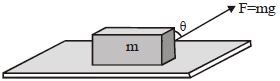
- 8A heavy box is to dragged along a rough horizontal floor. To do so, person $A$ pushes it at an angle $30^o$ from the horizontal and requires a minimum force $F_A$, while person $B$ pulls the box at an angle $60^o$ from the horizontal and needs minimum force $F_B$. If the coefficient of friction between the box and the floor is $\frac{{\sqrt 3 }}{5}$ , the ratio $\frac{{{F_A}}}{{{F_B}}}$ isView Solution
- 9A block of mass $m$ is in contact with the cart $C$ as shown in the figure. The coefficient of static friction between the block and the cart is $\mu .$ The acceleration $\alpha$ of the cart that will prevent the block from falling satisfiesView Solution
- 10A smooth circular groove has a smooth vertical wall as shown in figure. A block of mass $m$ moves against the wall with a speed $v$. Which of the following curve represents the correct relation between the normal reaction on the block by the wall $( N )$ and speed of the block $(v)$ ?View Solution