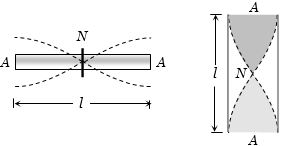
A steel rod $100 cm$ long is clamped at its mid-point. The funda-mental frequency of longitudinal vibrations of the rod is given to be $2.53 kHz$. What is the speed of sound in steel .... $km/s$
Medium


Download our appand get started for free
Experience the future of education. Simply download our apps or reach out to us for more information. Let's shape the future of learning together!No signup needed.*
Similar Questions
- 1Equation of a progressive wave is given by $y = a\,\sin \pi \,\left[ {\frac{t}{2} - \frac{x}{4}} \right]\,,$ where $t$ is in seconds and $x$ is in meters. The distance through which the wave moves in $8 sec$ is .... $(m)$ (in meter)View Solution
- 2In a medium sound travels $2\, km$ in $3\, sec$ and in air, it travels $3 \,km$ in $10\, sec$. The ratio of the wavelengths of sound in the two media isView Solution
- 3View SolutionAs a wave propagates
- 4Two waves having equationsView Solution
${x_1} = a\sin (\omega \,t + {\phi _1})$, ${x_2} = a\sin \,(\omega \,t + {\phi _2})$
If in the resultant wave the frequency and amplitude remain equal to those of superimposing waves. Then phase difference between them is
- 5A closed organ pipe of length $1.2 \,\,m$ vibrates in its first overtone mode. The pressure variation is maximum at:View Solution
- 6A wave of frequency $500 Hz$ has velocity $360\, m/sec.$ The distance between two nearest points $60^o$ out of phase, is .... $cm$View Solution
- 7An open pipe resonates with a tuning fork of frequency $500 Hz$. it is observed that two successive nodes are formed at distances $16$ and $46 cm $ from the open end. The speed of sound in air in the pipe is ..... $m/s$View Solution
- 8View SolutionWhen a stationary wave is formed then its frequency is
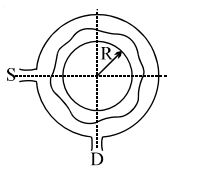
- 9A narrow tube is bent in the form of a circle of radius $R,$ as shown in the figure. Two small holes $S$ and $D$ are made in the tube at the positions right angle to each other. A source placed at $S$ generated a wave of intensity $I_0$ which is equally divided into two parts : One part travels along the longer path, while the other travels along the shorter path. Both the part waves meet at the point $D$ where a detector is placed The maximum value of $\lambda$ to produce a minima at $D$ is given byView Solution
- 10View SolutionWhen a tuning fork vibrates, the waves produced in the fork are