When a tuning fork vibrates, the waves produced in the fork are
Easy


Download our appand get started for free
Experience the future of education. Simply download our apps or reach out to us for more information. Let's shape the future of learning together!No signup needed.*
Similar Questions
- 1The pressure wave, $P = 0.01\,sin\,[1000t -3x]\,Nm^{-2},$ corresponds to the sound produced by a vibrating blade on a day when atmospheric temperature is $0\,^oC.$ On some other day when temperature is $T,$ the speed of sound produced by the same blade and at the same frequency is found to be $336 \,ms^{-1}$. Approximate value of $T$ is .... $^oC$View Solution
- 2View SolutionThe phenomenon of sound propagation in air is
- 3If in an experiment for determination of velocity of sound by resonance tube method using a tuning fork of $512 Hz$, first resonance was observed at $30.7 cm$ and second was obtained at $63.2 cm$, then maximum possible error in velocity of sound is .....$cm/sec$ (consider actual speed of sound in air is $332 m/s$)View Solution
- 4A person speaking normally produces a sound intensity of $40\,dB$ at a distance of $1\,m$. If the threshold intensity for reasonable audibility is $20\,dB,$ the maximum distance at which he can be heard clearly is ... $m$View Solution
- 5View SolutionAsufficiently long close organ pipe has a small hole at its bottom. Initially the pipe is empty. Water is poured into the pipe at a constant rate. The fundamental frequency of the air column in the pipe
- 6The equation of a wave travelling in a string can be written as $y = 3\cos \pi (100\,t - x)$. Its wavelength is .... $cm$View Solution
- 7If $v$ is the speed of sound in air then the shortest length of the closed pipe which resonates to a frequency $n$View Solution
- 8$‘SONAR’$ emits which of the following wavesView Solution
- 9View SolutionA device used for investigating the vibration of a fixed string or wire is
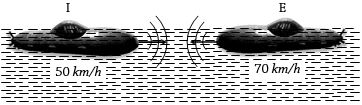
- 10An Indian submarine and an enemy submarine move towards each other during maneuvers in motionless water in the Indian ocean. The Indian submarine moves at $50 km/h$, and the enemy submarine at $70 km/h$. The Indian sub sends out a sonar signal (sound wave in water) at $1000 Hz$. Sonar waves travel at $5500 km/h$. What is the frequency detected by the Indian submarine .... $kHz$View Solution