MCQ
A steel rod $100 \,cm$ long is clamped at its middle. The fundamental frequency of longitudinal vibrations of the rod are given to be $2.53\,kHz$. What is the speed of sound in steel ..... $km/sec$
  • A
    $2.53$
  • $5.06$
  • C
    $10.12$
  • D
    $20.24$

Answer

Correct option: B.
$5.06$
b
$ \lambda / 2 =100 \mathrm{\,cm} $

$\lambda =200 \mathrm{\,cm}=2 \mathrm{\,m} $

$\mathrm{v} =\mathrm{n} \lambda$

$ =2.53 \times 10^{3} \times 2=5.06 \mathrm{\,km} / \mathrm{sec} $

Need a full question paper?

Generate a complete, print-ready paper with questions like this in minutes — across 16+ boards, with answer keys.

Start Generating Free

Similar questions

If $R$ and $L$ represent respectively resistance and self inductance, which of the following combinations has the dimensions of frequency
The quantity $\frac{\text{PV}}{\text{kT}}$ represents:
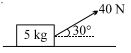
Adjoining figure shows a force of $40\, N$ acting at $30^o$ to the horizontal on a body of mass $5 \,kg$ resting on a smooth horizontal surface. Assuming that the acceleration of free-fall is $10\, ms^{-2}$, which of the following statements is (are) correct?

$[1]$ The horizontal force acting on the body is $20\, N$

$[2]$ The weight of the $5\, kg$ mass acts vertically downwards

$[3]$ The net vertical force acting on the body is $30\, N$
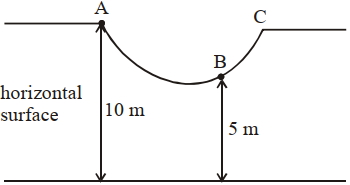
As shown in the figure, a particle of mass $10$ $kg$ is placed at a point $A$. When the particle is slightly displaced to its right, it starts moving and reaches the point $B$. The speed of the particle at $B$ is $x\, m / s$. (Take $\left. g =10\, m / s ^{2}\right)$ The value of $'x'$ to the nearest integer is.........
A particle projected from origin moves in $x-y$ plane with a velocity $\vec{v}=3 \hat{i}+6 x \hat{j}$, where $\hat{i}$ and $\hat{j}$ are the unit vectors along $x$ and $y$ axis. Find the equation of path followed by the particle
A gas performs minimum work when it expands:
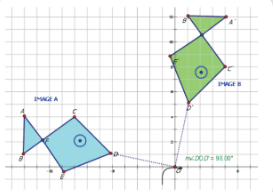
The figure below shows a pattern of two fishes. Write the mapping rule for the rotation of Image A to Image B.
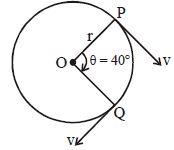
A particle is moving on a circular path of radius $r$ with uniform speed $v$. The magnitude of change in velocity when the particle moves from $P$ to $Q$ is  $(\angle POQ = 40^o)$
$A$ weightless rod is acted on by upward parallel forces of $2N$ and $4N$ ends $A$ and $B$ respectively. The total length of the rod $AB = 3m$. To keep the rod in equilibrium a force of $6N$ should act in the following manner:
An air bubble of radius $r$ in water is at a depth $h$ below the water surface at some instant. If $P$ is atmospheric pressure and $d$ and $T$ are the density and surface tension of water respectively. The pressure inside the bubble will be: