MCQ
The quantity $\frac{\text{PV}}{\text{kT}}$ represents:
  • A
    Mass of the gas.
  • B
    Kinetic energy of the gas.
  • C
    Number of moles of the gas.
  • Number of molecules in the gas.

Answer

Correct option: D.
Number of molecules in the gas.
Here,
$\text{PV = nRT ...(1)}$
Also,
$\text{k}=\frac{\text{R}}{\text{N}}$
$\Rightarrow\text{R}=\text{kN}\ ...(2)$
Now,
$\text{PV = nkNT} [$From eq. $(1)$ and eq. $(2)]$
$\Rightarrow\text{nN}=\frac{\text{PV}}{\text{kT}}$
$nN =$ Number of molecules
$\frac{\text{PV}}{\text{kT}} =$ Number of molecules.

Need a full question paper?

Generate a complete, print-ready paper with questions like this in minutes — across 16+ boards, with answer keys.
Start Generating Free

Similar questions

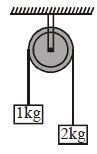
Two unequal masses are connected on two sides of light string passing over a light and smooth pulley as shown in the figure. The system is released from rest. The larger mass is stopped $1\, sec$ after the system is set into motion and then released. The time elapsed before the string is tight again $(g = 10\, m/sec^2)$
$250\,gm$ of water and an equal volume of alcohol of mass $200\,gm$ are placed successively in the same calorimeter and cools from $60^{\circ}\,C$ to $55^{\circ}\,C$ in $130\,sec$ and $67 sec$ respectively. If the water equivalent of the calorimeter is $10\,gm$. , then the specific heat of alcohol in cal/gm $cal / gm ^{\circ}\,C$ is
Two objects are projected with same velocity ' $u$ ' however at different angles $\alpha$ and $\beta$ with the horizontal. If $\alpha+\beta=90^{\circ}$, the ratio of horizontal range of the first object to the $2^{\text {nd }}$ object will be :
When an air bubble of radius $‘r’$ rises from the bottom to the surface of a lake, its radius becomes $5r/4$ (the pressure of the atmosphere is equal to the $10 \,m$ height of water column). If the temperature is constant and the surface tension is neglected, the depth of the lake is .... $m$
A cricket ball is thrown by a player at a speed of $20\,m / s$ in a direction $30^{\circ}$ above the horizontal. The maximum height attained by the ball during its motion is $........\,m$ $\left( g =10\,m / s ^2\right)$
A satellite is in an elliptical orbit around a planet $P.$ It is observed that the velocity of the satellite when it is farthest from the planet is $6$ time less than that when it is closest to the planet. The ratio of distances between the satellite and the planet at closest and farthest points is$......$
The temperature of $100 \,gm$ of water is to be raised from $24^{\circ} C$ to $90^{\circ} C$ by adding steam to it. The mass of the steam required for this purpose is ........... $g$
The scale on a steel metre stick is calibrated at $20^o\,C$.The error in the reading of $50\,cm$ at $30^o\,C$ is: (take linear expansion coefficient of steel $= 1.0 \times 10^{-5} /  ^oC)$
Two stones are dropped down simultaneously from different heights. At the starting time, the distance between them is $30\ cm.$ After $1\ s,$ the distance between the two stones will be $(g = 10\ ms^{-2}).$
Match List$-I$ with List$-II.$

  List$-I$   List$-II$
$(a)$ Magnetic Induction $(i)$ ${ML}^{2} {T}^{-2} {A}^{-1}$
$(b)$ Magnetic Flux $(ii)$ ${M}^{0} {L}^{-1} {A}$
$(c)$ Magnetic Permeability $(iii)$ ${MT}^{-2} {A}^{-1}$
$(d)$ Magnetization $(iv)$ ${MLT}^{-2} {A}^{-2}$

Choose the most appropriate answer from the options given below: