A steel rod $100\, cm$ long is damped at into middle. The fundamental frequency of longitudinal vibrations of the rod are given to be $2.53\, kHz$. What is the speed of sound in sound is steel ? (in $km/s$)
AIIMS 2018, Medium
Download our app for free and get started
In fundamental mode, $l=2\left(\frac{\lambda}{4}\right)=\frac{\lambda}{2}$
$\Rightarrow \lambda=2 l \ldots(i)$
Given, $l=100 cm , v=2.53 kHz =2.53 \times 10^{3} Hz$
We know that,
$v=v \lambda$
$=v \times 2 l$ [from equation $(i)]$
$=2.53 \times 10^{3} \times 2 \times 100 \times 10^{-2}$
$=5.06 \times 10^{3} m / s$
$=5.06 km / s$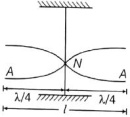

Download our appand get started for free
Experience the future of education. Simply download our apps or reach out to us for more information. Let's shape the future of learning together!No signup needed.*
Similar Questions
- 1If ${n_1},{n_2},{n_3}.........$ are the frequencies of segments of a stretched string, the frequency $n$ of the string is given byView Solution
- 2Standing waves are generated on a sonometer string loaded with a cylindrical body. If the cylinder is completely immersed in water, the length of the loops changes by a factor of $2.2$ . The specific gravity of the material of the cylinder isView Solution
- 3When an engine passes near to a stationary observer then its apparent frequencies occurs in the ratio $5/3$. If the velocity sound is $340 m/s$, than the velocity of engine is .... $m/s$View Solution
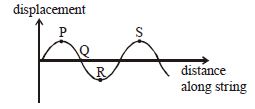
- 4The given graph illustrates a transverse wave travelling on a string at a particular instant, and the points $P, Q, R$ and $S$ represent elements of the string. Which of the following statements about the motion of the elements is correct?View Solution
- 5The equation of wave is given by $Y=10^{-2} \sin 2 \pi\left(160 t-0.5 x+\frac{\pi}{4}\right)$ Where $x$ and $Y$ are in $m$ and $t$ in $s$. The speed of the wave is $.....\,km h ^{-1}$View Solution
- 6On sounding tuning fork $A$ with another tuning fork $B$ of frequency $384 Hz, 6$ beats are produced per second. After loading the prongs of $A$ with some wax and then sounding it again with $B, 4$ beats are produced per second. What is the frequency of the tuning fork $A$ .... $Hz$View Solution
- 7A train moves towards a stationary observer with speed $34 m/s$. The train sounds a whistle and its frequency registered by the observer is ${f_1}$. If the train’s speed is reduced to $17\, m/s$, the frequency registered is ${f_2}$. If the speed of sound is 340 m/s then the ratio ${f_1}/{f_2}$ isView Solution
- 8A source of sound $S$ is moving with the velocity of $50\,m/s$ towards a stationary observer. The observer measures the frequency of the sound as $1000\,Hz.$ What will be the apparent frequency of the source when it is moving away from the observer after crossing him ... $Hz$ ? (Take velocity of sound in air is $350\,m/s$ )View Solution
- 9A second harmonic has to be generated in a string of length $l$ stretched between two rigid supports. The point where the string has to be plucked and touched areView Solution
- 10View SolutionIt is possible to hear beats from the two vibrating sources of frequency