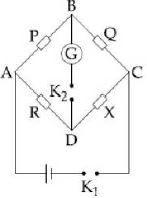
A steel wire has a resistance twice that of an aluminium wire. Both of them are connected with a constant voltage supply. More heat will be dissipated in
Easy


Download our appand get started for free
Experience the future of education. Simply download our apps or reach out to us for more information. Let's shape the future of learning together!No signup needed.*
Similar Questions
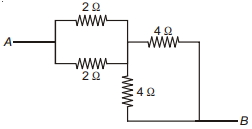
- 1Effective resistance across $A B$ in the network shown in .......... $\Omega$View Solution
- 2If current in an electric bulb changes by $1\%$, then the power will change by ............ $\%$View Solution
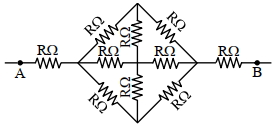
- 3The effective resistance between $A$ and $B$, if resistance of each resistor is $R$, will beView Solution
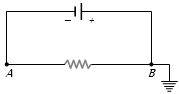
- 4A battery is connected to a uniform resistance wire $AB$ and $B$ is earthed. Which one of the graphs below shows how the current density $J$ varies along $AB$View Solution
- 5The resistors of resistances $2$ $\Omega$, $4$ $\Omega$ and $8$ $\Omega$ are connected in parallel, then the equivalent resistance of the combination will beView Solution
- 6View SolutionIn a sensitive meter bridge apparatus the bridge wire should possess
- 7The resistance of a wire is $R$. It is bent at the middle by $180^o$ and both the ends are twisted together to make a shorter wire. The resistance of the new wire isView Solution
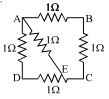
- 8$ABCD$ is a square where each side is a uniform wire of resistance $1\,\Omega$ . $A$ point $E$ lies on $CD$ such that if a uniform wire of resistance $1\,\Omega$ is connected across $AE$ and constant potential difference is applied across $A$ and $C$ then $B$ and $E$ are equipotential.View Solution
- 9A copper wire of resistance $R$ is cut into ten parts of equal length. Two pieces each are joined in series and then five such combinations are joined in parallel. The new combination will have a resistanceView Solution
- 10In a Wheatstone bridge (see figure) Resistance $P$ and $Q$ are approximately equal. When $R = 400\,\Omega ,$ the bridge is balanced. On interchanging $P$ and $Q,$ the value of $R,$ for balance is $405\,\Omega .$ The value of $X$ is close to ................. $ohm$View Solution