Question
A stone is dropped from a height $h$. Simultaneously, another stone is thrown up from the ground which reaches a height $4 \,h$. The two stones cross each other after time

Answer

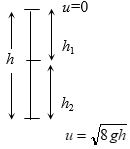
(a) For first stone $u = 0$ and

For second stone $\frac{{{u^2}}}{{2g}} = 4h \Rightarrow {u^2} = 8gh$

$\therefore u = \sqrt {8gh} $

Now, ${h_1} = \frac{1}{2}g{t^2}$

${h_2} = \sqrt {8gh} t - \frac{1}{2}g{t^2}$

where, $t =$ time to cross each other.

$\because {h_1} + {h_2} = h$

==> $\frac{1}{2}g{t^2} + \sqrt {8gh} t - \frac{1}{2}g{t^2} = h$ ==> $t = \frac{h}{{\sqrt {8gh} }} = \sqrt {\frac{h}{{8g}}} $
Need a full question paper?

Generate a complete, print-ready paper with questions like this in minutes — across 16+ boards, with answer keys.
Start Generating Free

Similar questions

To keep constant time, watches are fitted with balance wheel made of
Two electrons are moving towards each other, each with a velocity of $10^6 \,m / s$. What will be closest distance of approach between them is ......... $m$
Four forces are acting at a point $P$ in equilibrium as shown in figure. The ratio of force $F_{1}$ to $F_{2}$ is $1: x$ where $x =....$
The current sensitivity of moving coil galvanometer is increased by $25 \%$. This increase is achieved only by changing in the number of turns of coils and area of cross section of the wire while keeping the resistance of galvanometer coil constant. The percentage change in the voltage sensitivity will be $...........\%$
If T is the total time of flight, $h$ is the maximum height $ \& R$ is the range for horizontal motion, the $x$ and $y$ co-ordinates of projectile motion and time $t$ are related as
If the angular momentum of an electron is $\vec J$ then the magnitude of the magnetic moment will be
Three molecules of acetone in the presence of dry $HCl$ form
Two substances $A$ and $B$ of equal mass m are heated at uniform rate of $6\, cal s^{-1}$ under similar conditions. $A$ graph between temperature and time is shown in figure. Ratio of heat absorbed ${H_A}/{H_B}$ by them for complete fusion is
Consider two insulating sheets with thermal resistances $R_1$ and $R_2$ as shown. The temperatures $\theta $ is
An organic compound $‘A’$ has the molecular formula ${C_3}{H_6}O,$ it undergoes iodoform test. When saturated with dil. $HCl$ is gives $‘B’$ of molecular formula ${C_9}{H_{14}}O$. $A$ and $B$ respectively are