Two electrons are moving towards each other, each with a velocity of $10^6 \,m / s$. What will be closest distance of approach between them is ......... $m$
Medium
Download our app for free and get started
(b)
$2 . \frac{1}{2}\left(9.1 \times 10^{-31}\right)\left(10^6\right)^2=\frac{9 \times 10^9 \times\left(1.6 \times 10^{-19}\right)^2}{r}$
$9.1 \times 10^{-19}=\frac{9 \times 10^9 \times 2.56 \times 10^{-38}}{r}$
$r=2.56 \times 10^{-10} \,m$

Download our appand get started for free
Experience the future of education. Simply download our apps or reach out to us for more information. Let's shape the future of learning together!No signup needed.*
Similar Questions
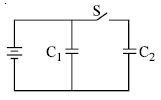
- 1Two capacitors of equal capacitance $(C_1 = C_2)$ are shown in the figure. Initially, while the switch $S$ is open, one of the capacitors is uncharged and the other carries charge $Q_0$. The energy stored in the charged capacitor is $U_0$. Sometimes after the switch is closed, the capacitors $C_1$ and $C_2$ carry charges $Q_1$ and $Q_2$, respectively; the voltages across the capacitors are $ V_1$ and $V_2$; and the energies stored in the capacitors are $U_1$ and $U_2$. Which of the following statements is INCORRECT ?View Solution
- 2The energy required to charge a capacitor of $5\,\mu \,F$ by connecting a $d.c$. source of $20\, kV$ is......$kJ$View Solution
- 3Ten capacitor are joined in parallel and charged with a battery up to a potential $V$. They are then disconnected from battery and joined again in series then the potential of this combination will be.......$V$View Solution
- 4The variation of electrostatic potential with radial distance $r$ from the centre of a positively charged metallic thin shell of radius $R$ is given by the graphView Solution
- 5An electric dipole of moment $\overrightarrow p $ placed in a uniform electric field $\overrightarrow E $ has minimum potential energy when the angle between $\overrightarrow p $ and $\overrightarrow E $ isView Solution
- 6Three concentric metallic spherical shells of radii $R, 2R, 3R$, are given charges $Q_1, Q_2, Q_3$, respectively. It is found that the surface charge densities on the outer surfaces of the shells are equal. Then, the ratio of the charges given to the shells, $Q_1 : Q_2 : Q_3$ isView Solution
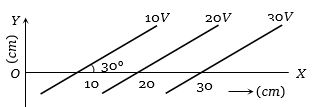
- 7View SolutionEquipotential surfaces are shown in figure. Then the electric field strength will be
- 8Electric potential at any point is $V = - 5x + 3y + \sqrt {15} z$, then the magnitude of the electric field isView Solution
- 9In a spherical condenser radius of the outer sphere is $R$. The different in the radii of outer and inner sphere in $x$. Its capacity is proportional toView Solution
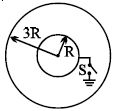
- 10Two thin conducting shells of radii $R$ and $3R$ are shown in the figure. The outer shell carries a charge $+ Q$ and the inner shell is neutral. The inner shell is earthed with the help of a switch $S$.View Solution