A stone is dropped into a lake from a tower $500\, metre$ high. The sound of the splash will be heard by the man approximately after ..... $\sec$
Diffcult


Download our appand get started for free
Experience the future of education. Simply download our apps or reach out to us for more information. Let's shape the future of learning together!No signup needed.*
Similar Questions
- 1View SolutionIf the pressure amplitude in a sound wave is tripled, then the intensity of sound is increased by a factor of
- 2The frequency changes by $10 \%$ as a sound source approaches a stationary observer with constant speed $V_s$. What would be percentage change in the frequency as the source recedes the observer with same speed $\left(V_s < V\right)$ is ........... $\%$View Solution
- 3A transverse wave travels on a taut steel wire with a velocity of ${v}$ when tension in it is $2.06 \times 10^{4} \;\mathrm{N} .$ When the tension is changed to $T$. the velocity changed to $\frac v2$. The value of $\mathrm{T}$ is close toView Solution
- 4$Assertion :$ When a beetle moves along the sand within a few tens of centimeters of a sand scorpion, the scorpion immediately turns towards the beetle and dashes towards itView Solution
$Reason :$ When a beetle disturbs the sand, it sends pulses along the sand's surface. One set of pulses is longitudinal while the other set is transverse. - 5A string of length $1\ m$ fixed at both ends is vibrating in $3^{rd}$ overtone. Tension in string is $200\ N$ and linear mass density is $5\ gm/m$ . Frequency of these vibrations is ..... $Hz$View Solution
- 6A uniform wire of length $L$ and mass $M$ is stretched between two fixed points, keeping tension $F$. A sound of frequency $m$ is impressed on it. Then the maximum vibrational energy is existing in the wire when $\mu $ =View Solution
- 7Two sources of sound placed close to each other, are emitting progressive waves given by $ y_1=4sin\left( {600\pi t} \right)$ and $y_2=5sin\left( {608\pi t} \right)$ An observer located near these two sources of sound will hearView Solution
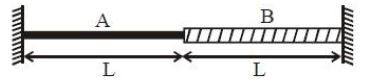
- 8A wire of length $2\,L$ is made by joining two wires $A$ and $B$ of same lengths but different radii $r$ and $2r$ and made of the same material. It is vibrating at a frequency such that the joint of the two wires forms a node. If the number of antinodes in wire $A$ is $p$ and that in $B$ is $q$ then the ratio $p : q$ isView Solution
- 9A tuning fork makes $256$ vibrations per second in air. When the velocity of sound is $330\, m/s$, then wavelength of the tone emitted is ... $m$View Solution
- 10A tuning fork and a sonometer wire were sounded together and produce $4$ beats per second. When the length of sonometer wire is $95 cm$ or $100 cm,$ the frequency of the tuning fork is ..... $Hz$View Solution