A wire of length $2\,L$ is made by joining two wires $A$ and $B$ of same lengths but different radii $r$ and $2r$ and made of the same material. It is vibrating at a frequency such that the joint of the two wires forms a node. If the number of antinodes in wire $A$ is $p$ and that in $B$ is $q$ then the ratio $p : q$ is
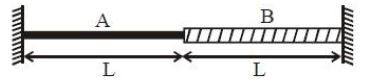
JEE MAIN 2019, Diffcult
Download our app for free and get started
Let mass per unit length of wires are $\mu_{1}$ and $\mu_{2}$ respectively.
$\because$ Materials are same, so density $\rho$ is same.
$\mu_{1}=\frac{\rho \pi r^{2} L}{L}=\mu \text { and } \mu_{2}=\frac{\rho 4 \pi r^{2} L}{L}=4 \mu$
Tension in both are same $=\mathrm{T},$ let speed of wave in wires are $V_{1}$ and $V_{2}$
$V_{1}=\frac{V_{1}}{2 L}=\frac{V}{2 L} \& f_{02}=\frac{V_{2}}{2 L}=\frac{V}{4 L}$
Frequency at which both resonate is $L.C.M.$ of both frequencies i.e. $\frac{\mathrm{V}}{2 \mathrm{L}}$
Hence number of loops in wires are $1$ and $2$ respectively
So, ratio of number of antinodes is $1:2$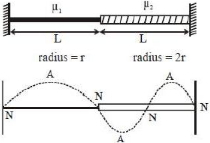

Download our appand get started for free
Experience the future of education. Simply download our apps or reach out to us for more information. Let's shape the future of learning together!No signup needed.*
Similar Questions
- 1The length of an open organ pipe is twice the length of another closed organ pipe. The fundamental frequency of the open pipe is $100\ Hz$ . The frequency of the third harmonic of the closed pipe is ..... $Hz$View Solution
- 2The length of the string of a musical instrument is $90 \;cm$ and has a fundamental frequency of $120 \;Hz$. Where (In $cm$) should it be pressed to produce fundamental frequency of $180 \;Hz ?$View Solution
- 3A source of sound emits $200\pi W$ power which is uniformly distributed over a sphere of $10 m$ radius. What is the loudness of sound on the surface of a sphereView Solution
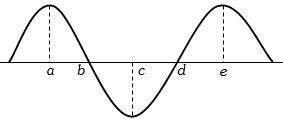
- 4The rope shown at an instant is carrying a wave travelling towards right, created by a source vibrating at a frequency $n$. Consider the following statementsView Solution
$I.$ The speed of the wave is $4n \times ab$
$II.$ The medium at $a$ will be in the same phase as $d$ after $\frac{4}{{3n}}s$
$III.$ The phase difference between $b$ and $e$ is $\frac{{3\pi }}{2}$
Which of these statements are correct
- 5Frequency of tuning fork $A$ is $256\,Hz$ . It produces four $beats/sec$ . with tuning fork $B$ . When wax is applied at tuning fork $B$ then $6\,beats/sec$ . are heard. By reducing little amount of wax $4\,beats/sec$ . are heard. Frequency of $B$ is .... $Hz$View Solution
- 6A train is moving with a constant speed along a large circular track. The engine of the train emits a sound of frequency $f$ . The frequency heard by the guard at rear end of the trainView Solution
- 7A second harmonic has to be generated in a string of length $l$ stretched between two rigid supports. The point where the string has to be plucked and touched areView Solution
- 8When two sound waves with a phase difference of $\pi /2$, and each having amplitude $A$ and frequency $\omega $, are superimposed on each other, then the maximum amplitude and frequency of resultant wave isView Solution
- 9A source of sound gives five beats per second when sounded with another source of frequency $100\,{s^{ - 1}}$. The second harmonic of the source together with a source of frequency $205\,{s^{ - 1}}$ gives five beats per second. What is the frequency of the source .... ${s^{ - 1}}$View Solution
- 10Sound waves of frequency $660 \,\,Hz$ fall normally on a perfectly reflecting wall. The shortest distance from the wall at which the air particle has maximum amplitude of vibration is .... $m$ (velocity of sound in air is $330 \,\,m/s$)View Solution