A stone is hung in air from a wire which is stretched over a sonometer. The bridges of the sonometer are $L \,cm$ apart when the wire is in unison with a tuning fork of frequency $ N$. When the stone is completely immersed in water, the length between the bridges is $l \,cm$ for re-establishing unison, the specific gravity of the material of the stone is
Diffcult
Download our app for free and get started
(c) Frequency of vib. is stretched string $n = \frac{1}{{2({\rm{Length)}}}}\sqrt {\frac{T}{m}} $
When the stone is completely immersed in water, length changes but frequency doesn’t ( $\because$ unison reestablished)
Hence length $ \propto \sqrt T $==> $\frac{L}{l} = \sqrt {\frac{{{T_{air}}}}{{{T_{water}}}}} = \sqrt {\frac{{V\rho g}}{{V(\rho - 1)g}}} $
(Density of stone $= \rho$ and density of water $ =1$)
==> $\frac{L}{l} = \sqrt {\frac{\rho }{{\rho - 1}}} $==> $\rho = \frac{{{L^2}}}{{{L^2} - {l^2}}}$
When the stone is completely immersed in water, length changes but frequency doesn’t ( $\because$ unison reestablished)
Hence length $ \propto \sqrt T $==> $\frac{L}{l} = \sqrt {\frac{{{T_{air}}}}{{{T_{water}}}}} = \sqrt {\frac{{V\rho g}}{{V(\rho - 1)g}}} $
(Density of stone $= \rho$ and density of water $ =1$)
==> $\frac{L}{l} = \sqrt {\frac{\rho }{{\rho - 1}}} $==> $\rho = \frac{{{L^2}}}{{{L^2} - {l^2}}}$

Download our appand get started for free
Experience the future of education. Simply download our apps or reach out to us for more information. Let's shape the future of learning together!No signup needed.*
Similar Questions
- 1When a car is approaching the observer, the frequency of horn is $100 Hz$. After passing the observer, it is $50\,Hz$. If the observer moves with the car, the frequency will be $\frac{ x }{3} Hz$ where $x =.....$View Solution
- 2A rope of length $L$ and uniform linear density is hanging from the ceiling. A transverse wave pulse, generated close to the free end of the rope, travels upwards through the rope. Select the correct option.View Solution
- 3View SolutionThe Doppler's effect is applicable for
- 4The speed of sound in a gas, in which two waves of wavelength $1.0\,\, m$ and $1.02\,\, m$ produce $6$ beats per second, is approximately .... $m/s$View Solution
- 5A plane progressive wave is given by $y=2 \cos 2 \pi(330 t-x) m$. The frequency of the wave is:View Solution
- 6A sound source is moving towards a stationary observer with $1/10$ of the speed of sound. The ratio of apparent to real frequency isView Solution
- 7View SolutionA device used for investigating the vibration of a fixed string or wire is
- 8The given diagram shows three light pieces of paper placed on a wire that is stretched over two supports, $Q$ and $R$ , a distance $4x$ apart. When the wire is made to vibrate at a particular frequency, all the pieces of paper, except the middle one, fall off the wire. Which of the following could be the wavelength of the vibration?View Solution
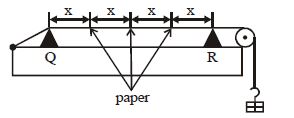
- 9A source of sound emits sound waves at frequency $f_0$. It is moving towards an observer with fixed speed $v_s$ ($v_s < v$, where $v$ is the speed of sound in air). If the observer were to move towards the source with speed $v_0$, one of the following two graphs ($A$ and $B$) will given the correct variation of the frequency $f$ heard by the observer as $v_0$ is changed The variation of $f$ with $v_0$ is given correctly byView Solution
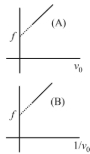
- 10A car $'A'$ chasing another car $'B'$ with a speed of $20\, m/s$ sounding a horn of $180\, Hz$. While both cars are moving towards a stationary siren of frequency $170\, Hz$. What is the speed of car $B$ so that it can't hear any beat ....$m/s$ (speed of sound $= 340\, m/s$)View Solution