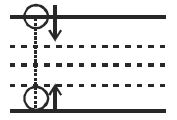
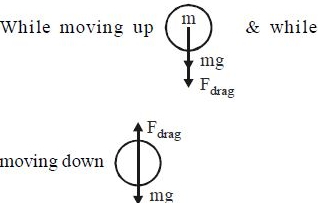
A stone is projected vertically up from the bottom of a water tank. Assuming no water resistance it will go up and come down in same time but if water drag is present then the time it takes to go up, $t_{up}$ and the time it takes to come down, $t_{down}$ are related as
AIIMS 2009, Medium
Download our app for free and get started

Download our appand get started for free
Experience the future of education. Simply download our apps or reach out to us for more information. Let's shape the future of learning together!No signup needed.*
Similar Questions
- 1A $0.5\ kg$ mass of lead is submerged in a container filled to the brim with water and a block of wood floats on top. The lead mass is slowly lifted from the container by a thin wire and as it emerges into air the level of the water in the container drops a bit. The lead mass is now placed on the block of wood. As the lead is placed on the wood.View Solution
- 2A cube of wood supporting $200\,gm$ mass just floats in water. When the mass is removed, the cube rises by $2\, cm$. ............ $cm$ is the side of cube .View Solution
- 3A particle released from rest is falling through a thick fluid under gravity. The fluid exerts a resistive force on the particle proportional to the square of its speed. Which one of the following graphs best depicts the variation of its speed $v$ with time $t$ ?View Solution
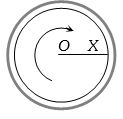
- 4The diagram shows a cup of tea seen from above. The tea has been stirred and is now rotating without turbulence. A graph showing the speed $ v$ with which the liquid is crossing points at a distance $ X$ from $O $ along a radius $XO$ would look likeView Solution
- 5Two cylindrical vessels of equal cross-sectional area $16\,cm ^{2}$ contain water upto herghts $100\,cm$ and $150\,cm$ respectively. The vessels are interconnected so that the water levels in them become equal. The work done by the force of gravity during the process, is $......J$ [Take density of water $=10^{3}\,kg / m ^{3}$ and $g =10\,ms ^{-2}$ ]View Solution
- 6View SolutionAs the temperature of water increases, its viscosity
- 7View SolutionWhich of the following is not the property of an ideal fluid?
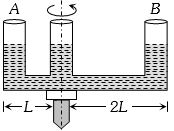
- 8A given shaped glass tube having uniform cross section is filled with water and is mounted on a rotatable shaft as shown in figure. If the tube is rotated with a constant angular velocity $\omega $thenView Solution
- 9A hydraulic automobile lift is designed to lift vehicles of mass $5000\,kg$. The area of cross section of the cylinder carrying the load is $250\,cm ^2$. The maximum pressure the smaller piston would have to bear is [Assume $g=10\,m / s ^2$]View Solution
- 10A small hole of area of cross-section $2\; \mathrm{mm}^{2}$ is present near the bottom of a fully filled open tank of height $2\; \mathrm{m} .$ Taking $\mathrm{g}=10 \;\mathrm{m} / \mathrm{s}^{2},$ the rate of flow of water through the open hole would be nearly ......... $\times 10^{-6} \;m^{3} /s$View Solution