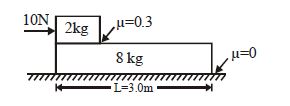
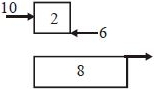
Determine the time in which the smaller block reaches other end of bigger block in the figure. $(g = 10\ m s^{-2})$ .......... $\sec$
Diffcult


Download our appand get started for free
Experience the future of education. Simply download our apps or reach out to us for more information. Let's shape the future of learning together!No signup needed.*
Similar Questions
- 1View SolutionWhich one of the following statements is incorrect?
- 2$A$ block of mass $M$ is placed on $a$ horizontal surface and it is tied with an inextensible string to $a$ block of mass, as shown in figure. A block of mass $m_0$ is also placed on $M$ In previous problem, the tension in the string will beView Solution

- 3Two blocks $A$ and $B$ of masses $5 \,kg$ and $3 \,kg$ respectively rest on a smooth horizontal surface with $B$ over $A$. The coefficient of friction between $A$ and $B$ is $0.5$. The maximum horizontal force (in $kg$ wt.) that can be applied to $A$, so that there will be motion of $A$ and $B$ without relative slipping, isView Solution
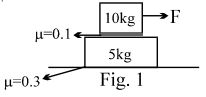
- 4When $F = 2N$, the frictional force between $10 kg$ block and $5 kg$ block is ...... $N$View Solution
- 5On a rough horizontal surface, a body of mass $2 \,kg$ is given a velocity of $10 \,m/s$. If the coefficient of friction is $0.2$ and $g = 10\, m/{s^2}$, the body will stop after covering a distance of ........ $m$View Solution
- 6A $1.0 kg$ block of wood sits on top of an identical block of wood, which sits on top of a flat level table made of plastic. The coefficient of static friction between the wood surfaces is $\mu_1$, and the coefficient of static friction between the wood and plastic is $\mu_2$. Ahorizontal force $F$ is applied to the top block only, and this force is increased until the top block starts to move. The bottom block will move with the top block if and only ifView Solution
- 7A mass of $100\, gm$ is tied to one end of a string $2 \,m$ long. The body is revolving in a horizontal circle making a maximum of $200$ revolutions per min. The other end of the string is fixed at the centre of the circle of revolution. The maximum tension that the string can bear is .......... $N$. (approximately)View Solution
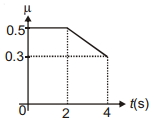
- 8A block is projected with speed $20 \,m / s$ on a rough horizontal surface. The coefficient of friction $(\mu)$ between the surfaces varies with time $(t)$ as shown in figure. The speed of body at the end of $4$ second will be ............ $m / s$ ( $g=$ $10 \,m / s ^2$ )View Solution
- 9View SolutionA passenger inside a bus moving with uniform speed suddenly finds that a ball at rest, starts moving towards his left. It means that the bus now is
- 10The acceleration of $10\, kg$ block when $F = 30\,N$ ........ $m/s^2$View Solution