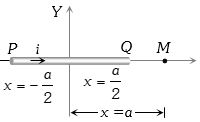
A straight section $PQ$ of a circuit lies along the $X$-axis from $x = - \frac{a}{2}$ to $x = \frac{a}{2}$ and carries a steady current $i$. The magnetic field due to the section $PQ$ at a point $X = + a$ will be
Medium


Download our appand get started for free
Experience the future of education. Simply download our apps or reach out to us for more information. Let's shape the future of learning together!No signup needed.*
Similar Questions
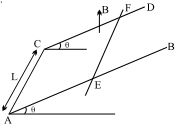
- 1$AB$ and $CD$ are smooth parallel rails, separated by a distance $l$, and inclined to the horizontal at an angle $\theta$ . $A$ uniform magnetic field of magnitude $B$, directed vertically upwards, exists in the region. $EF$ is a conductor of mass $m$, carrying a current $i$, if $B$ is normal to the plane of the railsView Solution
- 2An iron rod of length $L$ and magnetic moment $M$ is bent in the form of a semicircle. Now its magnetic moment will beView Solution
- 3A deuteron and an alpha particle having equal kinetic energy enter perpendicular into a magnetic field. Let $r_{d}$ and $r_{\alpha}$ be their respective radii of circular path. The value of $\frac{r_{d}}{r_{\alpha}}$ is equal toView Solution
- 4An electron enters a region where magnetic $(B)$ and electric $(E)$ fields are mutually perpendicular to one another, thenView Solution
- 5A charge particle projected with velocity $\vec v$ in uniform magnetic field ' $\vec B$ ' then for maximum magnetic force on it, which is correctView Solution
- 6When a galvanometer is shunted with a $4\,\Omega$ resistance, the deflection is reduced to one-fifth. If the galvanometer is further shunted with $2\,\Omega$ wire, the further reduction in the deflection will be (the main current remains same)View Solution
- 7View SolutionA current carrying wire in the neighborhood produces
- 8View SolutionIf cathode rays are projected at right angles to a magnetic field, their trajectory is
- 9Magnetic field due to a ring having $n$ turns at a distance $x$ on its axis is proportional to (if $r$ = radius of ring)View Solution
- 10An $\alpha - $ particle travels in a circular path of radius $0.45\, m$ in a magnetic field $B = 1.2\,Wb/{m^2}$ with a speed of $2.6 \times {10^7}\,m/\sec $. The period of revolution of the $\alpha - $ particle isView Solution