An iron rod of length $L$ and magnetic moment $M$ is bent in the form of a semicircle. Now its magnetic moment will be
Medium
Download our app for free and get started
(b) On bending a rod it’s pole strength remains unchanged where as its magnetic moment changes.
New magnetic moment $M' = m(2R) = m\left( {\frac{{2L}}{\pi }} \right) = \frac{{2M}}{\pi }$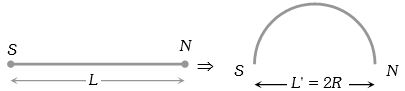

Download our appand get started for free
Experience the future of education. Simply download our apps or reach out to us for more information. Let's shape the future of learning together!No signup needed.*
Similar Questions
- 1The resistance of an ammeter is $13\, \Omega$ and its scale is graduated for a current upto $100$ $amps$. After an additional shunt has been connected to this ammeter it becomes possible to measure currents upto $750$ $ampere$ by this meter. The value of shunt-resistance isView Solution
- 2Two similar coils of radius $R$ are lying concentrically with their planes at right angles to each other. The currents flowing in them are $I$ and $2I$, respectively. The resultant magnetic field induction at the centre will beView Solution
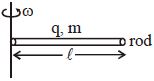
- 3In the given diagram a rod is rotating with angular velocity $\omega $. Mass of this rod is $m$ charge $q$ and length $l$ then find out magnetic moment of this rodView Solution
- 4A solenoid of $1.5$ $metre$ length and $4.0\, cm$ diameter posses $10$ $turn$ per $cm$. A current of $5$ $ampere$ is flowing through it. The magnetic induction at axis inside the solenoid isView Solution
- 5View SolutionA moving charge will gain energy due to the application of
- 6View SolutionA coil carrying electric current is placed in uniform magnetic field, then
- 7Current sensitivity of a moving coil galvanometer is $5\,div/mA$ and its voltage sensitivity (angular deflection per unit voltage applied) is $20\,div/V$. The resistance of the galvanometer is ................. $\Omega$View Solution
- 8View SolutionIf the direction of the initial velocity of the charged particle is neither along nor perpendicular to that of the magnetic field, then the orbit will be
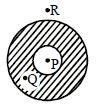
- 9View SolutionCurrent is flowing through a conducting hollow pipe whose area of cross-section is shown in the figure. The value of magnetic induction will be zero at
- 10The magnetic field on the axis of a circular loop of radius $100\,cm$ carrying current $I=\sqrt{2}\,A$, at point $1\,m$ away from the centre of the loop is given byView Solution