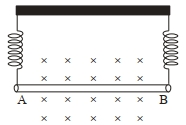
A straight wire $AB$ of mass $40\,g$ and length $50\,cm$ is suspended by a pair of flexible leads in uniform magnetic field of magnitude $0.40\,T$ as shown in the figure. The magnitude of the current required in the wire to remove the tension in the supporting leads is ...........$A$. (Take $g=10\,ms ^{-2}$ ).
JEE MAIN 2023, Medium
Download our app for free and get started
For equilibrium
$Mg = I \ell B$
$I =\frac{ mg }{\ell B }=\frac{40 \times 10^{-3} \times 10}{50 \times 10^{-2} \times 0.4}=2\,A$

Download our appand get started for free
Experience the future of education. Simply download our apps or reach out to us for more information. Let's shape the future of learning together!No signup needed.*
Similar Questions
- 1The magnetic field is uniform for $y>0$ and points into the plane. The magnetic field is uniform and points out of the plane for $y<0$. A proton denoted by filled circle leaves $y=0$ in the $-y$-direction with some speed as shown below.Which of the following best denotes the trajectory of the proton?View Solution

- 2A particle of charge per unit mass $\alpha$ is released from origin with a velocity $\bar{v}=v_0 \vec{i}$ in a uniform magnetic field $\bar{B}=-B_0 \hat{k}$. If the particle passes through $(0, y, 0)$ then $y$ is equal toView Solution
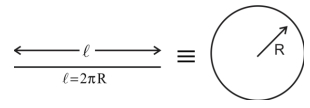
- 3A wire of length $314\,cm$ carrying current of $14\,A$ is bent to form a circle. The magnetic moment of the coil is $........A- m ^{2}$. [Given $\left.\pi=3.14\right]$View Solution
- 4A circular coil ‘$A$’ has a radius $R$ and the current flowing through it is $I$. Another circular coil ‘$B$’ has a radius $2R$ and if $2I$ is the current flowing through it, then the magnetic fields at the centre of the circular coil are in the ratio of (i.e.${B_A}$ to ${B_B}$)View Solution
- 5A galvanometer has a coil of resistance $100\, ohm$ and gives a full scale deflection for $30\, mA$ current. If it is to work as a voltmeter of $30\, volt$ range, the resistance required to be added will be.....$Ω$View Solution
- 6A proton and an alpha particle both enter a region of uniform magnetic field $B,$ moving at right angles to the field $B.$ If the radius of circular orbits for both the particles is equal and the kinetic energy acquired by proton is $1\,\, MeV,$ the energy acquired by the alpha particle will be......$MeV$View Solution
- 7View SolutionWhich is a vector quantity
- 8Two ions having same mass have charges in the ratio $1: 2$. They are projected normally in a uniform magnetic field with their speeds in the ratio $2: 3$. The ratio of the radii of their circular trajectories is -View Solution
- 9If two protons are moving with speed $v=4.5 \times 10^{5} \,m / s$ parallel to each other then the ratio of electrostatic and magnetic force between themView Solution
- 10View SolutionThe time period of a charged particle undergoing a circular motion in a uniform magnetic field is independent of its