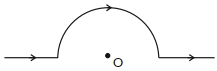
A straight wire carrying a current of $14\,A$ is bent into a semicircular are of radius $2.2\,cm$ as shown in the figure. The magnetic field produced by the current at the centre $(O)$ of the arc. is $.........\,\times 10^{-4}\, T$
JEE MAIN 2023, Easy
Download our app for free and get started
$B _{\text {at } 0}=\frac{\mu_0 I }{4 R }=\frac{4 \pi \times 10^{-7} \times 14}{4 \times 2.2 \times 10^{-2}}$
$=2 \times 10^{-4}\,T$

Download our appand get started for free
Experience the future of education. Simply download our apps or reach out to us for more information. Let's shape the future of learning together!No signup needed.*
Similar Questions
- 1View SolutionA proton and an alpha particle of the same enter in a uniform magnetic field which is acting perpendicular to their direction of motion. The ratio of the circular paths described by the alpha particle and proton is ....
- 2The magnetic moment of a bar magnet is $0.5 \mathrm{Am}^2$. It is suspended in a uniform magnetic field of $8 \times 10^{-2} \mathrm{~T}$. The work done in rotating it from its most stable to most unstable position is:View Solution
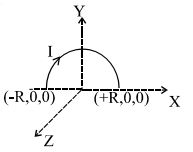
- 3A semi circular current carrying wire having radius $R$ is placed in $x-y$ plane with its centre at origin $‘O’$. There is non-uniform magnetic $\vec B = \frac{{{B_o}x}}{{2R}}\hat k$ (here $B_o$ is + $ve$ constant) is existing in the region. The magnetic force acting on semi circular wire will be alongView Solution
- 4Choose the correct sketch of the magnetic field lines of a circular current loop shown by the dot $ \odot $ and the cross $\otimes .$View Solution
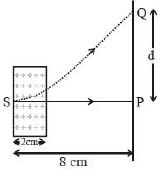
- 5An electron, moving along the $x-$ axis with an initial energy of $100\, eV$, enters a region of magnetic field $\vec B = (1.5\times10^{-3}T)\hat k$ at $S$ (See figure). The field extends between $x = 0$ and $x = 2\, cm$. The electron is detected at the point $Q$ on a screen placed $8\, cm$ away from the point $S$. The distance $d$ between $P$ and $Q$ (on the screen) is :......$cm$ (electron's charge $= 1.6\times10^{-19}\, C$, mass of electron $= 9.1\times10^{-31}\, kg$)View Solution
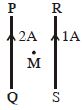
- 6$PQ$ and $RS$ are long parallel conductors separated by certain distance. $M$ is the mid-point between them (see the figure). The net magnetic field at $M$ is $B$ . Now, the current $2\,A$ is switched off. The field at $M$ now becomesView Solution
- 7A straight wire of length $0.5\, metre$ and carrying a current of $1.2\, ampere$ placed in a uniform magnetic field of induction $2\, Tesla$. The magnetic field is perpendicular to the length of the wire. The force on the wire is.......$N$View Solution
- 8View SolutionThe resultant magnetic moment of neon atom will be
- 9A charged particle (electron or proton) is introduced at the origin $(x=0, y=0, z=0)$ with a given initial velocity $\overrightarrow{\mathrm{v}}$. A uniform electric field $\overrightarrow{\mathrm{E}}$ and magnetic field $\vec{B}$ are given in columns $1,2$ and $3$ , respectively. The quantities $E_0, B_0$ are positive in magnitude.View Solution
column $I$
column $II$ column $III$ $(I)$ Electron with $\overrightarrow{\mathrm{v}}=2 \frac{\mathrm{E}_0}{\mathrm{~B}_0} \hat{\mathrm{x}}$ $(i)$ $\overrightarrow{\mathrm{E}}=\mathrm{E}_0^2 \hat{\mathrm{Z}}$ $(P)$ $\overrightarrow{\mathrm{B}}=-\mathrm{B}_0 \hat{\mathrm{x}}$ $(II)$ Electron with $\overrightarrow{\mathrm{v}}=\frac{\mathrm{E}_0}{\mathrm{~B}_0} \hat{\mathrm{y}}$ $(ii)$ $\overrightarrow{\mathrm{E}}=-\mathrm{E}_0 \hat{\mathrm{y}}$ $(Q)$ $\overrightarrow{\mathrm{B}}=\mathrm{B}_0 \hat{\mathrm{x}}$ $(III)$ Proton with $\overrightarrow{\mathrm{v}}=0$ $(iii)$ $\overrightarrow{\mathrm{E}}=-\mathrm{E}_0 \hat{\mathrm{x}}$ $(R)$ $\overrightarrow{\mathrm{B}}=\mathrm{B}_0 \hat{\mathrm{y}}$ $(IV)$ Proton with $\overrightarrow{\mathrm{v}}=2 \frac{\mathrm{E}_0}{\mathrm{~B}_0} \hat{\mathrm{x}}$ $(iv)$ $\overrightarrow{\mathrm{E}}=\mathrm{E}_0 \hat{\mathrm{x}}$ $(S)$ $\overrightarrow{\mathrm{B}}=\mathrm{B}_0 \hat{\mathrm{z}}$ ($1$) In which case will the particle move in a straight line with constant velocity?
$[A] (II) (iii) (S)$ $[B] (IV) (i) (S)$ $[C] (III) (ii) (R)$ $[D] (III) (iii) (P)$
($2$) In which case will the particle describe a helical path with axis along the positive $z$ direction?
$[A] (II) (ii) (R)$ $[B] (IV) (ii) (R)$ $[C] (IV) (i) (S)$ $[D] (III) (iii)(P)$
($3$) In which case would be particle move in a straight line along the negative direction of y-axis (i.e., more along $-\hat{y}$ )?
$[A] (IV) (ii) (S)$ $[B] (III) (ii) (P)$ $[C]$ (II) (iii) $(Q)$ $[D] (III) (ii) (R)$
- 10A galvanometer having a resistance of $9\, ohm$ is shunted by a wire of resistance $2\, ohm$. If the total current is $1\, amp$, the part of it passing through the shunt will be ............ $amp$View Solution