A straight wire of length $0.5\, metre$ and carrying a current of $1.2\, ampere$ placed in a uniform magnetic field of induction $2\, Tesla$. The magnetic field is perpendicular to the length of the wire. The force on the wire is.......$N$
AIPMT 1992, Easy
Download our app for free and get started
(b) $F = Bil = 2 \times 1.2 \times 0.5 = 1.2\,N$

Download our appand get started for free
Experience the future of education. Simply download our apps or reach out to us for more information. Let's shape the future of learning together!No signup needed.*
Similar Questions
- 1A long straight wire carries a current along the $x$-axis. Consider the points $A(0, 1, 0), B(0, 1, 1), C(1, 0, 1)$ and $D(1, 1, 1)$. Which of the following pairs of points will have magnetic fields of the same magnitude?View Solution
- 2An $\alpha $ particle and a proton travel with same velocity in a magnetic field perpendicular to the direction of their velocities, find the ratio of the radii of their circular pathView Solution
- 3A galvanometer of resistance $100 \Omega$ when connected in series with $400 \Omega$ measures a voltage of upto $10 \mathrm{~V}$. The value of resistance required to convert the galvanometer into ammeter to read upto $10 \mathrm{~A}$ is $\mathrm{x} \times 10^{-2} \Omega$. The value of $\mathrm{x}$ is :View Solution
- 4If induction of magnetic field at a point is $B$ and energy density is $U$ then which of the following graphs is correctView Solution
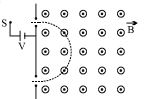
- 5A mass spectrometer is a device which select particle of equal mass. An iron with electric charge $q > 0$ and mass $m$ starts at rest from a source $S$ and is accelerated through a potential difference $V$. It passes $\rho$ through a hole into a region of constant magnetic field $\vec B\,$ perpendicular to the plane of the paper as shown in the figure. The particle is deflected by the magnetic field and emerges through the bottom hole at a distance $d$ from the top hole. The mass of the particle isView Solution
- 6If a proton, deutron and $\alpha - $ particle on being accelerated by the same potential difference enters perpendicular to the magnetic field, then the ratio of their kinetic energies isView Solution
- 7If $n$ represents the actual number of deflections in a converted galvanometer of resistance $G$ and shunt resistance $S$. Then the total current I when its figure of merit is $K$ will beView Solution
- 8The coil of a galvanometer consists of $100$ $turns$ and effective area of $1\, square-cm$. The restoring couple is ${10^{ - 8}}\,N - m/radian$. The magnetic field between the pole pieces is $5\, T$. The current sensitivity of this galvanometer will beView Solution
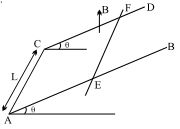
- 9$AB$ and $CD$ are smooth parallel rails, separated by a distance $l$, and inclined to the horizontal at an angle $\theta$ . $A$ uniform magnetic field of magnitude $B$, directed vertically upwards, exists in the region. $EF$ is a conductor of mass $m$, carrying a current $i$. For $EF$ to be in equilibrium,View Solution
- 10A uniform magnetic field $\vec B\,\, = \,\,{B_0}\,\hat j$ exists in a space. A particle of mass $m$ and charge $q$ is projected towards negative $x$-axis with speed $v$ from the a point $(d, 0, 0)$. The maximum value $v$ for which the particle does not hit $y-z$ plane isView Solution