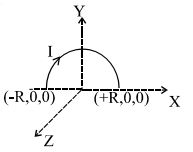
A semi circular current carrying wire having radius $R$ is placed in $x-y$ plane with its centre at origin $‘O’$. There is non-uniform magnetic $\vec B = \frac{{{B_o}x}}{{2R}}\hat k$ (here $B_o$ is + $ve$ constant) is existing in the region. The magnetic force acting on semi circular wire will be along
Advanced
Download our app for free and get started
$\mathrm{F}=\mathrm{I} \int \mathrm{R} \mathrm{d} \theta(\sin \theta \hat{\mathrm{i}}+\cos \theta \hat{\mathrm{j}}) \times \frac{\mathrm{B}_{0}}{2 \mathrm{R}}(-\mathrm{R} \cos \theta) \hat{\mathrm{k}}$
$=\frac{I B_{0} R}{2} \int_{0}^{\pi}(\sin \theta \hat{i}+\cos \theta \hat{j}) x(-\cos \theta \hat{k}) d \theta$
$=\int_{0}^{\pi}\left(\sin \theta \cos \theta \hat{j}-\cos ^{2} \theta \hat{i}\right) d \theta$
$=\int_{0}^{\pi}\left(\frac{\sin 2 \theta \hat{j}}{2}-\frac{(1+\cos 2 \theta) \hat{i}}{2}\right) d \theta$
$=\left[\frac{-\cos 2 \theta}{4}\right]_{0}^{\pi} \hat{j}-\left[\frac{\theta}{2}\right]_{0}^{\pi} \hat{i}-\left[\frac{\sin 2 \theta}{4}\right]_{0}^{\pi} \hat{i}$
$=0-(\pi / 2) \hat i-0=-(\pi / 2) \hat i$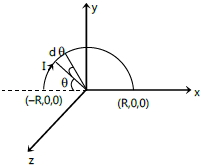

Download our appand get started for free
Experience the future of education. Simply download our apps or reach out to us for more information. Let's shape the future of learning together!No signup needed.*
Similar Questions
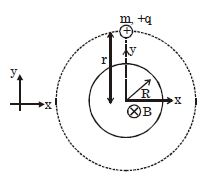
- 1Circular region of radius $R$ has uniform magnetic field $B = {B_0} + {B_0}t\left( { - \hat k} \right).\,At\,\,t\, = 0\,$ acceleration of charged particleView Solution
- 2A galvanometer of resistance $100 \Omega$ when connected in series with $400 \Omega$ measures a voltage of upto $10 \mathrm{~V}$. The value of resistance required to convert the galvanometer into ammeter to read upto $10 \mathrm{~A}$ is $\mathrm{x} \times 10^{-2} \Omega$. The value of $\mathrm{x}$ is :View Solution
- 3An electron is projected with velocity $v_0$ in a uniform electric field $E$ perpendicular to the field. Again it is projetced with velocity $v_0$ perpendicular to a uniform magnetic field $B/$ If $r_1$ is initial radius of curvature just after entering in the electric field and $r_2$ is initial radius of curvature just after entering in magnetic field then the ratio $r_1:r_2$ is equal toView Solution
- 4An electron (mass $= 9 \times 10^{-31}\,kg$. Charge $= 1.6 \times 10^{-19}\,C$) whose kinetic energy is $7.2 \times 10^{-18}$ $joule$ is moving in a circular orbit in a magnetic field of $9 \times 10^{-5} \,weber/m^2$. The radius of the orbit is.....$cm$View Solution
- 5An electron having charge $1.6 \times {10^{ - 19}}\,C$ and mass $9 \times {10^{ - 31}}\,kg$ is moving with $4 \times {10^6}\,m{s^{ - 1}}$ speed in a magnetic field $2 \times {10^{ - 1}}\,tesla$ in a circular orbit. The force acting on electron and the radius of the circular orbit will beView Solution
- 6A particle of charge $16\times10^{-16}\, C$ moving with velocity $10\, ms^{-1}$ along $x-$ axis enters a region where magnetic field of induction $\vec B$ is along the $y-$ axis and an electric field of magnitude $10^4\, Vm^{-1}$ is along the negative $z-$ axis. If the charged particle continues moving along $x-$ axis, the magnitude of $\vec B$ isView Solution
- 7In the following hexagons, made up of two different material $P$ and $Q,$ current enters and leaves from points $X$ and $Y$ respectively. In which case the magnetic field at its centre is not zero.View Solution
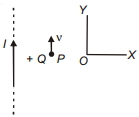
- 8A charge $Q$ moves parallel to a very long straight wire carrying a current $l$ as shown. The force on the charge isView Solution
- 9A charged particle enters a magnetic field $H$ with its initial velocity making an angle of $45^\circ $ with $H$. The path of the particle will beView Solution
- 10Ionized hydrogen atoms and $\alpha$ -particles with same momenta enters perpendicular to a constant magnetic field $B$. The ratio of their radii of their paths $\mathrm{r}_{\mathrm{H}}: \mathrm{r}_{\alpha}$ will beView Solution