A uniform magnetic field $\vec B\,\, = \,\,{B_0}\,\hat j$ exists in a space. A particle of mass $m$ and charge $q$ is projected towards negative $x$-axis with speed $v$ from the a point $(d, 0, 0)$. The maximum value $v$ for which the particle does not hit $y-z$ plane is
Medium


Download our appand get started for free
Experience the future of education. Simply download our apps or reach out to us for more information. Let's shape the future of learning together!No signup needed.*
Similar Questions
- 1Magnetic field due to $0.1\, A$ current flowing through a circular coil of radius $0.1\, m$ and $1000$ $turns$ at the centre of the coil isView Solution
- 2In the following figure a wire bent in the form of a regular polygon of $n$ sides is inscribed in a circle of radius $a$. Net magnetic field at centre will beView Solution
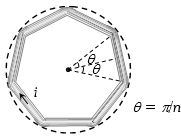
- 3View SolutionThe shape of the magnetic field lines due to an infinite long, straight current carrying conductor is :
- 4The radius of a circular ring of wire is $R$ and it carries a current of $I\,ampere$. At its centre a smaller ring of radius $r$ with current $i$ and $N\, turns$ is placed. Assuming that the planes of two rings are perpendicular to each other and the magnetic induction produced at the centre of bigger ring is constant, then the torque acting on smaller ring will beView Solution
- 5Surface charge density on a ring of radius $a$ and width $d$ is $\sigma$ as shown in the figure. It rotates with frequency $f$ about its own axis. Assume that the charge is only on outer surface. The magnetic field induction at centre is(Assume that $d \ll a$ )View Solution
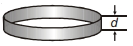
- 6The resistance of a galvanometer is $50\,\Omega $ and it requires $2\,\mu A$ per two division deflection. The value of the shunt required in order to convert this galvanometer into ammeter of range $5\,A$ is (The number of divisions on the galvanometer scale on one side is $30$)View Solution
- 7A thin non conducting disc of radius $R$ is rotating clockwise (see figure) with an angular velocity $w$ about its central axis, which is perpendicular to its plane. Both its surfaces carry $+ve$ charges of uniform surface density. Half the disc is in a region of a uniform, unidirectional magnetic field $B$ parallel to the plane of the disc, as shown. Then,View Solution
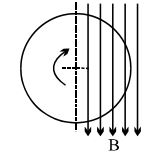
- 8In the diagram, $I_1$ , $I_2$ are the strength of the currents in the loop and infinite long straight conductor respectively. $OA = AB = R$ . The net magnetic field at the centre $O$ is zero. Then the ratio of the currents in the loop and the straight conductor isView Solution
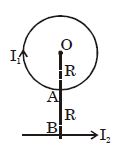
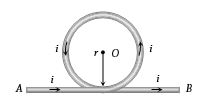
- 9A part of a long wire carrying a current $i$ is bent into a circle of radius $r$ as shown in figure. The net magnetic field at the centre $O$ of the circular loop isView Solution
- 10In order to pass $10\,\%$ of main current through a moving coil galvanometer of $99\, ohm$, the resistance of the required shunt is ............ $\Omega $View Solution