A straight wire of length $0.5\, metre$ and carrying a current of $1.2\, ampere$ placed in a uniform magnetic field of induction $2\, Tesla$. The magnetic field is perpendicular to the length of the wire. The force on the wire is.......$N$
AIPMT 1992, Easy


Download our appand get started for free
Experience the future of education. Simply download our apps or reach out to us for more information. Let's shape the future of learning together!No signup needed.*
Similar Questions
- 1The current in the windings of a toroid is $2.0\,A$. There are $400\,turns$ and the mean circumferential length is $40\,cm$. If the inside magnetic field is $1.0\,T,$ the relative permeability is near toView Solution
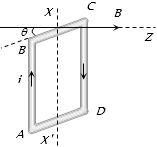
- 2The square loop $ABCD$, carrying a current $i$, is placed in uniform magnetic field $B$, as shown. The loop can rotate about the axis $XX$'. The plane of the loop makes and angle $\theta$ ($\theta$ $< 90^o$) with the direction of $B$. Through what angle will the loop rotate by itself before the torque on it becomes zeroView Solution
- 3A proton moving with a constant velocity, passes through a region of space without change in its velocity. If $E$ $\& B$ represent the electric and magnetic fields respectively, this region may haveView Solution
- 4A moving coil galvanometer has $50$ turns and each turn has an area $2 \times 10^{-4} m ^2$. The magnetic field produced by the magnet inside the galvanometer is $0.02 T$. The torsional constant of the suspension wire is $10^{-4} N m rad ^{-1}$. When a current flows through the galvanometer, a full scale deflection occurs if the coil rotates by $0.2$ rad. The resistance of the coil of the galvanometer is $50 \Omega$. This galvanometer is to be converted into an ammeter capable of measuring current in the range $0-1.0 A$. For this purpose, a shunt resistance is to be added in parallel to the galvanometer. The value of this shunt resistance, in ohms, is. . . . . .View Solution
- 5The resistance of a galvanometer coil is $R$. What is the shunt resistance required to convert it into an ammeter of range $4$ timesView Solution
- 6An ammeter gives full scale deflection when current of $1.0\, A$ is passed in it. To convert it into $10\, A$ range ammeter, the ratio of its resistance and the shunt resistance will beView Solution
- 7A proton and an alpha particle are separately projected in a region where a uniform magnetic field exists. Their initial velocities are perpendicular to direction of magnetic field. If both the particles move around magnetic field in circles of equal radii, the ratio of momentum of proton to alpha particle $\left( {\frac{{{P_p}}}{{{P_\alpha }}}} \right)$ isView Solution
- 8Equal current $i$ is flowing in three infinitely long wires along positive $x, y$ and $z$ directions. The magnitude field at a point $(0, 0, -a)$ would be:View Solution
- 9A proton (mass $m$ and charge $+e$) and an $\alpha - $particle (mass $4m$ and charge $+2e$) are projected with the same kinetic energy at right angles to the uniform magnetic field. Which one of the following statements will be trueView Solution
- 10Adjoining figure shows a very long semicylindrical conducting shell of radius $R$ and carrying a current $i$. An infinitely long straight current carrying conductor is lying along the axis of the semi-cylinder. If the current flowing through the straight wire be $i_0$, then the force per unit length on the conducting wire isView Solution