The resistance of a galvanometer coil is $R$. What is the shunt resistance required to convert it into an ammeter of range $4$ times
Medium
Download our app for free and get started
(c) $\frac{i}{{{i_g}}} = 1 + \frac{G}{S} \Rightarrow \frac{4}{1} = 1 + \frac{R}{S}$$ \Rightarrow S = \frac{R}{3}$.

Download our appand get started for free
Experience the future of education. Simply download our apps or reach out to us for more information. Let's shape the future of learning together!No signup needed.*
Similar Questions
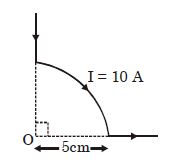
- 1Find out magnetic field at point $O$ ?View Solution
- 2Two circular coils $1$ and $2$ are made from the same wire but the radius of the $1^{st}$ coil is twice that of the $2^{nd}$ coil. What is the ratio of potential difference in volts should be applied across them so that the magnetic field at their centres is the same?View Solution
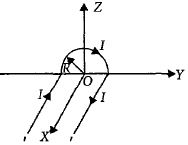
- 3A wire carrying current $I$ has the shape as shown in adjoining figure.Linear parts of the wire are very long and parallel to $X-$axis while semicircular portion of radius $R$ is lying in $Y-Z$ plane. Magnetic field at point $O$ isView Solution
- 4An electron moving in a circular orbit of radius $r$ makes $n$ rotations per second. The magnetic field produced at the centre has magnitudeView Solution
- 5A galvanometer has $36\,\Omega $ resistance. If a $4\,\Omega $ shunt is added to this, the fraction of current that passes through the shunt isView Solution
- 6A uniform magnetic field $B$ and a uniform electric field $E$ act in a common region. An electron is entering this region of space. The correct arrangement for it to escape undeviated isView Solution
- 7An electron is moving along the positive $x$-axis. If the uniform magnetic field is applied parallel to the negative $z$-axis. thenView Solution
$A.$ The electron will experience magnetic force along positive $y$-axis
$B.$ The electron will experience magnetic force along negative $y$-axis
$C.$ The electron will not experience any force in magnetic field
$D.$ The electron will continue to move along the positive $x$-axis
$E.$ The electron will move along circular path in magnetic field
Choose the correct answer from the options given below:
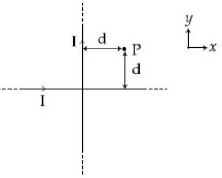
- 8Two very long, straight and insulated wires are kept at $90^o$ angle from each other In $xy -$ plane as shown in the figure. These wires carry current of equal magnitude $I$, whose directions are shown in the figure. The net magnetic field at point $P$ will beView Solution
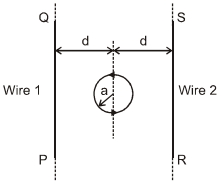
- 9The figure shows a circular loop of radius a with two long parallel wires (numbered $1$ and $2$) all in the plane of the paper. The distance of each wire from the centre of the loop is $d$. The loop and the wires are carrying the same current $I$. The current in the loop is in the counterclockwise direction if seen from above.$Image$View Solution
$1.$ When $d \approx$ a but wires are not touching the loop, it is found that the net magnetic filed on the axis of the loop is zero at a height $h$ above the loop. In that case
$(A)$ current in wire $1$ and wire $2$ is the direction $P Q$ and $R S$, respectively and $h \approx a$
$(B)$ current in wire $1$ and wire $2$ is the direction $PQ$ and $SR$, respectively and $h \approx a$
$(C)$ current in wire $1$ and wire $2$ is the direction $PQ$ and $SR$, respectively and $h \approx 1.2 a$
$(D)$ current in wire $1$ and wire $2$ is the direction $PQ$ and $RS$, resepectively and $h \approx 1.2 a$
$2.$ Consider $d \gg a$, and the loop is rotated about its diameter parallel to the wires by $30^{\circ}$ from the position shown in the figure. If the currents in the wires are in the opposite directions, the torque on the loop at its new position will be (assume that the net field due to the wires is constant over the loop)
$(A)$ $\frac{\mu_0 I^2 a^2}{d}$ $(B)$ $\frac{\mu_0 I^2 a^2}{2 d}$ $(C)$ $\frac{\sqrt{3} \mu_0 I^2 a^2}{d}$ $(D)$ $\frac{\sqrt{3} \mu_0 I^2 a^2}{2 d}$
Give the answer question $1$ and $2.$
- 10Two long and parallel wires are at a distance of $0.1\, m$ and a current of $5\, A$ is flowing in each of these wires. The force per unit length due to these wires will beView Solution