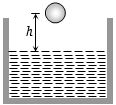
A stream-lined body falls through air from a height $h$ on the surface of liquid. Let $d$ and $D$ denote the densities of the materials of the body and the liquid respectively. If $D > d$, then the time after which the body will be instantaneously at rest, is
Diffcult
Download our app for free and get started
Velocity $u$ of the body when it enters the liquid is given by
$\mathrm{mgh}=\frac{1}{2} \mathrm{mu}^{2} \quad$ or $\quad \mathrm{u}=\sqrt{2 \mathrm{gh}}$
Let $\quad$ volume of the body $=V$
mass of the body $=\mathrm{Vd}$
weight of the body $=\mathrm{Vdg}$
Mass of liquid displaced $= VD$
Weight of liquid displaced $=\mathrm{VDg}$
Net upward force $=\mathrm{VDg}-\mathrm{Vdg}$
$=\mathrm{Vg}(\mathrm{D}-\mathrm{d})$
Retardation $=\frac{\text { net weight }}{\text { mass }}$
$=\frac{V(D-d) g}{V d}=\left(\frac{D-d}{d}\right) g$
Acceleration $a=-\left(\frac{D-d}{d}\right) g$
Final velocity, v in the liquid when the body is instantaneously at rest is zero. Let the time taken be $t.$
$\text { Now } \quad \mathrm{v}=\mathrm{u}+a \mathrm{t}$
$0=\sqrt{2 \mathrm{gh}}-\left(\frac{\mathrm{D}-\mathrm{d}}{\mathrm{d}}\right) \mathrm{gt},\left(\frac{\mathrm{D}-\mathrm{d}}{\mathrm{d}}\right) \mathrm{gt}=\sqrt{2 \mathrm{gh}}$
$\therefore \quad t=\left[\frac{d}{D-d}\right] \sqrt{\frac{2 h}{g}}$

Download our appand get started for free
Experience the future of education. Simply download our apps or reach out to us for more information. Let's shape the future of learning together!No signup needed.*
Similar Questions
- 1A manometer connected to a closed tap reads $4.5 \times {10^5}$ pascal. When the tap is opened the reading of the manometer falls to $4 \times {10^5}$ pascal. Then the velocity of flow of water is ........ $m{s^{ - 1}}$View Solution
- 2View SolutionFrom amongst the following curves, which one shows the variation of the velocity v with time t for a small sized spherical body falling vertically in a long column of a viscous liquid
- 3A wooden cube first floats inside water when a $200\,g$ mass is placed on it. When the mass is removed the cube is $2\,cm$ above water level. The side of cube is ........ $cm$View Solution
- 4A cube of wood supporting $200\,gm$ mass just floats in water. When the mass is removed, the cube rises by $2\, cm$. ............ $cm$ is the side of cube .View Solution
- 5A flat plate of area $0.1 \,m ^2$ is placed on a flat surface and is separated from it by a film of oil $10^{-5} \,m$ thick whose coefficient of viscosity is $1.5 N \,sm s ^{-2}$. The force required to cause the plate to slide on the surface at constant speed of $1 \,mm s ^{-1}$ is ............ $N$View Solution
- 6A ball of radius $r $ and density $\rho$ falls freely under gravity through a distance $h$ before entering water. Velocity of ball does not change even on entering water. If viscosity of water is $\eta$, the value of $h$ is given byView Solution
- 7$STATEMENT-1$ The stream of water flowing at high speed from a garcen hose pipe tends to spread like a fountain when held vertically up, but tends to narrow down when held vertically down. andView Solution
$STATEMENT-2$ In any steady flow of an incompressible fluid, the volume flow rate of the fluid remains constant.
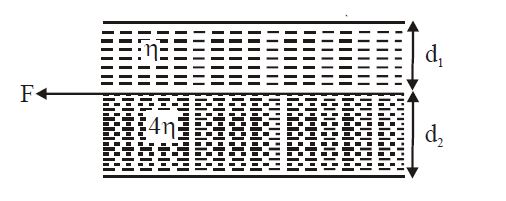
- 8A thin plate separates two liquids of coefficients of viscosity $\eta$ and $4\ \eta$ kept between two fixed plates as shown. If plate has to be pulled by applying minimum force then $\frac{d_2}{d_1}$ isView Solution
- 9A fluid is flowing through a horizontal pipe of varying cross-section, with speed $v\;ms^{-1}$ at a point where the pressure is $P$ Pascal. At another point where pressure is $\frac{ P }{2}$ Pascal its speed is $V\;ms^{-1}$. If the density of the fluid is $\rho\, kg\, m ^{-3}$ and the flow is streamline, then $V$ is equal toView Solution
- 10The vertical limbs of a $U$ shaped tube are filled with a liquid of density $\rho$ upto a height $h$ on each side. The horizontal portion of the $U$ tube having length $2h$ contains a liquid of density $2\rho$ . The $U$ tube is moved horizontally with an accelerator $g/2$ parallel to the horizontal arm. The difference in heights in liquid levels in the two vertical limbs, at steady state will beView Solution