Question
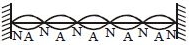
A string fixed at its both ends vibrates in $5\,\,loops$  as shown in the figure  

The total number of nodes and antinodes are respectively
Answer

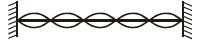
From figure,

Total nodes $=6$

Total antinodes $=5$

Need a full question paper?

Generate a complete, print-ready paper with questions like this in minutes — across 16+ boards, with answer keys.
Start Generating Free

Similar questions

A vibratory motion is represented by $x = 2A\,\cos \omega t + A\,\cos \,\left( {\omega t + \frac{\pi }{2}} \right) + A\,\cos \,\left( {\omega t + \pi } \right)$ $ + \frac{A}{2}\,\cos \left( {\omega t + \frac{{3\pi }}{2}} \right)$. The resultant amplitude of the motion is
The de-Broglie wavelength associated with the particle of mass $m$ moving with velocity $v$ is
A car moves towards a hill with speed $v_c$. It blows a horn of frequency $f$ which is heared by an observer following the car with speed $v_0$. The speed of sound in air is $v$.
The given transistor amplifier connection is
An $e.m.f$. of $12\, volt$ is produced in a coil when the current in it changes at the rate of $45$ $amp/minute$. The inductance of the coil is.......$henry$
$A$ rod of weight $w$ is supported by two parallel knife edges $A$ and $B$ and is in equilibrium in a horizontal position. The knives are at a distance $d$ from each other. The centre of mass of the rod is at a distance $x$ from $A$.
During mean life of a radioactive element, the fraction that disintegrates is
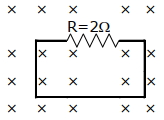
In the given figure the magnetic flux through the loop increases according to the relation $\phi_{B}(t)=10 t^{2}+20 t$, where $\phi_{B}$ is in milliwebers and $t$ is in seconds.

The magnitude of current through ${R}=2 \,\Omega$ resistor at ${t}=5\, {s}$ is $....\,{mA}$.
Three particles$ A$, $B$ and $C$ are thrown from the top of a tower with the same speed. $A$ is thrown up, $B$ is thrown down and $C$ is horizontally. They hit the ground with speeds ${V_A},\,\,{V_B}$ and ${V_C}$ respectively.
Two slits in Young's experiment have widths in the ratio $1 : 25.$ The ratio of intensity at the maxima and minima in the interference pattern, $\frac{I_{max}}{I_{min}}$ is