A string is rigidly tied at two ends and its equation of vibration is given by $y = \cos 2\pi \,t\sin \sin \pi x.$ Then minimum length of string is .... $m$
Medium


Download our appand get started for free
Experience the future of education. Simply download our apps or reach out to us for more information. Let's shape the future of learning together!No signup needed.*
Similar Questions
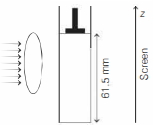
- 1A parallel beam of light is incident on a tank filled with water up to a height of $61.5 \,mm$ as shown in the figure below. Ultrasonic waves of frequency $0.5 \,MHz$ are sent along the length of the water column using a transducer placed at the top and they form longitudinal standing waves in the water. Which of the schematic plots below best describes the intensity distribution of the light as seen on the screen? (Take, the speed of sound in water to be $1500 \,m / s$ )View Solution
- 2A transverse wave is passing through a string shown in figure. Mass density of the string is $1 \ kg/m^3$ and cross section area of string is $0.01\ m^2.$ Equation of wave in string is $y = 2sin (20t - 10x).$ The hanging mass is (in $kg$):-View Solution
- 3A closed organ pipe of length $1.2 \,\,m$ vibrates in its first overtone mode. The pressure variation is maximum at:View Solution
- 4A wave is given by $y = 3\sin 2\pi \left( {\frac{t}{{0.04}} - \frac{x}{{0.01}}} \right)$, where $y$ is in $cm$. Frequency of wave and maximum acceleration of particle will beView Solution
- 5A car $P$ travelling at $20\,ms ^{-1}$ sounds its horn at a frequency of $400\,Hz$. Another car $Q$ is travelling behind the first car in the same direction with a velocity $40\,ms ^{-1}$. The frequency heard by the passenger of the car $Q$ is approximately $.......\,Hz$ [Take, velocity of sound $=360\,ms ^{-1}$ ]View Solution
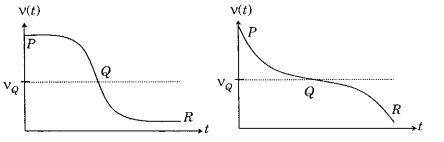
- 6Two loudspeakers $M$ and $N$ are located $20 \mathrm{~m}$ apart and emit sound at frequencies $118 \mathrm{~Hz}$ and $121 \mathrm{~Hz}$, respectively. $A$ car is initially at a point $P, 1800 \mathrm{~m}$ away from the midpoint $Q$ of the line $M N$ and moves towards $Q$ constantly at $60 \mathrm{~km} / \mathrm{hr}$ along the perpendicular bisector of $M N$. It crosses $Q$ and eventually reaches a point $R, 1800(m$ away from $Q$. Let $v(t)$ represent the beat frequency measured by a person sitting in tlie car at time $t$. Let $v_P, v_Q$ and $v_R$ be the beat frequencies measured at locations $P . Q$ and $R$, respectively. The speed of sound in air is $330 \mathrm{~m} \mathrm{~s}^{-1}$. Which of the following statement($s$) is(are) true regarding the sound heard by the person?View Solution
($A$) $v_P+v_R=2 v_Q$
($B$) The rate of change in beat frequency is maximum when the car passes through $Q$
($C$) The plot below represents schematically the variation of beat frequency with time
(image)
($D$) The plot below represents schematically the variation of beat frequency with time
(image)
- 7View SolutionIf vm is the velocity of sound in moist air, vd is the velocity of sound in dry air, under identical conditions of pressure and temperature
- 8Two closed pipe produce $10$ beats per second when emitting their fundamental nodes. If their length are in ratio of $25 : 26$. Then their fundamental frequency in $Hz$, areView Solution
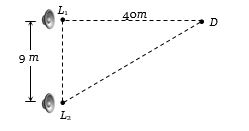
- 9Two loudspeakers $L_1$ and $L_2$ driven by a common oscillator and amplifier, are arranged as shown. The frequency of the oscillator is gradually increased from zero and the detector at $D$ records a series of maxima and minima. If the speed of sound is $330\,ms^{-1}$ then the frequency at which the first maximum is observed is .... $Hz$View Solution
- 10View SolutionIn the musical octave ‘Sa’, ‘Re’, ‘Ga’