Question
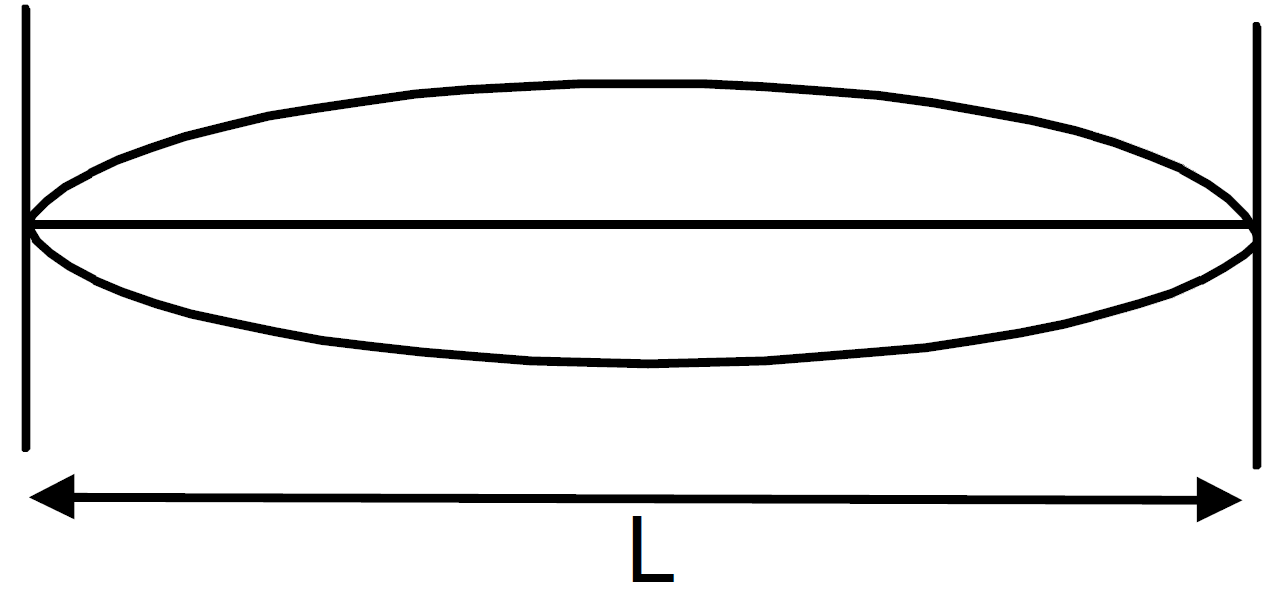
A string of length L fixed at both ends vibrates in its fundamental mode at a frequency v and a maximum amplitude A.
  1. Find the wavelength and the wave number k.
  2. Take the origin at one end of the string and the X-axis along the string. Take the Y-axis along the direction of the displacement. Take t = 0 at the instant when the middle point of the string passes through its mean position and is going towards the positive y-directian. Write the equation describing the standing wave:
Answer

Fundamental frequency$\text{v}=\frac{1}{2\text{l}}\sqrt{\frac{\text{T}}{\text{m}}}$
$\Rightarrow\sqrt{\frac{\text{T}}{\text{m}}}=\text{v}2\text{l}$ $\Big[\sqrt{\frac{\text{T}}{\text{m}}}=$ velocity of wave$\Big]$
  1. Wavelength, $\lambda=\frac{\text{velocity}}{\text{frequency}}=\frac{\text{v}2\text{l}}{\text{v}}=2\text{l}$
and wave number $\text{K}=\frac{2\pi}{\lambda}=\frac{2\pi}{2\text{l}}=\frac{\pi}{\text{l}}$
  1. Therefore, equation of the stationary wave is
$\text{y}=\text{A}\cos\Big(\frac{2\pi\text{x}}{\lambda}\Big)\sin\Big(\frac{2\pi\text{Vt}}{\text{L}}\Big)$
$=\text{A}\cos\Big(\frac{2\pi\text{x}}{2}\Big)\sin\Big(\frac{2\pi\text{Vt}}{\text{2L}}\Big)$
$\text{v}=\frac{\text{V}}{2\text{L}}$ $\Big[$because $\text{v}=\big(\frac{\text{v}}{2\text{l}}\big)\Big]$

Need a full question paper?

Generate a complete, print-ready paper with questions like this in minutes — across 16+ boards, with answer keys.

Start Generating Free

Similar questions

A molecule. of hydrogen contains two protons and two electrons. The nuclear force between these two protons is always neglected while discussing the behaviour of a hydrogen molecule. Why?
Sketch a graph between frequency of incident radiations and stopping potential for a given photosensitive material. What information can be obtained from the value of the intercept on the potential axis? A source of light of frequency greater than the threshold frequency is placed at a distance of 1 m from the cathode of a photo-cell. The stopping potential is found to be V. If the distance of the light source from the cathode is reduced, explain giving reasons, what change will you observe in the.
  1. photoelectric current,
  2. stopping potential.
The magnetic field due to a long straight wire has been derived in terms of $\mu_0,$ i and d. Express this in terms of $\epsilon_0,$ C, i and d.
A short bar magnet has a magnetic moment of $0.48 JT ^{-1}$.Give the direction and magnitude of the magnetic field produced by the magnet at a distance of 10 cm from the centre of the magnet on (a) the axis, (b) the equatorial lines (normal bisector) of the magnet.
How does an unpolarised light get polarised when passed through a polaroid?
Two polaroids are set in crossed positions. A third polaroid is placed between the two making an angle $\theta $ with the pass axis of the first polaroid. Write the expression for the intensity of light transmitted from the second polaroid. In what orientations will the transmitted intensity be $(i)$ minimum and $(ii)$ maximum?
  1. A rod of length l is moved horizontally with a uniform velocity ‘v’ in a direction perpendicular to its length through a region in which a uniform magnetic field is acting vertically downward. Derive the expression for the emf induced across the ends of the rod.
  2. How does one understand this motional emf by invoking the Lorentz force acting on the free charge carriers of the conductor? Explain.
  1. Write the principle of working of a metre bridge.
  2. In a metre bridge, the balance point is found at a distance $l_1$ with resistances R and S as shown in the figure.

An unknown resistance X is now connected in parallel to the resistance S and the balance point is found at a distance $l_2$. Obtain a formula for X in terms of $l_1$, $l_2$ and S.
The following figure shows the V-I characteristics of a semiconductor diode.
i. Identify the semiconductor diode used.
ii. Draw the circuit diagram to obtain the given characteristics of this device.
iii. Briefly explain how this diode can be used as a voltage regulator.
Image
An electron and a proton possess equal kinetic energy. Which of these has the greater de Broglie wavelength?
It is said that any charge given to a conductor comes to its surface. Should all the protons come to the surface? Should all the electrons come to the surface? Should all the free electrons come to the surface?