A string under a tension of $129.6\,\, N$ produces $10\,\, beats /sec$ when it is vibrated along with a tuning fork. When the tension is the string is increased to $160\,\, N,$ it sounds in unison with same tuning fork. calculate fundamental freq. of tuning fork .... $Hz$
Diffcult
Download our app for free and get started
frequency of tuning fork $ = \frac{{\sqrt {\frac{{160}}{{\rm{m}}}} }}{{2l}}$
According to the question
$\frac{1}{{2l}}\sqrt {\frac{{160}}{{\rm{m}}}} - \frac{1}{{2l}}\sqrt {\frac{{129.6}}{{\rm{m}}}} = 10$
$\frac{1}{{2l}}\sqrt {\frac{{10}}{m}} [4 - 3.6] = 10 \Rightarrow \frac{1}{{2l}}\sqrt {\frac{{10}}{m}} = 25$
so ${{\rm{V}}_{{\rm{TF}}}} = \frac{1}{{2l}}\sqrt {\frac{{160}}{{\rm{m}}}} = 4\left[ {\frac{1}{{2l}}\sqrt {\frac{{10}}{{\rm{m}}}} } \right] = 100\,{\rm{Hz}}$

Download our appand get started for free
Experience the future of education. Simply download our apps or reach out to us for more information. Let's shape the future of learning together!No signup needed.*
Similar Questions
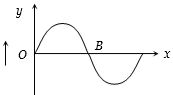
- 1Fig. below shows the wave $y = A\sin (\omega t - kx)$ at any instant travelling in the $+ve$ $x-$direction. What is the slope of the curve at $B$View Solution
- 2A person blows into open-end of a long pipe. As a result, a high-pressure pulse of air travels down the pipe. When this pulse reaches the other end of the pipe.View Solution
$(A)$ a high-pressure pulse starts traveling up the pipe, if the other end of the pipe is open.
$(B)$ a low-pressure pulse starts traveling up the pipe, if the other end of the pipe is open.
$(C)$ a low-pressure pulse starts traveling up the pipe, if the other end of the pipe is closed.
$(D)$ a high-pressure pulse starts traveling up the pipe, if the other end of the pipe is closed.
- 3The relation between frequency $‘n’$ wavelength ‘$\lambda$’ and velocity of propagation $‘v’$ of wave isView Solution
- 4A transverse wave propagating on the string can be described by the equation $y=2 \sin (10 x+300 t)$. where $x$ and $y$ are in metres and $t$ in second. If the vibrating string has linear density of $0.6 \times 10^{-3} \,g / cm$, then the tension in the string is .............. $N$View Solution
- 5Two cars ${X}$ and ${Y}$ are approaching each other with velocities $36\; {km} / {h}$ and $72\; {km} / {h}$ respectively. The frequency of a whistle sound as emitted by a passenger in car ${X}$, heard by the passenger in car ${Y}$ is $1320 \;{Hz}$. If the velocity of sound in air is $340\; {m} / {s}$, the actual frequency of the whistle sound produced is ........ $Hz.$View Solution
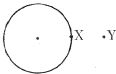
- 6A motorcyclist going around a circular track of radius $50\ m$ with a speed of $25\ m/s$ , is at a point $X$. A static siren at $Y$ is emitting sound of frequency $n$. How many times (approximately) in an hour will the motor cyclist hear the sound of actual frequency $Y$ ?View Solution
- 7An organ pipe of length $L$ is open at one end and closed at other end. The wavelengths of the three lowest resonating frequencies that can be produced by this pipe areView Solution
- 8An air column in a pipe, which is closed at one end, will be in resonance with a vibrating body of frequency $166 \,Hz$, if the length of the air column is .... $m$View Solution
- 9A police car horn emits a sound at a frequency $240 Hz$ when the car is at rest. If the speed of the sound is $330 m/s$, the frequency heard by an observer who is approaching the car at a speed of $11 m/s,$ is ... $Hz$View Solution
- 10The velocity of sound is $v_s$ in air. If the density of air is increased to $4$ times, then the new velocity of sound will beView Solution