A strong magnetic field is applied on a stationary electron, then
Easy


Download our appand get started for free
Experience the future of education. Simply download our apps or reach out to us for more information. Let's shape the future of learning together!No signup needed.*
Similar Questions
- 1View SolutionIn a current carrying long solenoid, the field produced does not depend upon
- 2The field normal to the plane of a wire of $n$ turns and radius $r$ which carries a current $i$ is measured on the axis of the coil at a small distance $h$ from the centre of the coil. This is smaller than the field at the centre by the fractionView Solution
- 3View SolutionMagnetic effect of current was discovered by
- 4A particle of charge $ - 16 \times {10^{ - 18}}$ $coulomb$ moving with velocity $10\,\,m{s^{ - 1}}$ along the $x$-axis enters a region where a magnetic field of induction $B$ is along the $y$-axis, and an electric field of magnitude ${10^4}\,\,V/m$ is along the negative $z$-axis. If the charged particle continues moving along the $x$-axis, the magnitude of $B$ isView Solution
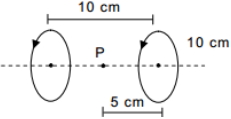
- 5Two circular loops having same radius $[ R =10\, cm ]$ and same current $\frac{7}{2} A$ are placed along same axis as shown. If distance between their centre is $10\, cm$, find net magnetic field at of point $P.$View Solution
- 6An electron is moving along the positive $X$$-$axis. You want to apply a magnetic field for a short time so that the electron may reverse its direction and move parallel to the negative $X$$-$axis. This can be done by applying the magnetic field alongView Solution
- 7If $ m$ is magnetic moment and $B$ is the magnetic field, then the torque is given byView Solution
- 8The magnetic field on the axis of a circular loop of radius $100\,cm$ carrying current $I=\sqrt{2}\,A$, at point $1\,m$ away from the centre of the loop is given byView Solution
- 9View SolutionWhat is shape of magnet in moving coil galvanometer to make the radial magnetic field
- 10The magnetic induction in air at a point $1\,cm $ away from a long wire that carries a current of $1\,A$, will beView Solution