Question
A student did an experiment with a convex lens. He put an object at different distances 25cm, 30cm, 40cm, 60cm and 120cm from the lens. In each case he measured the distance of the image from the lens. His results were 100cm, 24cm, 60cm, 30cm and 40cm, respectively. Unfortunately his results are written in wrong order:
  1. Rewrite the image distances in the correct order.
  2. What would be the image distance if the object distance was 90cm?
  3. Which of the object distances gives the biggest image?
  4. What is the focal length of this lens?
Answer

  1. Since the focal length is a constant quantity, we have to pair the object distance (u) and the image distance (v) such that the focal length always comes out to be the same. From the above argument, we get the correct order of the image distance as 100, 60, 40, 30 and 24. The reason being, as the object is carried far from a convex lens, the image is formed closer to the lens.
  2. Lens formula is given by,

$\frac{1}{\text{f}}=\frac{1}{\text{v}}-\frac{1}{\text{u}}$

$\Rightarrow\frac{1}{20}=\frac{1}{\text{v}}-\frac{1}{-90}$

$\Rightarrow\frac{1}{20}=\frac{1}{\text{v}}+\frac{1}{90}$

$\Rightarrow\frac{1}{\text{v}}=\frac{1}{20}-\frac{1}{90}$

$\Rightarrow\frac{1}{\text{v}}=\frac{9-2}{180}$

$\Rightarrow\frac{1}{\text{v}}=\frac{7}{180}$

$\Rightarrow{\text{u}}=\frac{180}{7}$

$\Rightarrow{\text{u}}=25.7\text{cm}$

The image distance will be 25.7cm if the object distance is 90cm.

  1. The object distance of 25 gives the biggest image because at this position, the object is between f and 2f. We know that when an object is placed between f and 2f of a convex lens, we get a real, inverted and magnified image.
  2. The image of an object at 2f is formed at 2f. This means that the pair of u and v that is equal in value gives us the value of 2f, which is 40. Hence, the value of f (focal length) is $\frac{40}{2}$

$\therefore\ \text{f}=20\text{cm}$

Need a full question paper?

Generate a complete, print-ready paper with questions like this in minutes — across 16+ boards, with answer keys.

Start Generating Free

Similar questions

a. List four characteristics of the image formed by a convex lens when an object is placed between its optical centre and principal focus.
b. Size of the image of an object by a concave lens of focal length 20 cm is observed to be reduced to $\frac{1}{3} \mathrm{rd}$ of its size. Find the distance of the object from the lens.
An object is placed at a distance of 30cm from a concave lens of focal length 15cm. List four characteristics (nature, position, etc.) of the image formed by the lens.
At what distance from a concave mirror of focal length 10cm should an object be placed so that:
  1. Its real image is formed 20cm from the mirror?
  2. Its virtual image is formed 20cm from the mirror?
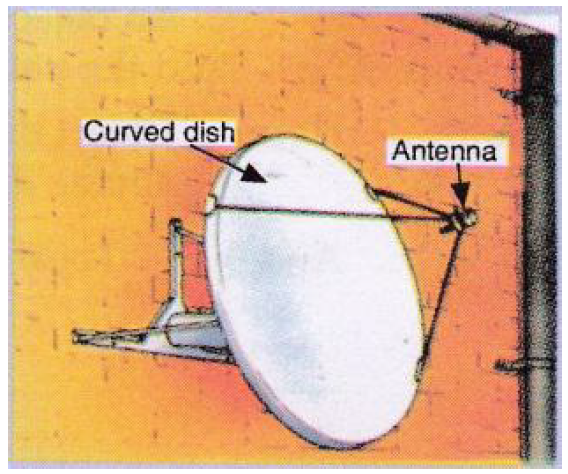
The diagram shows a dish antenna which is used to receive television signals from a satellite. The antenna (signal detector) is fixed in front of the curved dish.

  1. What is the purpose of the dish?
  2. Should it be concave or convex?
  3. Where should the antenna be positioned to receive the strongest possible signals?
  4. Explain what change you would expect in the signals if a larger dish was used.
An object is placed 10cm from a lens of focal length 5cm. Draw the ray diagrams to show the formation of image if the lens is:
  1. Converging, and
  2. Diverging.
State and explain Maxwell’s right-hand thumb rule.
i. Define principal axis of a lens. Draw a ray diagram to show what happens when a ray of light parallel to the principal axis of a concave lens passes through it.
ii. The focal length of a concave lens is 20 cm . At what distance from the lens should a 5 cm tall object be placed so that its image is formed at a distance of 15 cm from the lens? Also calculate the size of the image formed.
i. State laws of reflection of light.
ii. An object of height 5.0 cm is placed at 15 cm in front of a concave mirror of focal length 10 cm . At what distance from the mirror should a screen be placed, so that a focussed image is obtained on it? Find the height of the image.
Why does a light ray incident on a rectangular glass slab immersed in any medium emerges parallel to itself? Explain using a diagram.
Draw a labelled circuit diagram of a simple electric motor and explain its working. In what way these simple electric motors are diffferent from commercial motors?