Question
Baking soda is used in small amounts for making bread and cakes. It helps to make these soft and spongy. An aqueous solution of baking soda turns red litmus blue. It is also used in soda acid fire extinguisher. Use this information to answer the following questions.
(i) Write the equation for the reaction between baking soda and acid.
(ii) How does it help in extinguishing fire?
(iii) What is the reaction involved when it is heated?
or
(iv) Is the $pH$ value of baking soda solution lower than or higher than 7 ?
Answer

(i) The equation for the reaction is
$2 NaHCO _3( s )+ H _2 SO _4( aq )$
(Baking soda)
$\longrightarrow Na _2 SO _4( s )+2 H _2 O (l)+2 CO _2(g)$
(ii) The $CO _2$ gas produced by the reaction of baking soda and acid in the soda-acid fire extinguisher, helps in extinguishing fire.
(iii) The reaction involved is
$2 NaHCO _3( s ) \stackrel{\Delta}{\longrightarrow} Na _2 CO _3( s )+ H _2 O (l)+ CO _2( g ) \uparrow$
or
(iv) The $pH$ value of baking soda solution in higher than 7, i.e. it is alkaline.

Need a full question paper?

Generate a complete, print-ready paper with questions like this in minutes — across 16+ boards, with answer keys.

Start Generating Free

Similar questions

A student fixes a sheet of white paper on a drawing board using some adhesive materials. She places a bar magnet in the centre of it and sprinkles some iron filings uniformly around the bar magnet using a salt sprinkler. On tapping the board gently, she observes that the iron filings have arranged themselves in a particular pattern.
(a) What makes iron filings arrange in a definite pattern?
(b) Draw a diagram to show this pattern of iron filings.
(c) How is the direction of magnetic field at a point determined using the field lines? Why do two magnetic field lines not cross each other?
OR
How are the magnetic field lines of a bar magnet drawn using a small compass needle? Draw one magnetic field line each on both sides of the magnet.
Salt of a strong acid and strong base is neutral with a pH value of 7. NaCl common salt is formed by a combination of hydrochloride and sodium hydroxide solution. This is the salt that is used in food. Some salt is called rock salt, bed of rock salt was formed when seas of bygone ages dried up. The common salt thus obtained is an important raw material for various materials of daily use, such as sodium hydroxide, baking soda, washing soda, and bleaching powder.
a. If given acids are phosphoric acid, carbonic acid, hydrochloric acid and sulphuric acid, then which acid
does not form an acidic salt?
b. What is the formula of baking soda?

OR


Name the substance which on treatment with chlorine to obtain bleaching powder
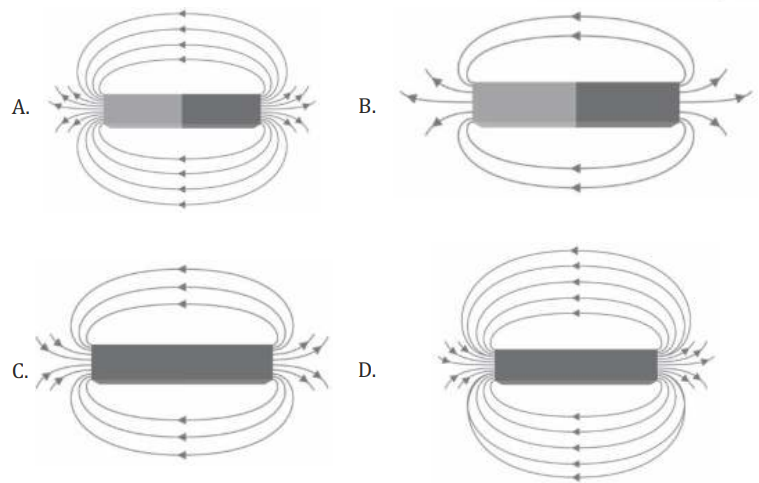
Which of these magnets has the strongest magnetic field?

Image

Read the following and answer any three questions from (i) to (iv).Bleaching powder is also known as chloride of lime. It is a solid and yellowish white in colour. Bleaching powder can be easily identified by the strong smell of chlorine. When calcium hydroxide (slaked lime) reacts with chlorine, it gives calcium oxychloride (bleaching powder) and water is formed. Aqueous solution of bleaching powder is basic in nature. The material to be bleached is first passed through solution of Na OH to remove greasy matter. Then it is passed through aqueous solution of bleaching powder and very dil. HCl solution. HCl reacts with bleaching powder to liberate nascent oxygen which bleaches material.
  1. Write two uses of Bleaching powder?
     
  2. Bleaching powder is also known as?
     
  3. A) Why does Bleaching powder gives smell of chlorine?
    B) What happens when calcium hydroxide reacts with chlorine?

    OR
    What happens when HCl reacts with bleaching powder?
Read the following and answer any three questions from (i) to (iv).ln 1913, Henry Moseley showed that the atomic number of an element is the more fundamental property than its atomic mass. Accordingly, Mendeleev's periodic law was modified and atomic number was adopted as the basis of modem periodic table.
ln this periodic table, the elements are arranged in increasing order of their atomic numbers.
There are 18 vertical columns in the periodic table which constitute 18 groups or families. The groups are numbered as 1, 2, 3, ... upto 18. All the members of a particular group have similar outer shell electronic configuration. There are seven horizontal rows of the periodic table, which are known as periods.
  1. According to modern periodic law, the properties of elements are the periodic function of their __________
     
  2. All the elements in a period in the periodic table have the same_____________.
     
  3. a) Write the combinations of elements that belong to the same group?
    b) The atoms of elements belonging to the same group of periodic table have same number of__________.

    OR
  4. ln the periodic table, the element with atomic numbers 16, 24, and 35 will be respectively placed in the which group.
Electronic configuration of some of the elements are given :
Type of elementElementAtomic numberNumber of electrons in shell
MetalsSodium (Na)Magnesium (Mg)Aluminium (Al)1112132828283
Non-metalsOxygen (O)Sulphur (S)Chlorine (Cl)8161726286287

(i) State one physical property to distinguish between metals and non-metals.
(ii) What is the nature of the bond formed when magnesium reacts with chlorine? Write the formula of the compound.
or
(ii) What is common between oxygen and sulphur? Draw the electron dot structure of $O _2$ molecule.

Read the following and answer any three questions from (i) to (iv).The table given below shows six organic compounds A, B, C, D, E and F having different molecular formula:
Organic compound
Molecular formula
A
$C _7 H _{16}$
B
$C _8 H _{16}$  
C
$C _4 H _6$  
D
$C _6 H _{10}$  
E
$C _5 H _{10}$  
F
$C _9 H _{20}$
  1. Write compounds belonging to the same homologous series?
     
  2. Write the member of the same homologous series as E with the help of the table?
     
  3. Identify Compound B from a given table.

    OR
     
  4. A) Write the general formula of Compound (F).
    B) Explain Different between organic and molecular compounds.
The reactivity series is a list of metals arranged in the order of their decreasing activities. The metal at the top of the reactivity series is the most reactive and metal at the bottom is the least reactive. The more reactive metal displaces less reactive metal from its salt solution.
KPotassiumMore reactive
NaSodium
CaCalcium
MgMagnesium
AlAluminium
ZnZincMore reactive
FeIron
PbLead
[H][ Hydrogen]
CuCopper
HgMercury
AgSilver
AuGoldLeast reactive

(i) Name the metals which react with steam but not with hot water.
(ii) What happen when calcium react with nitric acid and which method is used to extract metal present at the top of the reactivity series?
or
(ii) Which of the following metals exist in their native states in nature?
I. $Cu$
II. $Au$
III. $Zn$
IV. Ag

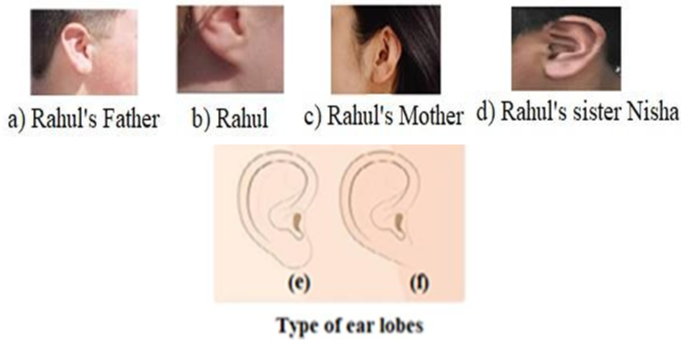
Figures (a) to (d) given below represent the type of ear lobes present in a family consisting of 2 children – Rahul, Nisha and their parents.
Image

Excited by his observation of different types of ear lobes present in his family, Rahul conducted a survey of the type of ear lobes found {Figure (e) and (f)} in his classmates. He found two types of ear lobes in his classmates as per the frequency given below:
Sex Free Attached
Male 36 14
Female 31 19
On the basis of above data answer the following questions.
a) Which of the two characteristics - 'free ear lobe' or 'attached ear lobe' appears to be dominant in this case? Why?
b) Is the inheritance of the free ear lobe linked with sex of the individual? Give reason for your answer.
c) What type of ear lobe is present in father, mother, Rahul and his sister Nisha? Write the genetic constitution of each of these family members which explains the inheritance of this character in this family?
(Gene for Free ear lobe is represented by $F$ and gene for attached ear lobe is represented by $f$ for writing the genetic constitution).
OR
Suresh's parents have attached earl obes. What type of ear lobe can be seen in Suresh and his sister Siya? Explain by giving the genetic composition of all.
The table below shows the refractive index of different materials.

Water

Kerosene

Flint glass

Diamond

Refractive index of the material

1.33

1.44

1.65

2.42

The formula for calculating the refractive index (nm) of a material is,
$n_m=\frac{\text { Speef of light in } X}{\text { Speef of light in the medium }}$
8. What does X stand for?