MCQ
A student studying the similarities and differences between a camera and the human eye makes the following observations:

$I$. Both the eye and the camera have convex lenses.

$II$. In order to focus, the eye lens expands or contracts while the camera lens moves forward or backward.

$III$. The camera lens produces upside down real images while the eye lens produces only upright real images.

$IV$. A screen in camera is equivalent to the retina in the eyes.

$V$. A camera adjusts the amount of light entering in it by adjusting the aperture of the lens. In the eye, the cornea controls the amount of light. Which of the above statements are correct?

  • A
    Statements $I, II$ and $IV$ are correct
  • B
    Statements $I, III$ and $V$ are correct
  • Statements $I, II, IV$ and $V$ are correct
  • D
    All statements are correct

Answer

Correct option: C.
Statements $I, II, IV$ and $V$ are correct
c
(c)

Image produced on retina are real and inverted. We are able to perceive them as erect because of processing of our brain.

Only statement $III$ is incorrect all other are correct.

Need a full question paper?

Generate a complete, print-ready paper with questions like this in minutes — across 16+ boards, with answer keys.

Start Generating Free

Similar questions

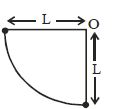
The mass of the $bob$ of a simple pendulum of length $L$ is $m$. If the $bob$ is left from its horizontal position then the speed of the $bob$ and tension in the thread in the lowest position of the $bob$ will be respectively
When a coil is connected across a $20 \mathrm{~V}$ dc supply, it draws a current of $5 \mathrm{~A}$. When it is connected across $20 \mathrm{~V}, 50 \mathrm{~Hz}$ ac supply, it draws a current of $4 \mathrm{~A}$. The self inductance of the coil is .............. $\mathrm{mH}$. (Take $\pi=3$ )
Surface of the lake is at $2°C$ . Find the temperature of the bottom of the lake..... $^oC$
Compared to a burn due to water at $100°C$, a burn due to steam at $100°C$ is
A ray of light passes through the equilateral prism such that angle of incidence is equal to the angle of emergence if the angle of incidence is $45^o.$ The angle of deviation will be.......$^o$
A composition string is made up by joining two strings of different masses per unit length $\rightarrow \mu$ and $4\mu$ . The composite string is under the same tension. A transverse wave pulse $: Y = (6 mm) \,\,sin\,\,(5t + 40x),$ where $‘t’$ is in seconds and $‘x’$ in meters, is sent along the lighter string towards the joint, the percentage of power transmitted to the heavier string through the joint is approximately ..... $\%$
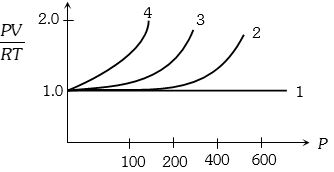
A fix amount of nitrogen gas ($1$ mole) is taken and is subjected to pressure and temperature variation. The experiment is performed at high pressure as well as high temperatures. The results obtained are shown in the figures. The correct variation of $PV/RT$ with $P$ will be exhibited by
$A$ block of mass $m$ moving with a velocity $v_0$ on a smooth horizontal surface strikes and compresses a spring of stiffness $k$ till mass comes to rest as shown in the figure. This phenomenon is observed by two observers:

$A$: standing on the horizontal surface

$B$: standing on the block To an observer

$A$, the work done by the normal reaction $N$ between the block and the spring on the block is

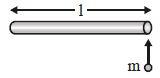
A stick of length $l$ and mass $M$ lies on a frictionless horizontal surface on which it is free to move in any way. A ball of mass $m$ moving with speed $v$ collides elastically with the stick as shown in the figure. If after the collision ball comes to rest, then what should be the mass of the ball
A vernier callipers used by student has $20$ divisions in $1\;cm$ on main scale. $10$ vernier divisions coincide with $9$ main scale divisions. When jaws are closed, zero of main scale is on left of zero of vernier scale and $6\ th$ division of vernier scale coincides with any of main scale divisions. He places a wooden cylinder in between the jaws and measures the length. The zero of vernier scale is on right of $3.20\;cm$ and $8\ th$ vernier division coincides with any main scale division. When he measures thickness of cylinder he finds that zero of vernier scale lies on right of $1.50\;cm$ mark of main scale and $6\ th$ division of vernier scale coincides with any main scale division. The correct values of measured length and diameter are respectively