Question
  1. A student suffering from myopia is not able to see distinctly the objects placed beyond 5 m. List two possible reasons due to which this defect of vision may have arisen. With the help of ray diagrams, explain.
  1. Why the student is unable to see distinctly the objects placed beyond 5 m from his eyes.
  2. The type of the corrective lens used to restore proper vision and how this defect is corrected by the use of this lens.
  1. If, in this case, the numerical value of the focal length of the corrective lens is 5 m, find the power of the lens as per the new Cartesian sign convention.
Answer

Two possible reasons due to which this defect of vision may have arisen are:

  1. Increase in curvature of the lens.
  2. Increase in length of the eyeball.
  1.  
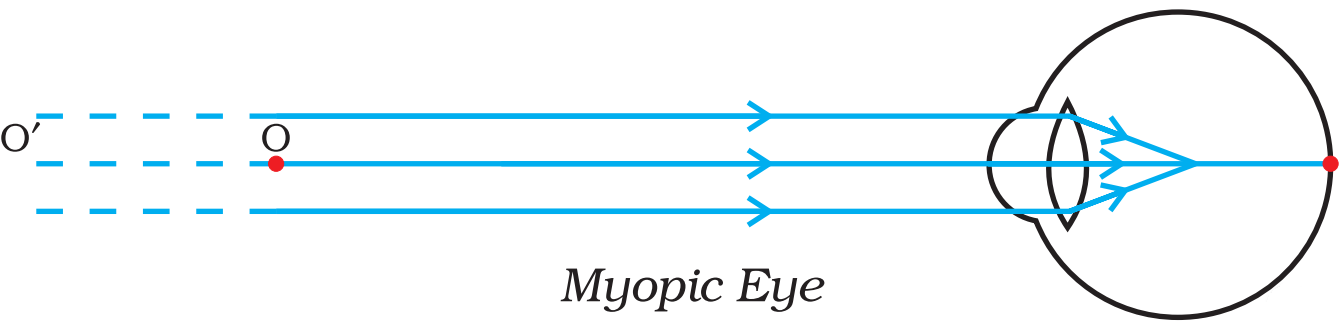
  1. A myopic eye has its far point nearer than infinity. It forms the image of a distant object in front of its retina as shown in the figure given below. In the given case student's far point is 5 m. So, image of the object placed beyond 5 m from his eyes is formed in front of the retina and hence appears blurred. That is why the student is unable to see distinctly the objects placed beyond 5 m from his eyes.

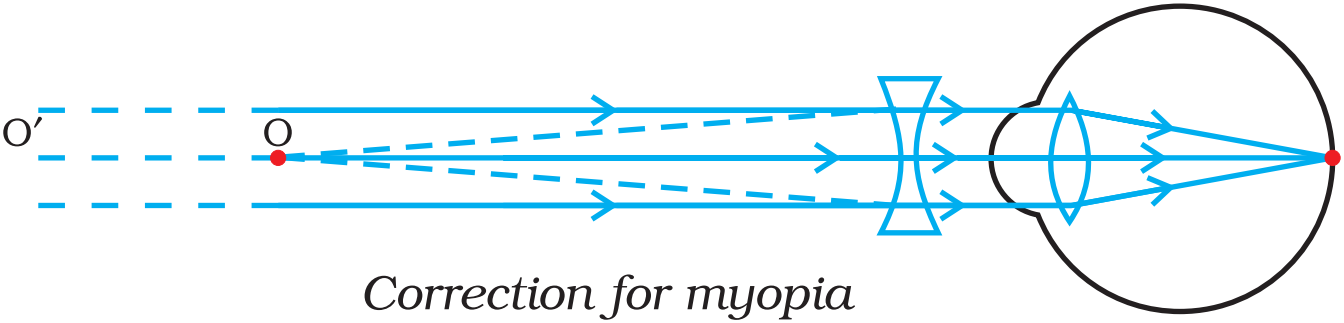
  1. Since a concave lens has an ability to diverge incoming rays, it is used to correct this defect of vision. The image is allowed to form at the retina by using a concave lens of suitable power as shown in the given figure.


  1. Power of the required corrective lens $(\text{P})=\frac{1}{\text{f}\text{(in m)}}$

$\text{P}=-\frac{1}{5}$

$\text{P} = -0.2\text{D}$

Hence, the power of corrective lens is -0.2D.

Need a full question paper?

Generate a complete, print-ready paper with questions like this in minutes — across 16+ boards, with answer keys.

Start Generating Free

Similar questions

State and explain the laws of reflection of light at a plane surface (like a plane mirror), with the help of a labelled ray-diagram. Mark the angles of ‘incidence’ and ‘reflection’ clearly on the diagram. If the angle of reflection is 47.5°, what will be the angle of incidence?
The image in a plane mirror is virtual and laterally inverted. What does this statement mean?
An electric heater which is connected to a 220V supply line has two resistance coils A and B of $24 Ω$ resistance each. These coils can be used separately (one at a time), in series or in parallel. Calculate the current drawn when:
  1. Only one coil A is used.
  2. Coils A and B are used in series.
  3. Coils A and B are used in parallel.
The variation of image distance (v) with object distance (u) for a convex lens is given in the following observation table. Analyse it and answer the questions that follow:
S.NO.Object distance (u) cmImage distance (v) cm
1-150+30
2-75+37.5
3-50+50
4-37.5+75
5-30+150
6-15+37.5

i. Without calculation, find the focal length of the convex lens. Justify your answer.
ii. Which observation is not correct? Why? Draw ray diagram to find the position of the image formed for this position of the object.
iii. Find the approximate value of magnification for $u=-30 \mathrm{~cm}$.
  1. If the image formed by a lens is diminished in size and erect, for all positions of the object, what type of lens is it?
  2. Name the point on the lens through which a ray of light passes undeviated.
  3. An object is placed perpendicular to the principal axis of a convex lens of focal length 20cm. The distance of the object from the lens is 30cm. Find,
  1. The position.
  2. The magnification.
  3. The nature of the image formed.
The speed of light in vacuum and in two different glasses is given in the table below:
Medium
Speed of light
Vacuum
Flint glass
Crown glass
3.00× 10⁸m/ s
1.86× 10⁸m/ s
1.97× 10⁸m/ s
  1. Calculate the absolute refractive indexes of flint glass and crown glass.
  2. Calculate the relative refractive index for light going from crown glass to flint glass.
At what distance from a concave mirror of focal length 10cm should an object be placed so that:
  1. Its real image is formed 20cm from the mirror?
  2. Its virtual image is formed 20cm from the mirror?
Draw a labelled circuit diagram of a simple electric motor and explain its working. In what way these simple electric motors are diffferent from commercial motors?
B1, B2 and B3 are three identical bulbs connected as shown in Figure. When all the three bulbs glow, a current of 3A is recorded by the ammeter A.

  1. What happens to the glow of the other two bulbs when the bulb B1 gets fused?
  2. What happens to the reading of A1, A2, A3 and A when the bulb B2 gets fused?
  3. How much power is dissipated in the circuit when all the three bulbs glow together?
  1. What is a solenoid? Draw a sketch of the pattern of field lines of the magnetic field through and around a current carrying solenoid.
  2. Consider a circular loop of wire lying in the plane of the table. Let the current pass through the loop clockwise. Apply the right hand rule to find out the direction of the magnetic field inside and outside the loop.