Question
What do you mean by multiple covalent bonding? Explain with the help of examples.

Answer

Multiple covalent Bonding: We know that electron pair shared between two atoms is responsible for the formation of a covalent
bond. This shared pair is also called bonding pair of electrons. The bonding atoms may share more than one pair of electrons also depending upon their requirement to complete the Octet. If the two atoms share one electron pair$,$bond is known as single covalent bond and is represented by one dash $(-).$ If the two atoms share two electron pairs$,$bond is known as double covalent bond and is represented by two dashes $(=)$. If the two atoms share three electron pairs$,$bond is known as triple covalent bond and is represented by three dashes $(=).$
In the case of $H_2$,$Cl_2$ and $\text{HCI}$ molecules $($given above$)$ there are single bonds between the atoms.
Formation of Double Bond: Two oxygen atoms combine to form an oxygen molecule by sharing two electron pairs. In the formation of oxygen molecule each oxygen atom has six electrons in the valence shell and require two electrons to complete the octet. Therefore$,$both the atoms contribute two electron pairs are shared and hence there is a double bond between the oxygen
atoms. The covalency of oxygen is two.
Image
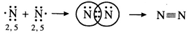
Formation of Triple Bond: In the formation of a nitrogen molecule$,$each of the bond nitrogen atoms having five electrons$,$provides three electrons to form three electrons pairs for sharing. Thus$,$a triple bond is formed between the two atoms. Here$,$covalency of nitrogen is three.
Image

Need a full question paper?

Generate a complete, print-ready paper with questions like this in minutes — across 16+ boards, with answer keys.

Start Generating Free

Similar questions

An endocrine gland P is located below the stomach in the human body. The gland P secretes a hormone H. The deficiency of hormone H in the body leads to a rise in blood sugar, due to which a disease D is caused.
Draw the possible isomers of the compound with molecular formula $C _3 H _6 O$ and also give their electron dot structures.
A non - metal X which is the largest constituent of air combines with hydrogen when heated in the presence of iron as catalyst to form a gas Y. When gas Y is treated with sulphuric acid, it forms a compound Z which is used as a chemical fertiliser.
  1. What are X, Y and Z?
  2. To which group of periodic table does X belong?
  3. Name the period of periodic table in which X is placed.
  4. Which element is placed just before X in the period?
  5. Which element is placed just after X in the period?
  1. Draw a ray diagram to show the formation of image by a convex lens when an object is placed in front of the lens between its optical centre and principal focus.
  2. In the above ray diagram mark the object-distance (u) and the image-distance (v) with their proper signs (+ve or – ve as per the new Cartesian sign convention) and state how these distances are related to the focal length (f) of the convex lens in this case.
  3. Find the power of a convex lens which forms a real, and inverted image of magnification –1 of an object placed at a distance of 20 cm from its optical centre.
  1. State in brief the functions of the following organs in the human female reproductive system:
Ovary, Fallopian tube, Uterus
  1. What is menstruation? Why does it occur?
Describe the process of fertilisation in humans and development of embryo briefly.
Sample of five metals ‘A’, ‘B’, ‘C’, ‘D’ and ‘E’ was taken and added to the following solution one by one. The results obtained have been tabulated as follows.
Metal $FeSO _4$ $CuSO _4$ $ZnSO _4$ $AgNO _3$ $Al _2\left( SO _4\right)_3$ $MgSO _4$
A No reaction Displacement No reaction Displacement No reaction No reaction
B Displacement Displacement No reaction Displacement No reaction No reaction
C No reaction No reaction No reaction Displacement No reaction No reaction
D No reaction No reaction No reaction No reaction No reaction No reaction
E Displacement Displacement Displacement Displacement No reaction No reaction
Use the above table to answer the following questions about the given metals.
  1. Which of them is most reactive and why?
  2. What would you observe if ‘B’ is added to $CuSO_4$?
  3. Arrange ‘A’, ‘B’, ‘C’, ‘D’ and ‘E’ in the increasing order of reactivity.
  4. Container of which metal can store zinc sulphate and silver nitrate solution?
  5. Which of the above solution(s) can be stored in a container made of any of these metals and why?
Esters are sweet-smelling substances and are used in making perfumes. Suggest some activity and the reaction involved for the preparation of an ester with a well-labeled diagram.
What are the scientific names for the following receptors in animals?
  1. Receptors for light.
  2. Receptors for heat.
  3. Receptors for sound.
  4. Receptors for smell.
  5. Receptors for taste.
How phototropism does occur in plants?