MCQ
A student traces the path of a ray of light through a rectangular glass slab for four different angles of incidence. He very cautiously measures the angle f, angle r and the angle e. On analysing his measurements, he is likely to draw the following conclusion:
  • A
    $\angle\text{i} = \angle\text{e} > \angle\text{r}$
  • B
    $\angle\text{i} > \angle\text{r} > \angle\text{e}$
  • C
    $\angle\text{i} = \text{Zr} < \text{Ze}$
  • D
    $\angle\text{i} = \angle\text{e}< \angle\text{r}$
Answer

  1. $\angle\text{i} = \angle\text{e} > \angle\text{r}$

​​​​​​​​​​​​​​Explanation:

Since the emergent ray is always parallel to the incident ray, therefore the angle of incidence is always equal to the angle of emergence i.e.

$\angle\text{i}=\angle\text{e}\ .....(\text{i})$

Also, when a light ray travels from rarer to denser medium, it bends towards the normal. Hence

$\angle\text{i}>\angle\text{r}\ .....(\text{ii})$

From (i) and (ii), we get 

$\angle\text{i}=\angle\text{e}>\angle\text{r}$

Hence, the correct answer is $\angle\text{i}=\angle\text{e}>\angle\text{r}$

Need a full question paper?

Generate a complete, print-ready paper with questions like this in minutes — across 16+ boards, with answer keys.

Start Generating Free

Similar questions

Magnification produced by a plane mirror is:
One of the following does not apply to a concave mirror. This is:
  1. Focal length is negative.
  2. Image distance can be positive or negative.
  3. Image distance is always positive.
  4. Height of image can be positive or negative.
At noon the sun appears white as:
  1. Light is least scattered.
  2. All the colours of the white light are scattered away.
  3. Blue colour is scattered the most.
  4. Red colour is scattered the most.
When the area of cross-section of a conductor is doubled, its resistance becomes:
An induced current is produced when a magnet is moved into a coil. The magnitude of induced current does not depend on:
The figure given alongside shows the image of a clock as seen a plane mirror. The correct time is:
Figure.
  1. 2.25
  2. 2.35
  3. 6.45
  4. 9.25
An object is placed at the following distances from a concave mirror of focal length 15cm, turn by turn:
  1. 35cm
  2. 30cm
  3. 20cm
  4. 10cm
Which position of the object will produce:
A student has obtained an image of a distant object on a screen to determine the focal length F1 of the given lens. His teacher after checking the image, gave him another lens of focal length F2 and asked to focus the same object on the same screen. The student found that to obtain a sharp image he has to move the lens away from the screen. From this finding we may conclude that both the lenses given to the student were:
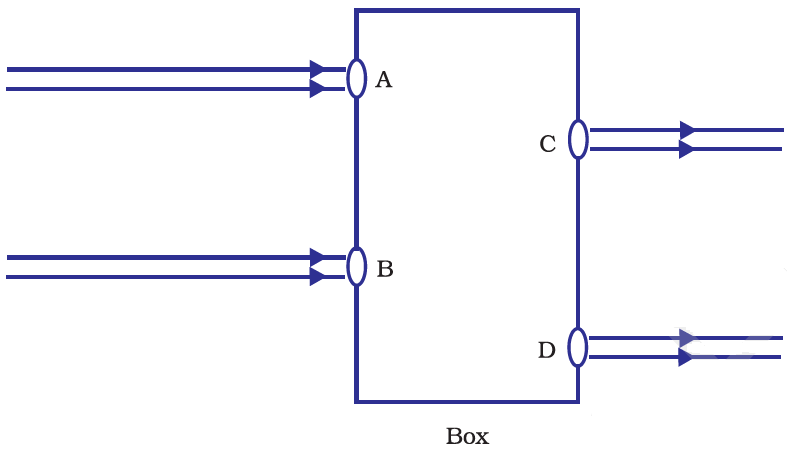
A beam of light is incident through the holes on one side of a box and emerges out through the holes on its opposite side as shown in the following figure:

The box contains:
  1. A glass prism.
  2. A concave lens.
  3. A convex lens
  4. A parallel-sided glass slab.