Questions · Page 1 of 5

M.C.Q-[Phy-1M]

🎯

Test yourself on this topic

50 questions · timed · auto-graded

MCQ 11 Mark
Which of the following lenses would you prefer to use while reading small letters found in a dictionary?
  • A
    A convex lens of focal length 50 cm.
  • B
    A concave lens of focal length 50 cm.
  • C
    A convex lens of focal length 5 cm.
  • D
    A concave lens of focal length 5 cm.
Answer
  1. A convex lens of focal length 5 cm.
View full question & answer
MCQ 21 Mark
No matter how far you stand from a mirror, your image appears erect. The mirror is likely to be
  • A
    plane.
  • B
    concave.
  • C
    convex.
  • D
    either plane or convex.
Answer
  1. Either plane or convex.
View full question & answer
MCQ 31 Mark
A spherical mirror and a spherical lens each have a focal length of, -15cm. The mirror and the lens are likely to be:
  • A
    Both concave.
  • B
    Both convex.
  • C
    The mirror is concave but the lens is convex.
  • D
    The mirror is convex but the lens is concave.
Answer
  1. Both concave.

Explanation:

According to the sign convention, the focal length for both a concave mirror and a concave lens is negative.

View full question & answer
MCQ 41 Mark
Where should an object be placed in front of a convex lens to get a real image of the size of the object?
  • A
    At the principal focus of the lens.
  • B
    At twice the focal length.
  • C
    At infinity.
  • D
    Between the optical centre of the lens and its principal focus.
Answer
  1. At twice the focal length.
View full question & answer
MCQ 51 Mark
The image formed by a concave mirror is observed to be virtual, erect and larger than the object. Where should be the position of the object?
  • A
    Between the principal focus and the centre of curvature.
  • B
    At the centre of curvature.
  • C
    Beyond the centre of curvature.
  • D
    Between the pole of the mirror and its principal focus.
Answer
  1. Between the pole of the mirror and its principal focus.
View full question & answer
MCQ 61 Mark
Which one of the following materials cannot be used to make a lens?
  • A
    Water.
  • B
    Glass.
  • C
    Plastic.
  • D
    Clay.
Answer
  1. Clay.

Explanation:

Since it is opaque and does not let light to pass through it.

View full question & answer
MCQ 71 Mark
When light enters the atmosphere it strikes on extremely fine particles, which deflect the rays of light in all possible directions, This is due to -
  • A
    reflection of light
  • B
    atmospheric refraction
  • scattering of light
  • D
    dispersion of light
Answer
Correct option: C.
scattering of light
(C) scattering of light.
View full question & answer
MCQ 81 Mark
An object is placed in front of a convex mirror. Its image is formed :
  • A
    at a distance equal to the object distance in front of the mirror.
  • B
    at twice the distance of the object in front of the mirror.
  • C
    half the distance of the object in front of the mirror.
  • behind the mirror and it's position varies according to the object distance.
Answer
Correct option: D.
behind the mirror and it's position varies according to the object distance.
(D) behind the mirror and its position varies according to the object distance.
View full question & answer
MCQ 91 Mark
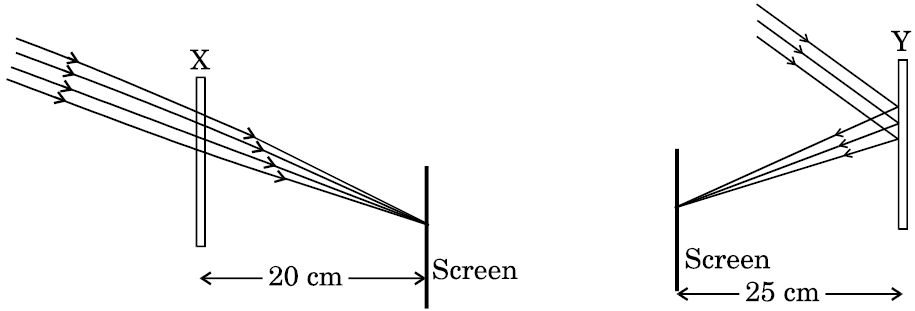
Study the given ray diagrams and select the correct statement from the following:
  • A
    Device X is a concave mirror and device Y is a convex lens, whose focal lengths are 20 cm and 25 cm respectively.
  • B
    Device X is a convex lens and device Y is a concave mirror, whose focal lengths are 10 cm and 25 cm respectively.
  • C
    Device X is a concave lens and device Y is a convex mirror, whose focal lengths are 20 cm and 25 cm respectively.
  • D
    Device X is a convex lens and device Y is a concave mirror, whose focal lengths are 20 cm and 25 cm respectively.
Answer
  1. Device X is a convex lens and device Y is a concave mirror, whose focal lengths are 20 cm and 25 cm respectively.

Explanation:

From the given figures we can conclude that the device X is a convex lens as it converges the rays and the device Y is a concave mirror as it also converges the rays but in the same side of the mirror .Their focal lengths are 20 cm and 25 cm respectively Regards.

View full question & answer
MCQ 101 Mark
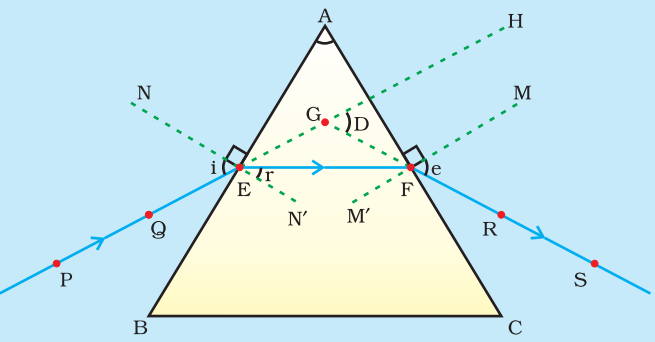
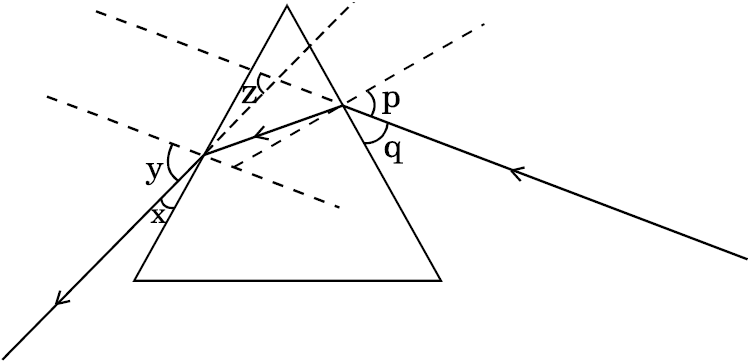
Study the following ray diagram:

In this diagram, the angle of incidence, the angle of emergence and the angle of deviation respectively have been represented by.
  • A
    y, p, z
  • B
    x, q, z
  • C
    p, y, z
  • D
    p, z, y
Answer
  1. p, y, z

Explanation:

The angle between the incident ray and the normal is known as the angle of incidence, and the angle between the emergent ray and the normal is known as the angle of emergence. The emergent ray is bent at an angle with the direction of the incident ray. This angle is called the angle of deviation.

View full question & answer
MCQ 111 Mark
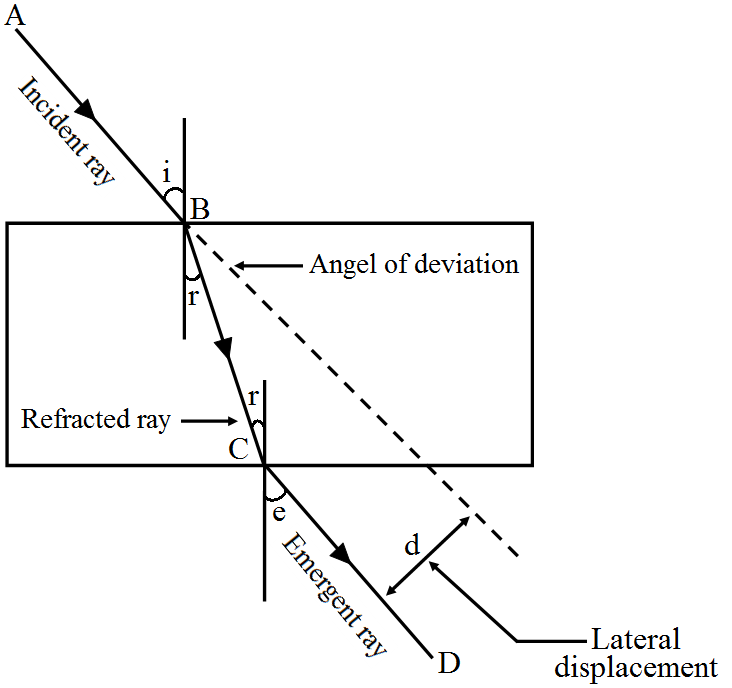
A student very cautiously traces the path of a ray through a glass slab for different values of the angle of incidence refraction$(\angle\text{i}).$ He then measures the corresponding values of the angle of refraction $(\angle\text{r}) $ and the angle of emergence $(\angle\text{e})$ for every value of the angle of incidence. On analysing these measurements of angles, his conclusion would be.
  • A
    $\angle\text{i}>\angle\text{r}>\angle\text{e}$
  • B
    $\angle\text{i}=\angle\text{e}>\angle\text{r}$
  • C
    $\angle\text{i}<\angle\text{r}<\angle\text{e}$
  • D
    $\angle\text{i}=\angle\text{e}<\angle\text{r}$
Answer
  1. $\angle\text{i}=\angle\text{e}>\angle\text{r}$

Explanation:

Since the emergent ray is always parallel to the incident ray, therefore the angle of incidence is always equal to the angle of emergence i.e.,

$\angle\text{i}=\angle\text{e}\ .....\text{(i)}$

Also, when a light ray travels from rarer to denser medium, it bends towards the normal. Hence

$\angle\text{i}>\angle\text{r}\ ..... \text{(ii)}$

From (i) and (ii), we get

$\angle\text{i}=\angle\text{e}>\angle\text{r}$

Hence, the correct answer is $\angle\text{i}=\angle\text{e}>\angle\text{r}.$​​​​​​​

View full question & answer
MCQ 121 Mark
A student obtains a blurred image of a distant object on a screen using a convex lens. To obtain a distinct image on the screen he should move the lens.
  • A
    Away from the screen.
  • B
    Towards the screen.
  • C
    To a position very far away from the screen.
  • D
    Either towards or away from the screen depending upon the position of the object.
Answer
  1. Either towards or away from the screen depending upon the position of the object.

Explanation:

The position of object is not known whether it is at infinity or beyond centre of curvature or at centre of curvature of lens. So depending upon the position of object we have to move the lens away or towards the screen.

View full question & answer
MCQ 131 Mark
In your laboratory you trace the path of light rays through a glass slab for different values of angle of incidence ($\angle\text{i}$) and in each case measure the values of the corresponding angle of refraction (​​​​​​$\angle\text{r}$) and angle of emergence ($\angle\text{e}$). On the basis of your observations your correct conclusion is:
  • A
    $\angle\text{i } \text{is more than} \angle\text{r}, \text{but nearly equal to} \angle\text{e}$
  • B
    $\angle\text{i }\text{ is less than} \angle\text{r }, \text{but nearly equal to}\angle\text{e}$
  • C
    $\angle\text{i } \text{is more than} \angle\text{e } , \text{but nearly equal to}\angle\text{r }$
  • D
    $\angle\text{i } \text{is less than} \angle\text{e },\text{ but nearly equal to}\angle\text{r} .$
Answer
  1. $\angle\text{i } \text{is more than } \angle\text{r}, \text{but nearly equal to } \angle\text{e}.$

​​​​​​​Explanation:


On entering a glass slab, the incident light gets refracted. According to Snell’s law, we get
$\mu=\frac{\sin\text{i}}{\sin\text{r}}$
For glass μ > 1
$\therefore \sin\text{r} < \sin\text{i}$

or r < i

In refraction of light through a glass slab, the emergent ray is parallel to the incident ray. Thus, $\angle\text{i}=\angle\text{e}$.

View full question & answer
MCQ 141 Mark
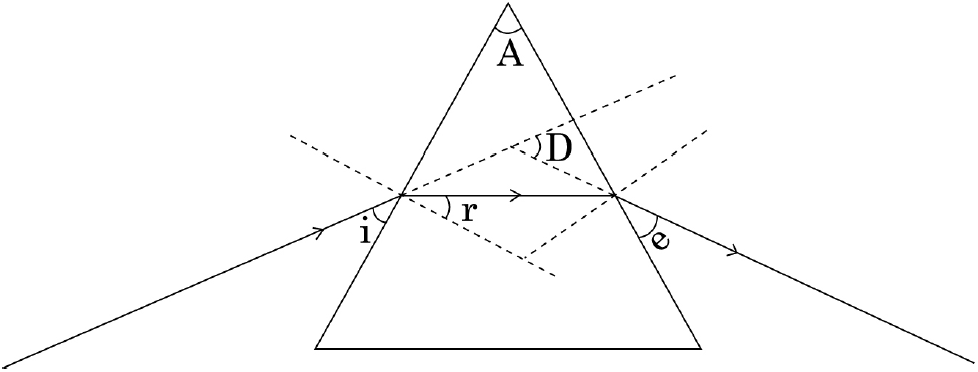
In the following ray diagram the correctly marked angle are:
  • A
    $\angle\text{i}\text{ and } \angle\text{e}$
  • B
    $\angle\text{A }\text{ and } \angle\text{D}$
  • C
    $\angle\text{i }, \angle\text{e } \text{ and } \angle\text{D}$
  • D
    $\angle\text{r }, \angle\text{A } \text{ and } \angle\text{D}.$
Answer
  1. $\angle\text{r }, \angle\text{A } \text{ and } \angle\text{D}.$

​​​​​​​Explanation:

The angle between the normal and the incident ray is the angle of incidence. The angle between the normal and the emergent ray is the angle of emergence. The correctly marked angles are shown in the diagram below:


View full question & answer
MCQ 151 Mark
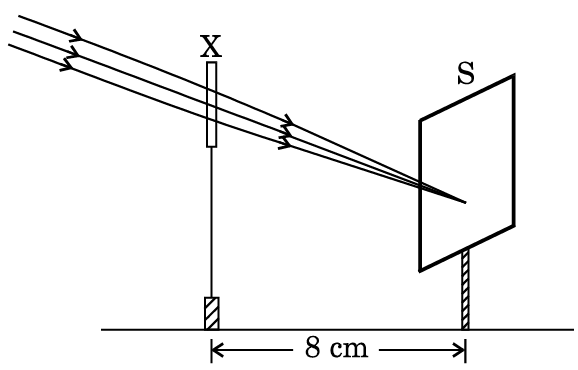
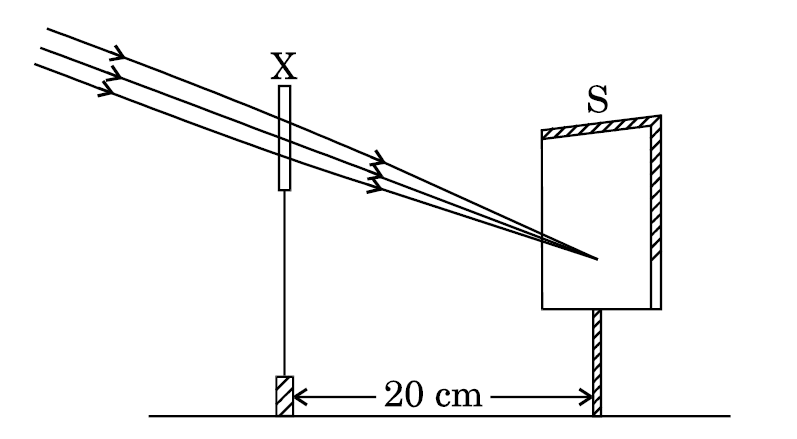
A student used a device (X) to obtain/focus the image of a well illuminated distant building on a screen (S) as shown below in the diagram. Select the correct statement about the device (X).
  • A
    This device is a concave lens of focal length 8 cm.
  • B
    This device is a convex mirror of focal length 8 cm.
  • C
    This device is a convex lens of focal length 4 cm.
  • D
    This device is a convex lens of focal length 8 cm.
Answer
  1. This device is a convex lens of focal length 8cm.

Explanation:

The incident rays after passing through the lens converge at the focus. So, the device 'X' is a converging or a convex lens. The distance between the lens and the screen gives the focal length of the lens.

View full question & answer
MCQ 161 Mark
A student traces the path of a ray of light through a rectangular glass slab for the different values of angle of incidence. He observes all possible precautions at each step of the experiment. At the end of the experiment, on analysing the measurements, which of the following conclusions is he likely to draw?
  • A
    $\angle\text{i} = \angle\text{ e} <\angle\text{r}$
  • B
    $\angle\text{i} < \angle\text{ e} <\angle\text{r}$
  • C
    $\angle\text{i} > \angle\text{ e} >\angle\text{r}$
  • D
    $\angle\text{i} = \angle\text{ e} >\angle\text{r}.$
Answer
  1. $\angle\text{i} = \angle\text{ e} >\angle\text{r}.$

​​​​​​​​​​​​​​​​​​​​​​​​​​​​​​​​​​​​​​​​​​Explanation:

When a ray of light passes through a rectangular glass slab then due to change in the refractive index from air to glass and then glass to air, the light is refracted. The angle of incidence is equal to the angle of emergency of light ray and also greater than angle of refraction.

View full question & answer
MCQ 171 Mark
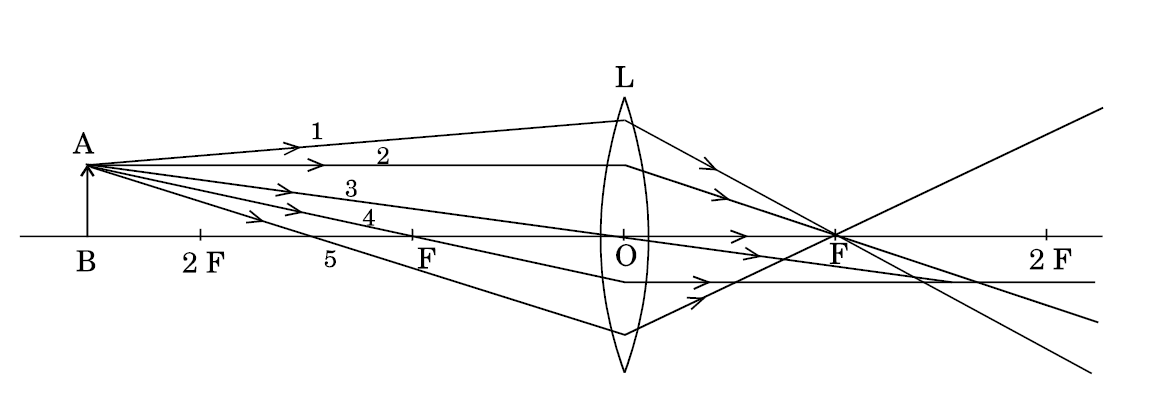
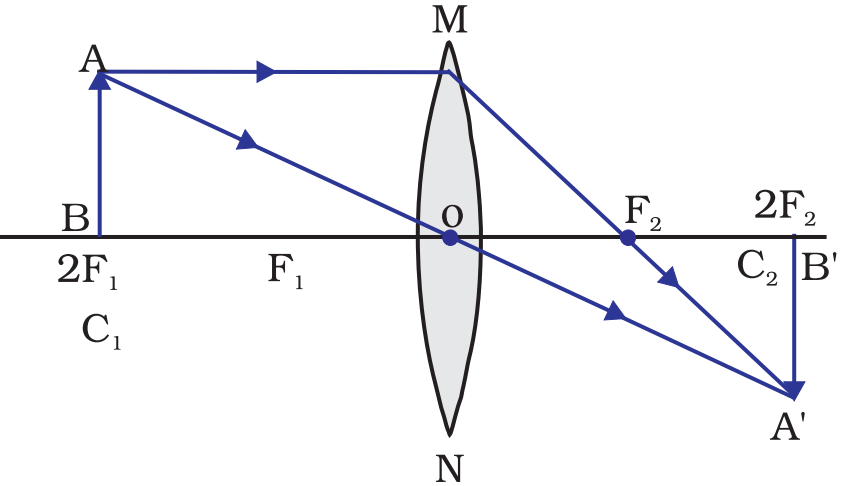
A student is using a convex lens of focal length 18 cm to study the image formation by it for the various positions of the object. He observes that when he places the object at 27 cm, the location of the image is at 54 cm on the other side of the lens. Identify from the following diagram the three rays that are obeying the laws of refraction and may be used to draw the corresponding ray diagram.
  • A
    1, 2 and 4
  • B
    1, 3 and 5
  • C
    2, 4 and 5
  • D
    2, 3 and 4
Answer
  1. 2, 3 and 4.

​​​​​​​​​​​​​​​​​​​​​​​​​​​​Explanation:

Ray 2, 3 and 4 are obeys the laws of refraction.

Ray 2 is parallel to the principal axis and passes through the principal focus after refraction.

Ray 3 passes from the optical centre of the lens and emerges without any deviation.

Ray 4 is passing through the principal focus and after refraction from a convex lens emerges parallel to the principal axis.

Ray 1 and 5 cannot pass through the focus after refraction as they are not parallel to the principal axis.
Ray 2, 3 and 4 are obeys the laws of refraction.

Ray 2 is parallel to the principal axis and passes through the principal focus after refraction.

Ray 3 passes from the optical centre of the lens and emerges without any deviation.

Ray 4 is passing through the principal focus and after refraction from a convex lens emerges parallel to the principal axis.

Ray 1 and 5 cannot pass through the focus after refraction as they are not parallel to the principal axis.
View full question & answer
MCQ 181 Mark
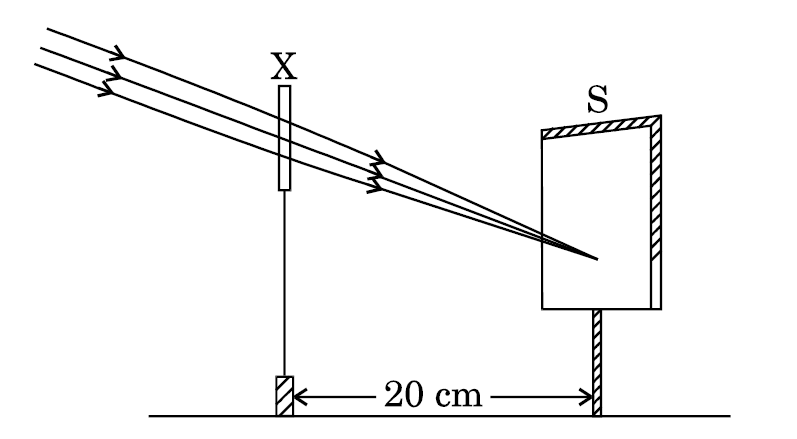
A student focussed the Sun rays using an optical device ‘X’ on a screen S as shown.

From this it may be concluded that the device ‘X’ is a (select the correct option)
  • A
    Convex lens of focal length 10cm.
  • B
    Convex lens of radius of curvature 20cm.
  • C
    Convex lens of focal length 20cm.
  • D
    Concave mirror of focal length 20cm.
Answer
  1. Convex lens of focal length 20cm.

​​​​​​​​​​​​​​​​​​​​​​​​​​​​Explanation:

Light rays from infinity are converged at the focal point of the convex lens. Therefore, the focal length of the convex lens is 20cm.

Hence, the correct option is C.

View full question & answer
MCQ 191 Mark
A student is using a convex lens of focal length 10 cm to study the image formation by a convex lens for the various positions of the object. In one of his observations, he may observe that when the object is placed at a distance of 20 cm from the lens, its image is formed at (select the correct option):
  • A
    20 cm on the other side of the lens and is of the same size, real and erect.
  • B
    40 cm on the other side of the lens and is magnified, real and inverted.
  • C
    20 cm on the other side of the lens and is of the same size, real and inverted.
  • D
    20 cm on the other side of the lens and is of the same size, virtual and erect.
Answer
  1. 20cm on the other side of the lens and is of the same size, real and inverted.

​​​​​​​​​​​​​​​​​​​​​​​​​​​​Explanation:

Given, focal length of the image, f = 10cm.​​​​​​​

Thus, the object is placed at 2F (2 × 10 = 20cm). Hence, the image is also formed at 2F.

The image will be of same size as that of the object and is real and inverted.


​​​​​​​
View full question & answer
MCQ 201 Mark
A student very cautiously traces the path of a ray through a glass slab for different values of the angle of incidence $(\angle\text{i}).$ He then measures the corresponding values of the angle of refraction $(\angle\text{r})$ and the angle of emergence $(\angle\text{e})$ for every value of the angle of incidence. On analysing these measurements of angles, his conclusion would be
  • A
    $\angle\text{i}>\angle\text{r}> \angle\text{e}$
  • B
    $\angle\text{i}=\angle\text{e}>\angle\text{r}$
  • C
    $\angle\text{i}<\angle\text{r}<\angle\text{e}$
  • D
    $\angle\text{i}=\angle\text{e}<\angle\text{r}$
Answer
  1. $\angle\text{i}=\angle\text{e}>\angle\text{r}$

Explanation:

Since the emergent ray is always parallel to the incident ray, therefore the angle of incidence is always equal to the angle of emergence i.e.,

$\angle\text{i}=\angle\text{e}\ .....\text{(i)}$

Also, when a light ray travels from rarer to denser medium, it bends towards the normal. Hence

$\angle\text{i}>\angle\text{r}\ .....\text{(ii)}$

From (i) and (ii), we get

$\angle\text{i}=\angle\text{e}>\angle\text{r}$

Hence, the correct answer is $\angle\text{i}=\angle\text{e}>\angle\text{r}.$

View full question & answer
MCQ 211 Mark
To determine the approximate value of the focal length of a given concave mirror, you focus the image of a distant object formed by the mirror on a screen. The image obtained on the screen, as compared to the object is always:
  • A
    Laterally inverted and diminished.
  • B
    Inverted and diminished.
  • C
    Erect and diminished.
  • D
    Erect and highly diminished.
Answer
  1. Inverted and diminished.

​​​​​​​​​​​​​​Explanation:

The rays from a distant object (from infinity) always converge at the focus of the mirror. So the position of the screen in this case will give the location of the focus and the distance of screen from the pole of the mirror will give the focal length of the mirror. Also the image formed in such a case is real, inverted and diminished, so the correct answer is real, inverted and diminished.

View full question & answer
MCQ 221 Mark
Suppose you have focused on a screen the image of candle flame placed at the farthest end of the laboratory table using a convex lens. If your teacher suggests you to focus the parallel rays of the sun, reaching your laboratory table, on the same screen, what you are expected to do is to move the:
  • A
    Lens slightly towards the screen.
  • B
    Lens slightly away from the screen.
  • C
    Lens slightly towards the sun.
  • D
    Lens and screen both towards the sun.
Answer
  1. Lens slightly towards the screen.

​​​​​​​​​​​​​​​​​​​​​Explanation:

In the case of candle flame, the object is placed beyond c, which means the image is formed or focused between c and f. in second case, the object or sun is at infinity, so the image will be formed at focus. This means that the distance between image and lens has decreased in the second case. Either we have to the screen towards the lens or the lens towards the screen. 

So, option (a) is correct.

View full question & answer
MCQ 231 Mark
A student traces the path of a ray of light through a triangular glass prism for different values of angle of incidence. On analysing the ray diagrams, which one of the following conclusions is he likely to draw?
  • A
    The emergent ray is parallel to the incident ray.
  • B
    The emergent ray bends at an angle to the direction of the incident ray.
  • C
    The emergent ray and the refracted ray are at right angles to each other.
  • D
    The emergent ray is perpendicular to the incident ray.
Answer
  1. The emergent ray bends at an angle to the direction of the incident ray.

​​​​​​​Explanation:

In refraction of light through a glass prism, there is deviation or change in the path of light passing through the prism.

View full question & answer
MCQ 241 Mark
A student focussed the Sun rays using an optical device ‘X’ on a screen S as shown.

From this it may be concluded that the device ‘X’ is a (select the correct option)
  • A
    Convex lens of focal length 10 cm.
  • B
    Convex lens of radius of curvature 20 cm.
  • C
    Convex lens of focal length 20 cm.
  • D
    Concave mirror of focal length 20 cm.
Answer
  1. Convex lens of focal length 20 cm.

​​​​​​​​​​​​​​Explanation:

Light rays from infinity are converged at the focal point of the convex lens. Therefore, the focal length of the convex lens is 20 cm.

Hence, the correct option is C.

View full question & answer
MCQ 251 Mark
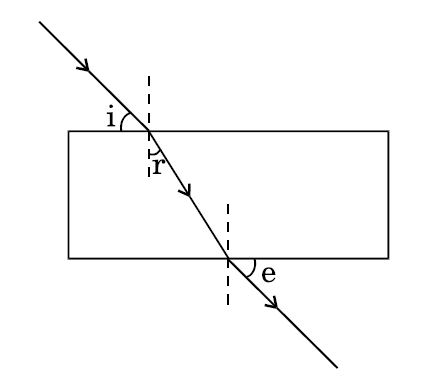
A student traces the path of a ray of light passing through a rectangular glass slab and marks the angle of incidence i, angle of refraction r and angle of emergence e, as shown.

The correctly marked angle(s) is/are:
  • A
    $\angle$ i only.
  • B
    $\angle$ e only.
  • C
    $\angle$ r only.
  • D
    $\angle$ i and $\angle$ e.
Answer
  1. $\angle$ r only.
View full question & answer
MCQ 261 Mark
A student has obtained an image of a well-illuminated distant object on a screen to determine the focal length, $\text{F}_{1}$  of the given spherical mirror. The teacher then gave him another mirror of focal length, $\text{F}_{2}$  and asked him to obtain a focussed image of the same object on the same screen. The student found that in order to focus the same object using the second mirror, he has to move the mirror away from the screen. From this observation it may be concluded that both the spherical mirrors given to the student were (select the correct option)
  • A
    Concave and $\text{F}_{1} < \text{F}_{2}$
  • B
    Concave and $\text{F}_{1} > \text{F}_{2}$
  • C
    Convex and $\text{F}_{1} < \text{F}_{2}$
  • D
    Convex and $\text{F}_{1} > \text{F}_{2}$
Answer
  1. Concave and F1 < F2.

​​​​​​​​​​​​​​Explanation:

Since the image is focused, the spherical mirror is a concave mirror. For second mirror the distance is increased to focus the image on the screen. Hence, focal length is more than that of first mirror.

View full question & answer
MCQ 271 Mark
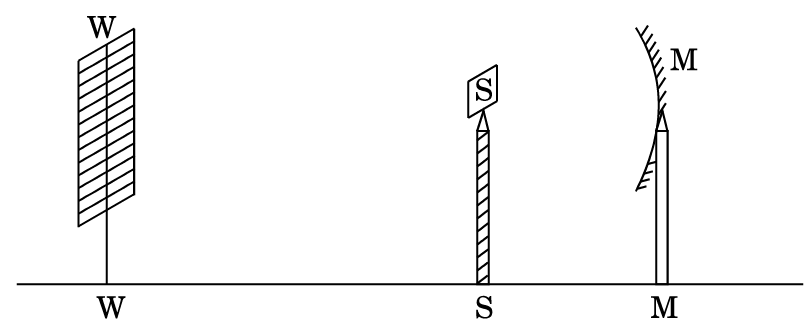
A student obtains a sharp image of the distant window (W) of the school laboratory on the screen (S) using the given concave mirror (M) to determine its focal length. Which of the following distances should he measure to get the focal length of the mirror?
  • A
    MW.
  • B
    MS.
  • C
    SW.
  • D
    MW - MS. 
Answer
  1. MS.

Explanation:

To get the focal length of the mirror, the student should measure the distance between mirror and screen because when the object is at infinity, the image is formed at focus i.e. between screen and mirror. So, the distance between screen and mirror should be measured.

View full question & answer
MCQ 281 Mark
He then measures the corresponding values of the angle of $(\angle\text{i}).$A student very cautiously traces the path of a ray through a glass slab for different values of the angle of incidence refraction $(\angle\text{r}).$ and the angle of emergence $(\angle\text{e}).$ for every value of the angle of incidence. On analysing these measurements of angles, his conclusion would be.
  • A
    $\angle\text{i}>\angle\text{r}>\angle\text{e}$
  • B
    $\angle\text{i}=\angle\text{e}>\angle\text{r}$
  • C
    $\angle\text{i}<\angle\text{r}<\angle\text{e}$
  • D
    $\angle\text{i}=\angle\text{e}<\angle\text{r}$
Answer
  1. $\angle\text{i}=\angle\text{e}>\angle\text{r}$

​​​​​​​Explanation:

Since the emergent ray is always parallel to the incident ray, therefore the angle of incidence is always equal to the angle of emergence i.e.,

$\angle\text{i}=\angle\text{e}\ .....\text{(i)}$

Also, when a light ray travels from rarer to denser medium, it bends towards the normal. Hence

$\angle\text{i}>\angle\text{r}\ .....\text{(ii)}$

From (i) and (ii), we get

$\angle\text{i}=\angle\text{e}>\angle\text{r}$

Hence, the correct answer is $\angle\text{i}=\angle\text{e}>\angle\text{r}.$

View full question & answer
MCQ 291 Mark
After tracing the path of a ray of light passing through a rectangular glass slab for four different values of the angle of incidence, a student reported his observations in tabular form as given below:
S. No.$\angle\text{ i}$$\angle\text{ r}$$\angle\text{ e}$
I$30^{0}$$19^{0}$$29^{0}$
II$40^{0}$$28^{0}$$40^{0}$
III$50^{0}$$36^{0}$$50^{0}$
IV$60^{0}$$40^{0}$$59^{0}$
The best observation is:
  • A
    I
  • B
    II
  • C
    III
  • D
    IV
Answer
  1. III.

​​​​​​​​​​​​​​​​​​​​​​​​​​​​​​​​​​​Explanation:

For best results, the following conditions must be satisfied:

  1. The angle of incidence must be nearly equal to the angle of emergence.
  2. The angle of refraction must be less than the angle the incidence.​​​​​​​
  3. $\frac{\sin\text{i}}{\sin\text{r}}=1.5$ (Since, the refractive index of glass is 1.5)

Out of the 4 observations, the first observation, that is angle i = 30º; angle r = 19º and angle e = 29º is the correct observation. In this case, $\frac{\sin 30^\circ}{\sin 19^\circ}=1.535$.

View full question & answer
MCQ 301 Mark
A student traces the path of a ray of light through a rectangular glass slab for four different angles of incidence. He very cautiously measures the angle f, angle r and the angle e. On analysing his measurements, he is likely to draw the following conclusion:
  • A
    $\angle\text{i} = \angle\text{e} > \angle\text{r}$
  • B
    $\angle\text{i} > \angle\text{r} > \angle\text{e}$
  • C
    $\angle\text{i} = \text{Zr} < \text{Ze}$
  • D
    $\angle\text{i} = \angle\text{e}< \angle\text{r}$
Answer
  1. $\angle\text{i} = \angle\text{e} > \angle\text{r}$

​​​​​​​​​​​​​​Explanation:

Since the emergent ray is always parallel to the incident ray, therefore the angle of incidence is always equal to the angle of emergence i.e.

$\angle\text{i}=\angle\text{e}\ .....(\text{i})$

Also, when a light ray travels from rarer to denser medium, it bends towards the normal. Hence

$\angle\text{i}>\angle\text{r}\ .....(\text{ii})$

From (i) and (ii), we get 

$\angle\text{i}=\angle\text{e}>\angle\text{r}$

Hence, the correct answer is $\angle\text{i}=\angle\text{e}>\angle\text{r}$

View full question & answer
MCQ 311 Mark
If you are to determine to focal length of a convex lens, you should have
  • A
    A convex lens and a screen.
  • B
    A convex lens and a lens holder.
  • C
    A lens holder, a screen holder and a scale.
  • D
    A convex lens, a screen, holder for them and a scale.
Answer
  1. A convex lens, a screen, holder for them and a scale.
View full question & answer
MCQ 321 Mark
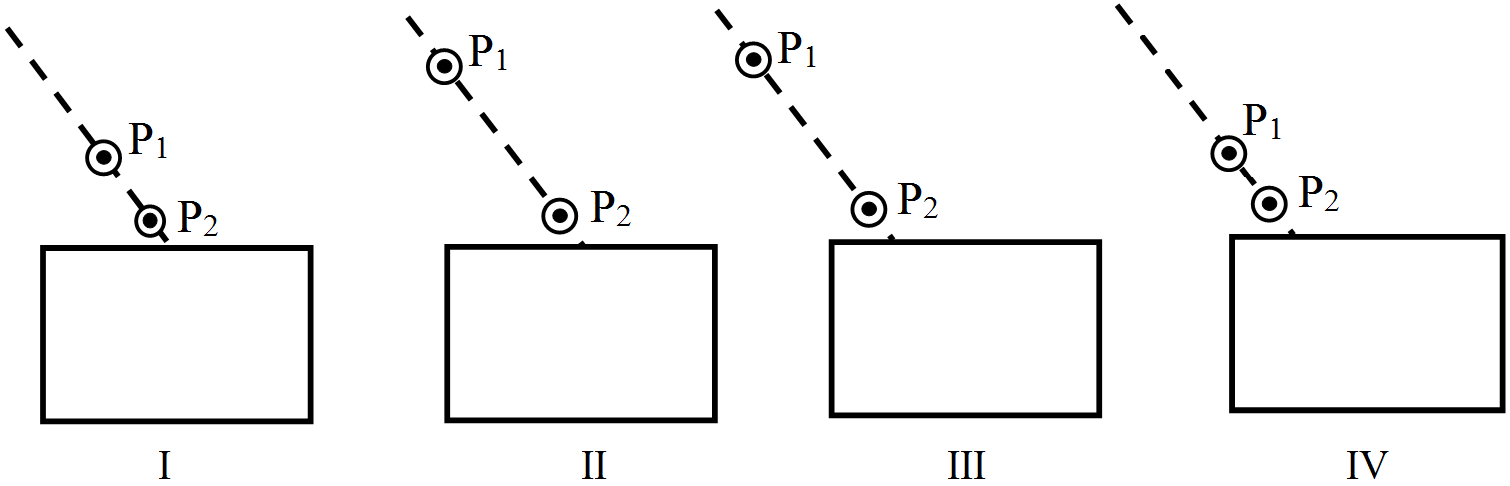
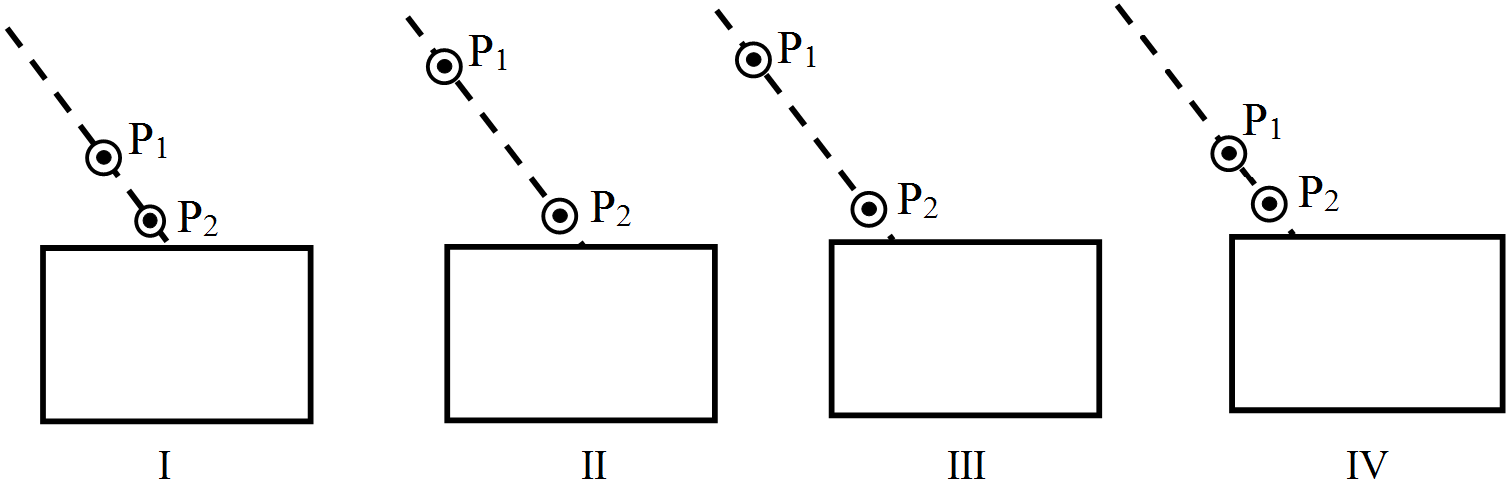
While performing the experiment on tracing the path of a ray of light through a rectangular glass slab, in which of the following experimental set-ups is a student likely to get best results? P1 and Pare the positions of pins fixed by him.
  • A
    I
  • B
    II
  • C
    III
  • D
    IV
Answer
  1. III.
View full question & answer
MCQ 331 Mark
Four students showed the following traces of the path of a ray of light passing through a rectangular glass slab.

The trace most likely to be correct is that of student:
  • A
    I
  • B
    II
  • C
    III
  • D
    IV
Answer
  1. III.
View full question & answer
MCQ 341 Mark
A student obtained a sharp inverted image of a distant tree on a screen placed in front of the concave mirror. He then removed the screen and tried to look into the mirror. He would now see
  • A
    A very blurred image on the wall opposite to the mirror.
  • B
    An erect and magnified image of the tree in the mirror.
  • C
    No image as the screen has been removed.
  • D
    A highly diminished inverted image of the tree at the focus of the mirror.
Answer
  1. A highly diminished inverted image of the tree at the focus of the mirror.
View full question & answer
MCQ 351 Mark
A student has to determine the focal length of a concave mirror by obtaining the image of a distant object on a screen. For getting best result he should focus:
  • A
    A distant tree or an electric pole.
  • B
    A well-illuminated distant building.
  • C
    Well-lit grills of the nearest window.
  • D
    A burning candle laced at the distant edge of the laboratory table.
Answer
  1. A distant tree or an electric pole.
View full question & answer
MCQ 361 Mark
To determine the focal length of a convex lens by obtaining a sharp image of a distant object,the following steps were suggested which are not in proper sequence:
  1. Hold the lens between the object and the screen.
  2. Adjust the position of the lens to form sharp image.
  3. Select a suitable distant object.
  4. Measure the distance between the lens and the screen.
The correct sequence of steps to determine the focal length of the lens is:
  • A
    III, I, II, IV
  • B
    III, I, IV, II
  • C
    III, IV, II, I
  • D
    I, II, III, IV
Answer
  1. III, I, II, IV.
View full question & answer
MCQ 371 Mark
The steps involved in observing a slide under a microscope are given below. They may not be in proper sequence.

  1. Focus the object under high power of the microscope.

  2. Place the slide on the stage of the microscope.

  3. Arrange the mirror to reflect maximum light to the slide.

  4. Focus the object under low power of the microscope.

The proper sequence of steps is:
  • A
    II, III, IV, I
  • B
    I, II, III, IV
  • C
    IV, III, II, I
  • D
    III, I, II, IV
Answer
  1. II, III, IV, I.
View full question & answer
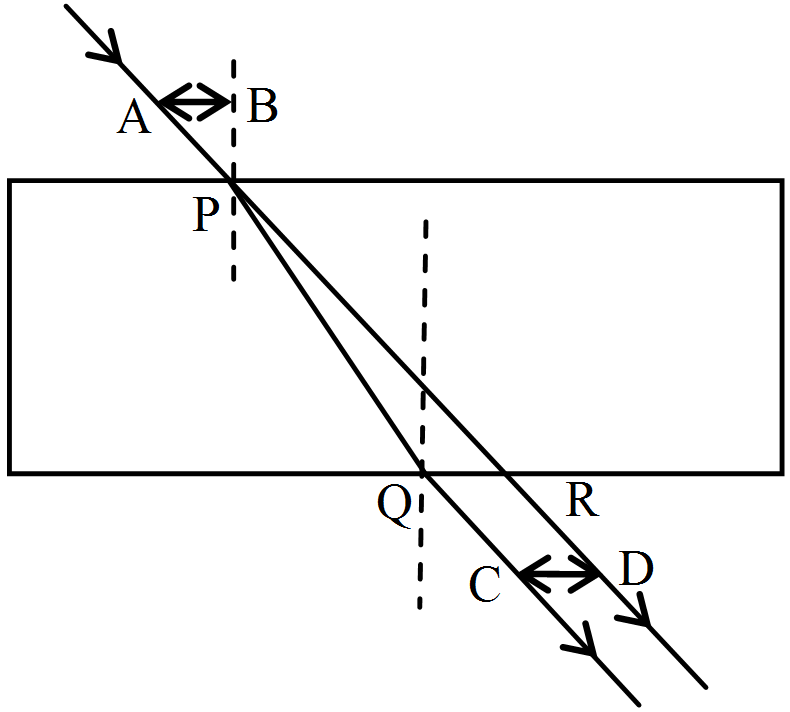
MCQ 381 Mark
For a ray of light passing through a glass slab.

The lateral displacement was correctly measured as:
  • A
    AB
  • B
    PQ
  • C
    CD
  • D
    PR
Answer
  1. CD.
View full question & answer
MCQ 391 Mark

To find the focal length of a concave mirror, Sita should choose which one of the following set-ups?

  • A
    A mirror holder and a screen holder.
  • B
    A screen holder and a scale.
  • C
    A mirror holder, a screen holder and a scale.
  • D
    A screen, a mirror, holders for them and a scale.
Answer
  1. A screen, a mirror, holders for them and a scale.
View full question & answer
MCQ 401 Mark
By using convex lens, a student obtained a sharp image of his class-room window grill on a screen. In which direction should he move the lens to "focus a distant tree instead of the grill?
  • A
    Towards the screen.
  • B
    Away from the screen.
  • C
    Very far away from the screen.
  • D
    Behind the screen.
Answer
  1. Towards the screen.
View full question & answer
MCQ 411 Mark
In these diagrams, the angle of refraction r has been correctly marked in which diagram?
  • A
    I
  • B
    II
  • C
    III
  • D
    IV
Answer
  1. IV.
View full question & answer
Question 421 Mark
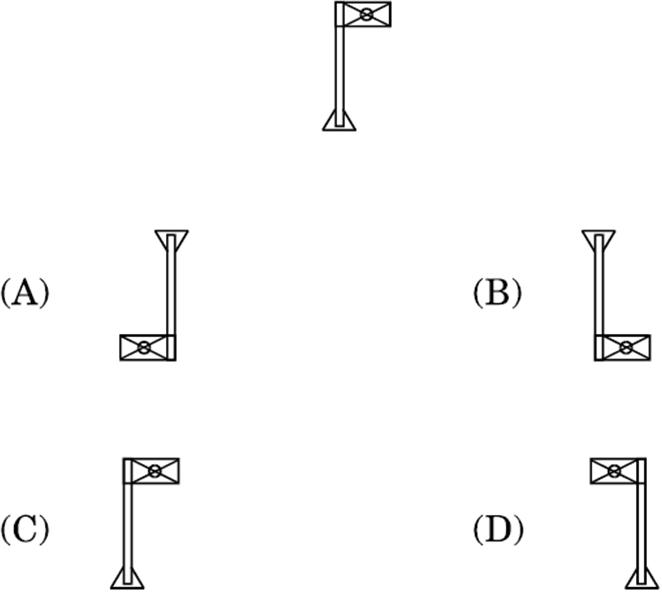
When you focus the image of a distant flag, whose shape is given below, on a screen using a convex lens, the shape of the image as it appears on the screen is:
View full question & answer
MCQ 431 Mark
An optical device has been given to a student and he determines its focal length by focusing the image of the sun on a screen placed 24cm from the device on the same side as the sun. Select the correct statement about the device.
  • A
    Convex mirror of focal length 12cm.
  • B
    Convex lens of focal length 24cm.
  • C
    Concave mirror of focal length 24cm.
  • D
    Convex lens of focal length 12cm.
Answer
  1. Concave mirror of focal length 24cm.
View full question & answer
MCQ 441 Mark
In an experiment to trace the path of a ray of light through a triangular glass prism, a student would observe that the emergent ray.
  • A
    Is parallel to the incident ray.incident ray.
  • B
    Is along the same direction of incident ray.
  • C
    Gets deviated and bends towards the thinner part of the prism.
  • D
    Gets deviated and bends towards the thicker part (base) of the prism.
Answer
  1. Gets deviated and bends towards the thicker part (base) of the prism.

​​​​​​​Explanation:

If the refractive index of the medium (dispersing medium in our case "glass") through which the light passes during dispersion is greater than the medium through which the light enters (in our case "air") the dispersing medium, then the net deviation in the path of light is always towards the thicker part of the prism.

View full question & answer
MCQ 451 Mark
An optical device has been given to a student and he determines its focal length by focusing the image of the sun on a screen placed 24 cm from the device on the same side as the sun. Select the correct statement about the device.
  • A
    Convex mirror of focal length 12 cm.
  • B
    Convex lens of focal length 24 cm.
  • C
    Concave mirror of focal length 24 cm.
  • D
    Convex lens of focal length 12 cm.
Answer
  1. Concave mirror of focal length 24 cm.
View full question & answer
MCQ 461 Mark
A teacher sets up the stand carrying a convex lens of focal length 15 cm at 42.7 cm mark on the optical bench. He asks four students A, B, C and D to suggest the position of screen on the optical bench so that a distinct image of a distant tree is obtained almost immediately on it. The positions suggested by the students were as:
  1. 12.7 cm.
  2. 29.7 cm.
  3. 57.7 cm.
  4. 72.7 cm.
The correct position of the screen was suggested by.
  • A
    A
  • B
    B
  • C
    C
  • D
    D
Answer
  1. C

Explanation:

A ray comes from infinity, after refraction through a convex lens, meet at the second principal focus. So, screen should be placed at the second principal focus of a convex lens. e.g., screen should be placed at 15cm from the pole of convex lens.

Now, the position of the screen on the optical bench = distance between screen from the pole of convex lens + distance of optical bench from the pole of convex lens {as you can see in attachment}

= 15 cm + 42.7cm

= 57.7cm

Hence, option (C) is correct

View full question & answer
MCQ 471 Mark
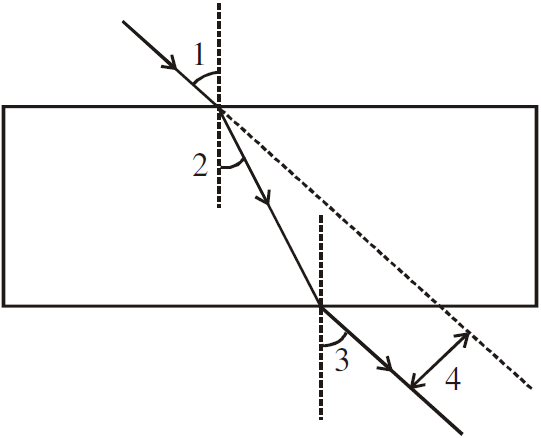
A student has traced the path of a ray of light through a glass slab as follows. If you are asked to label 1, 2, 3 and 4, the correct sequencing of labeling $\angle\text{i}, \angle\text{e}, \angle\text{r}$ and lateral displacement respectively is
  • A
    2, 1, 3, 4
  • B
    1, 2, 3, 4
  • C
    1, 3, 2, 4
  • D
    1, 3, 4, 2
Answer
  1. 1, 3, 2, 4
View full question & answer
MCQ 481 Mark
A student determines the focal length of a device ‘X’ by focusing the image of a distant object on a screen placed 20cm from the device on the same side as the object. The device ‘X’ is.
  • A
    Concave lens of focal length 10cm.
  • B
    Convex lens of focal length 20cm.
  • C
    Concave mirror of focal length 10cm.
  • D
    Concave mirror of focal length 20cm.
Answer
  1. Concave mirror of focal length 20cm.

Explanation:

Since the object and the image are on the same side, and the image is real (since it is focused on a screen) the device X is a concave mirror of focal length 20cm.

View full question & answer
MCQ 491 Mark
A teacher sets up the stand carrying a convex lens of focal length 15cm at 42.7cm mark on the optical bench. He asks four students A, B, C and D to suggest the position of screen on the optical bench so that a distinct image of a distant tree is obtained almost immediately on it. The positions suggested by the students were as:
  1. 12.7cm.
  2. 29.7cm.
  3. 57.7cm.
  4. 72.7cm.
The correct position of the screen was suggested by.
  • A
    A
  • B
    B
  • C
    C
  • D
    D
Answer
  1. C

Explanation:

A ray comes from infinity, after refraction through a convex lens, meet at the second principal focus. So, screen should be placed at the second principal focus of a convex lens. e.g., screen should be placed at 15cm from the pole of convex lens.

Now, the position of the screen on the optical bench = distance between screen from the pole of convex lens + distance of optical bench from the pole of convex lens {as you can see in attachment}

= 15cm + 42.7cm

= 57.7cm

Hence, option (C) is correct.

View full question & answer
Question 501 Mark
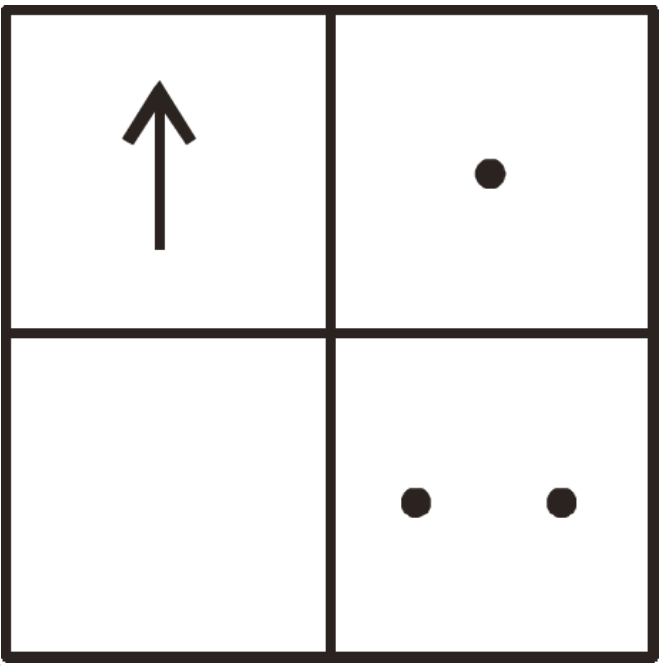
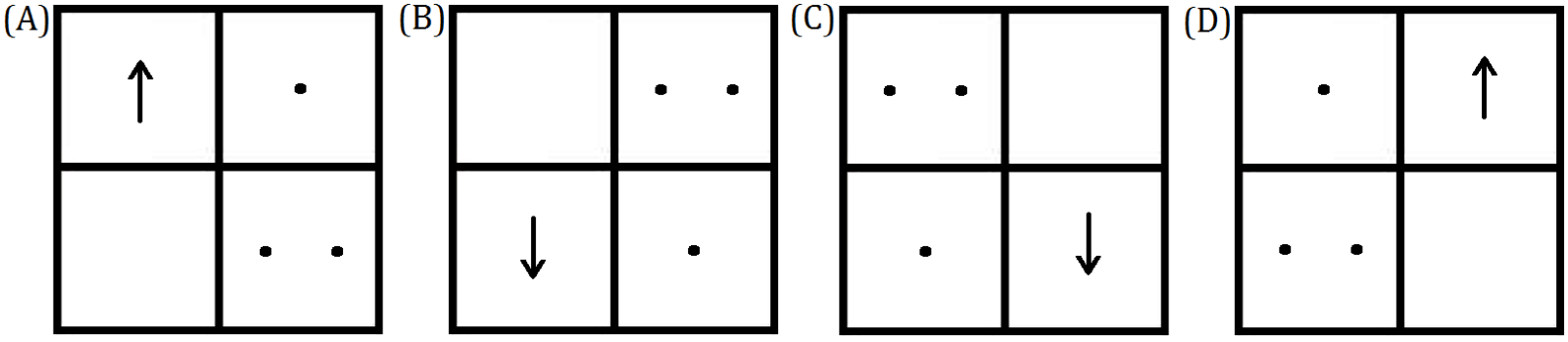
If you focus the image of a distant object, whose shape is given below, on a screen using a convex lens,

the shape of the image of this object on the screen would be:
View full question & answer
M.C.Q-[Phy-1M] - Science STD 10 Questions - Vidyadip