A student wants to project the image of a candle flame on a screen 48 cm in front of a mirror by keeping the flame at a distance of 12 cm from its pole.
- Suggest the type of mirror he should use.
- Find the linear magnification of the image produced.
- How far is the image from its object?
- Draw ray diagram to show the image formation in this case.
CBSE OUTSIDE DELHI - SET 2 2014
Download our app for free and get started
- He should use a concave mirror, as it forms a real image on the same side of the mirror.
- Object distance, u = -12 cm.
Magnification, $m = -\frac{v}{u} = - \frac{(-48)}{(-12)} = -4$
The minus sign in magnification shows that the image formed is real and inverted.
- The image is formed at a distance of 36 cm from the object.
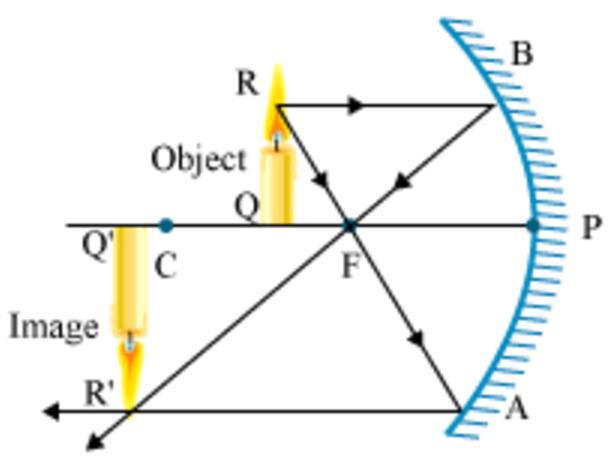
In this case, the image is formed beyond the centre of curvature. This image is real, inverted and enlarged.

Download our appand get started for free
Experience the future of education. Simply download our apps or reach out to us for more information. Let's shape the future of learning together!No signup needed.*
Similar Questions
- 1View SolutionWith the help of a labelled diagram, explain why a tank full of water appears less deep than it actually is.
- 2View SolutionHow far should an object be placed from a convex lens of focal length 20 cm to obtain its image at a distance of 30 cm from the lens? What will be the height of the image if the object is 6 cm tall?
- 3View SolutionCalculate the image distance for an object of height 12mm at a distance of 0.20m from a concave lens of focal length 0.30 m, and state the nature and size of the image.
- 4View SolutionA student uses a lens of focal length -50cm. What is the nature of the lens and its power?
- 5View SolutionThe image of a candle flame placed at a distance of 30 cm from a mirror is formed on a screen placed in front of the mirror at a distance of 60 cm from its pole. What is the nature of the mirror? Find its focal length. If the height of the flame is 2.4 cm, find the height of its image. State whether the image formed is erect or inverted.
- 6QUESTION For the same angle of incidence, the angle of refraction in three different media $A , B$ and C are $10^{\circ}, 25^{\circ}$ and $40^{\circ}$, respectively. In which medium the velocity of light will be maximum?View Solution
- 7View SolutionA 4 cm tall object is placed perpendicular to the principal axis of a convex lens of focal length 24 cm. The distance of the object from the lens is 16 cm. Find the position, size and nature of the image formed, using the lens formula.
- 8View SolutionThe image of an object place at 60cm in front of a lens is obtained on a screen at a distance of 120cm from it. Find the focal length of the lens. What would be the lens? What would be the height of the image? If the object is 5cm high?
- 9View SolutionState the laws of refraction of light. Explain the term ‘absolute refractive index of a medium’ and write an expression to relate it with the speed of light in vacuum.
- 10View SolutionGive three examples of materials that refract light rays. What happens to the speed of light rays when they enter these materials?