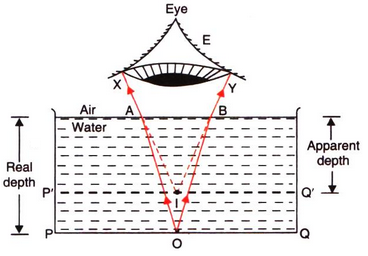
With the help of a labelled diagram, explain why a tank full of water appears less deep than it actually is.
Download our app for free and get started
If we look into a tank of water, it appears to be less deep than it really is. This is due to the refraction of light which takes place when light rays pass from the tank of water into air. When we look into the tank, we do not see the actual bottom of the tank, we see a virtual image of the bottom of the pool which is formed by the refraction of light coming from the water into the air.

Download our appand get started for free
Experience the future of education. Simply download our apps or reach out to us for more information. Let's shape the future of learning together!No signup needed.*
Similar Questions
- 1View SolutionA concave lens has a focal length of 20cm. At what distance from the lens a 5cm tall object be placed so that it forms an image at 15cm from the lens? Also calculate the size of the image formed.
- 2View SolutionThe image of an object formed by a mirror is real, inverted and is of magnification - I. If the image is at a distance of 40 cm from themirror, where is the object placed? Where would the image be if the object is moved 20 cm towards the mirror? State reason and also draw ray diagram for the new position of the object to justify your answer.
- 3View SolutionAn object is placed at a distance of 100cm from a converging lens of focal length 40cm.
- What is the nature of image?
- What is the position of image?
- 4View SolutionA spherical mirror produces an image of magnification −1 on a screen placed at a distance of 40 cm from the mirror:
- Write the type of mirror.
- What is the nature of the image formed?
- How far is the object located from the mirror?
- Draw the ray diagram to show the image formation in this case.
- 5View SolutionWith the help of a diagram, explain why the image of an object viewed through a concave lens appears smaller and closer than the object.
- 6View SolutionTwo lenses A and B have focal lengths of +20cm and, -10cm, respectively.
- What is the nature of lens A and lens B?
- What is the power of lens A and lens B?
- What is the power of combination if lenses A and B are held close together?
- 7View SolutionA 4 cm tall object is placed perpendicular to the principal axis of a convex lens of focal length 24 cm. The distance of the object from the lens is 16 cm. Find the position, size and nature of the image formed, using the lens formula.
- 8View SolutionWhat is the effect on the size and position of the image of moving the object:
- Towards the lens, and
- Away from the lens?
- 9View SolutionWhat is the difference between regular reflection of light and diffuse reflection of light? What type of reflection of light takes place from:
- A cinema screen.
- A plane mirror.
- A cardboard.
- Still water surface of a lake
- 10Define Snell’s law of refraction. A ray of light is incident on a glass slab at an angle of incidence of 60°. If the angle of refraction be 32.7°, calculate the refractive index of glass.$(\text{Given:}\ \sin60^\circ=0.866,\text{ and }\sin32.7^\circ=540)$View Solution