MCQ
A system has basic dimensions as density $[D]$, velocity $[V]$ and area $[A]$. The dimensional representation of force in this system is 
  • $[AV^2D]$
  • B
    $[A^2VD]$
  • C
    $[AVD^2]$
  • D
    $[A^0VD]$

Answer

Correct option: A.
$[AV^2D]$
a
$\mathrm{F}=\mathrm{Ma}=$ volume $\times$ density $\times\left(\frac{\mathrm{L}}{\mathrm{T}^{2}}\right)$

$=(\text { Area } \times \text { length }) \times$ density $\times \frac{\mathrm{L}}{\mathrm{T}^{2}}$

$\left[\text { velocity } \mathrm{v}^{2}=\frac{\mathrm{L}^{2}}{\mathrm{T}^{2}}\right]$

$=\left[\mathrm{Av}^{2} \mathrm{D}\right]$

Need a full question paper?

Generate a complete, print-ready paper with questions like this in minutes — across 16+ boards, with answer keys.
Start Generating Free

Similar questions

The density and breaking stress of a wire are $6 \times$ $10^4 \mathrm{~kg} / \mathrm{m}^3$ and $1.2 \times 10^8 \mathrm{~N} / \mathrm{m}^2$ respectively. The wire is suspended from a rigid support on a planet where acceleration due to gravity is $\frac{1^{\text {rd }}}{3}$ of the value on the surface of earth. The maximum length of the wire with breaking is ............ $\mathrm{m}$ (take, $\mathrm{g}=$ $\left.10 \mathrm{~m} / \mathrm{s}^2\right)$
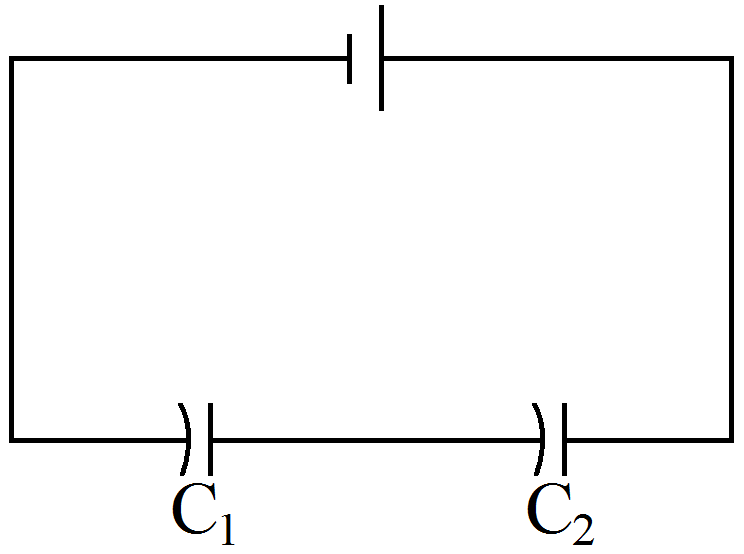
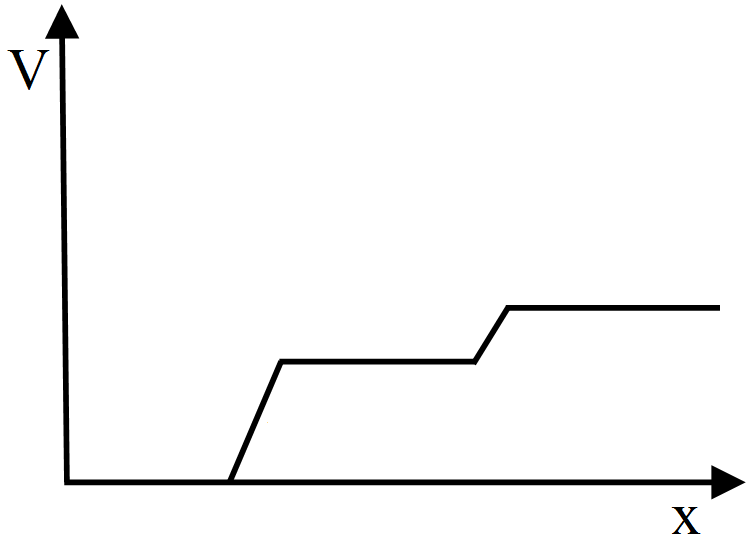
Figure shows two capacitors connected in series and joined to a battery. The graph shows the variation in potential as one moves from left to right on the branch containing the capacitors:

In the previous question, the smallest kinetic energy at the bottom of the incline will be achieved by:
The root mean square velocity of a gas molecule of mass $m$ at a given temperature is proportional to
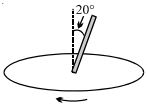
$A$ uniform rod is fixed to a rotating turntable so that its lower end is on the axis of the turntable and it makes an angle of $20^o$ to the vertical. (The rod is thus rotating with uniform angular velocity about a vertical axis passing through one end.) If the turntable is rotating clockwise as seen from above. Is there a torque acting on it, and if so in what direction?
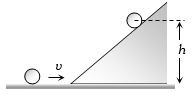
A disc of mass $M$ and radius $R$ rolls in a horizontal surface and then rolls up an inclined plane as shown in the fig. If the velocity of the disc is $v$, the height to which the disc will rise will be..
There is formation of layer of snow $x\,cm$ thick on water, when the temperature of air is $ - {\theta ^o}C$ (less than freezing point). The thickness of layer increases from $x$ to $y$ in the time $t$, then the value of $t$is given by
Mark the correct options:
The position-time $(x-t)$ graph for positive acceleration is
When a body moves with a constant speed along a circle