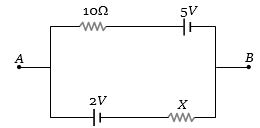
If ${V_{AB}} = 4\,V$ in the given figure, then resistance $X$ will be .............. $\Omega$
Medium


Download our appand get started for free
Experience the future of education. Simply download our apps or reach out to us for more information. Let's shape the future of learning together!No signup needed.*
Similar Questions
- 1By using only two resistance coils-singly, in series, or in parallel one should be able to obtain resistances of $3$, $4$, $12$ and $16\, ohms$. The separate resistances of the coil areView Solution
- 2A potentiometer wire has length $4\,\, m$ and resistance $8\,\,\Omega $. The resistance that must be connected in series with the wire and an accumulator of e.m.f. $2\,\, V,$ so as to get a potential gradient $1\,\, m \,V$ per $cm$ on the wire is ............. $\Omega$View Solution
- 3Thousand cells of same emf $E$ and same internal resistance $r$ are connected in series in same order without an external resistance. The potential drop across $399$ cells is found to be ......... $E$View Solution
- 4The resistance of a wire of uniform diameter $d$ and length $L$ is $R$. The resistance of another wire of the same material but diameter $2d$ and length $4L$ will beView Solution
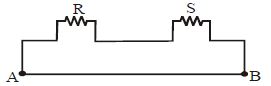
- 5In a meter bridge, the null point is found at a distance of $25\, cm$ from $A$. If now a resistance of $10\,\Omega $ is connected in parallel with $S$, the null point occurs at mid point of $AB$. The value of $R$ is ................. $\Omega$View Solution
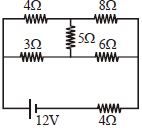
- 6In the given figure the ratio of current in $8\,\Omega $ and $3\,\Omega $ will beView Solution
- 7View SolutionThe maximum current that flows through a fuse wire before it blows out varies with its radius as
- 8View SolutionOhm's law is true
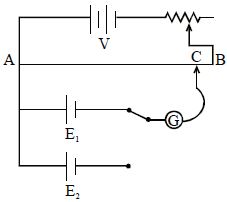
- 9The circuit shown here is used to compare the emf of two cells $E_1$ and $E_2 (E_1 > E_2)$. The null point is at $C$ when the galvanometer is connected to $E_1$. When the galvanometer is connected to $E_2$, the null point will beView Solution
- 10View SolutionThe reciprocal of resistance is