MCQ
A system is changed from state $A$  to state $B$  by one path and from $B$  to $A$ another path. If ${E_1}$ and ${E_2}$ are the corresponding changes in internal energy, then
  • A
    ${E_1} + {E_2} = - ve$
  • B
    ${E_1} + {E_2} = + ve$
  • C
    None of these


  • ${E_1} + {E_2} = 0$

Answer

Correct option: D.
${E_1} + {E_2} = 0$
(d) Internal Energy is a state dependent function.

Need a full question paper?

Generate a complete, print-ready paper with questions like this in minutes — across 16+ boards, with answer keys.

Start Generating Free

Similar questions

A graph plotted between $\log \,K$ vs $ 1/T$ for calculating activation energy is shown by
The conjugate acid of ${H_2}PO_4^ - $ is
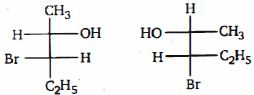
The molecules represented by the above two structures are
A triglyceride can have how many different acyl groups?
Consider the following sequence of reaction $A, B, C$ are
The experimental data for reaction
$2A + B_2 \longrightarrow 2AB$

Exp. $[A]$ $[B_2]$ Rate $(mol\,L^{-1}\,S^{-1})$
$1$ $0.50$ $0.50$ $1.6 \times {10^{ - 4}}$
$2$ $0.50$ $1.00$ $3.2 \times {10^{ - 4}}$
$3$ $1.00$ $1.00$ $3.2 \times {10^{ - 4}}$

The rate law

The major product $(C)$ is
Which of the following form dimeric halides
The possible number of stereoisomers of the product of following reaction would be

$\begin{array}{*{20}{c}}
  {Ph - CH = CH - CH - C = O\xrightarrow[{PH = 4.5}]{{{H_2}N - OH}}} \\ 
  {{\mkern 1mu} {\mkern 1mu} \,\,\,\,\,\,\,\,\,\,\,\,\,\,\,\,\,\,\,\,|\,\,\,\,\,\,\,\,\,\,\,\,\,\,\,|{\mkern 1mu} {\mkern 1mu} {\mkern 1mu} {\mkern 1mu} {\mkern 1mu} {\mkern 1mu} {\mkern 1mu} {\mkern 1mu} {\mkern 1mu} {\mkern 1mu} {\mkern 1mu} {\mkern 1mu} {\mkern 1mu} {\mkern 1mu} {\mkern 1mu} {\mkern 1mu} {\mkern 1mu} {\mkern 1mu} {\mkern 1mu} {\mkern 1mu} {\mkern 1mu} {\mkern 1mu} {\mkern 1mu} {\mkern 1mu} {\mkern 1mu} } \\ 
  {{\mkern 1mu} {\mkern 1mu} {\mkern 1mu} {\mkern 1mu} \,\,\,\,\,\,\,\,\,\,\,\,\,\,\,\,\,\,\,\,\,C{H_3}\,\,\,\,\,\,\,H{\mkern 1mu} {\mkern 1mu} \,\,{\mkern 1mu} {\mkern 1mu} {\mkern 1mu} {\mkern 1mu} {\mkern 1mu} {\mkern 1mu} {\mkern 1mu} {\mkern 1mu} {\mkern 1mu} {\mkern 1mu} {\mkern 1mu} {\mkern 1mu} {\mkern 1mu} {\mkern 1mu} {\mkern 1mu} {\mkern 1mu} {\mkern 1mu} {\mkern 1mu} {\mkern 1mu} {\mkern 1mu} {\mkern 1mu} {\mkern 1mu} {\mkern 1mu} {\mkern 1mu} } 
\end{array}$ ?
Which of the following species must have maximum number of electrons in $'d_{xy}$ ;  orbital ?

