MCQ
A thermo-dynamical system is changed from state $\left(P_1, V_1\right)$ to $\left(P_2, V_2\right)$ by two different process. The quantity which will remain same will be
  • A
    $\Delta Q$
  • B
    $\Delta W$
  • C
    $\Delta Q+\Delta W$
  • $\Delta Q-\Delta W$

Answer

Correct option: D.
$\Delta Q-\Delta W$
(d) Change in internal energy does not depend upon path so $\Delta U=\Delta Q-\Delta W$ remain constant.

Need a full question paper?

Generate a complete, print-ready paper with questions like this in minutes — across 16+ boards, with answer keys.
Start Generating Free

Similar questions

A $20 cm$ length of a certain solution causes right-handed rotation of $38^{\circ}$. A $30 cm$ length of another solution causes left-handed rotation of $24^{\circ}$. The optical rotation caused by $30 cm$ length of a mixture of the above solutions in the volume ratio $1: 2$ is
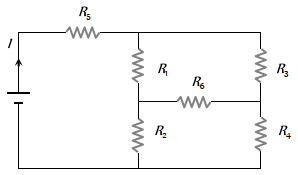
In the given circuit, it is observed that the current $l$ is independent of the value of the resistance $R$. Then the resistance values must satisfy

Image

A transverse sinusoidal wave of amplitude $a$, wavelength $\lambda$ and frequency $n$ is travelling on a stretched string. The maximum speed of any point on the string is $v / 10$, where $v$ is the speed of propagation of the wave. If $a=10^{-3} \mathrm{~m}$ and $v=10 \mathrm{~ms}^{-1}$, then $\lambda$ and $n$ are given by
Can the resultant of 2 vectors be zero
If a magnet of length $10 \mathrm{~cm}$ and pole strength $40 \mathrm{~A}-\mathrm{m}$ is placed at an angle of $45$ in an uniform induction field of intensity $2 \times 10^{-4}\  T$, the couple acting on it is
Ultraviolet light of wavelength $300 \mathrm{~nm}$ and intensity $1.0 \mathrm{watt} / \mathrm{m}$ falls on the surface of a photosensitive material. If $1 \%$ of the incident photons produce photoelectrons, then the number of photoelectrons emitted from an area of $1.0 \mathrm{~cm}$ of the surface is nearly
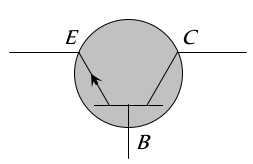
The symbol given in figure represents
Image
Whenever a hydrogen atom emits a photon in the Balmer series
The $21\ cm$ radio wave emitted by hydrogen in interstellar space is due to the interaction called the hyperfine interaction is atomic hydrogen. the energy of the emitted wave is nearly
A convex lens has $9 \mathrm{~cm}$ focal length and a concave lens has $-18 \mathrm{~cm}$ focal length. The focal length of the combination in contact will be