Question
A thermodynamic system is taken from an original state to an intermediate state by the linear process shown in Fig.
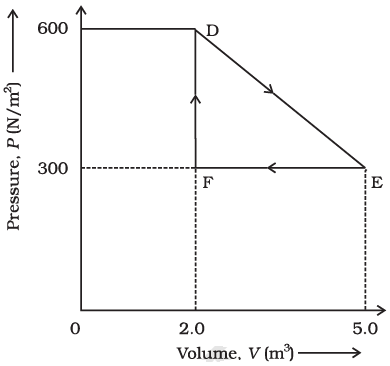
Its volume is then reduced to the original value from E to F by an isobaric process. Calculate the total work done by the gas from D to E to F.
Answer

Total work done by the gas from D to E to $\mathrm{F}=$ Area of $\triangle \mathrm{DEF}$ Area of $\triangle \mathrm{DEF}=(1 / 2) \mathrm{DE} \times \mathrm{EF}$ Where, $\mathrm{DF}=$ Change in pressure $=600 \mathrm{~N} / \mathrm{m}^2-300 \mathrm{~N} / \mathrm{m}^2=300 \mathrm{~N} / \mathrm{m}^2 \mathrm{FE}=$ Change in volume $=5.0 \mathrm{~m}^3-2.0 \mathrm{~m}^3=3.0 \mathrm{~m}^3$ Area of $\triangle \mathrm{DEF}=$ $(1 / 2) \times 300 \times 3=450$ J Therefore, the total work done by the gas from $D$ to $E$ to $F$ is 450 J.

Need a full question paper?

Generate a complete, print-ready paper with questions like this in minutes — across 16+ boards, with answer keys.

Start Generating Free

Similar questions

A nearsighted person cannot see beyond 25cm. Assuming that the separation of them glass from the eye is 1cm, find the power of lens needed to see distant objects.
Prove that the elastic potential energy density of a stretched wire is equal to half the product of stress and strain.
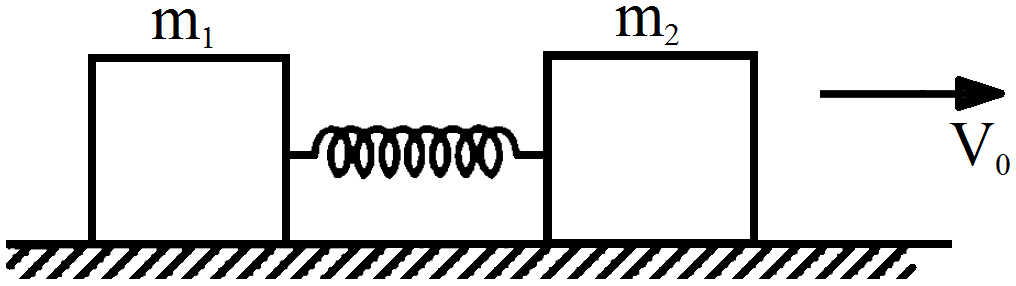
Two blocks of masses $m_1$ and $m_2$ are connected by a spring of spring constant $k.$ The block of mass $m_2$ is given a sharp impulse so that it acquires a velocity $v_0$ towards right. Find
  1. The velocity of the centre of mass.
  2. The maximum elongation that the spring will suffer.
The physicists think at a level far higher than a normal individual. Explain.
A stone dropped from the top of a tower of height 300 m splashes into the water of a pond near the base of the tower. When is the splash heard at the top given that the speed of sound in air is $340 m s ^{-1} ?\left(g=9.8 m s ^{-2}\right)$
Time period of a planet around the Sun is $11.6$ years. How far is the planet from the Sun? The distance between the Sun and the earth is $1.5 \times 10^8km$.
In one-dimensional motion the velocity of a particle depends on time in the following manner :
$
v=(5 t+7) m / s
$
If the particle is at the origin at $t=0$, then what will be the position of the particle at $t=2 sec$ ?
Give examples of a one-dimensional motion where: The particle moving along positive x-direction comes to rest periodically and moves forward.
A particle is released from the top of an incline of height h. Does the kinetic energy of the particle at the bottom of the incline depend on the angle of incline? Do you need any more information to answer this question in Yes or No?
A railway track (made of iron) is laid in winter when the average temperature is $18^{\circ} \mathrm{C}$. The track consists of sections of 12.0 m placed one after the other. How much pp should be left between two such sections 80 that there is no compression during summer when the maximum temperature goes to $48^{\circ} \mathrm{C}$ ? Coefficient of linear expansion of iron $=11 \times 10^{-6}{ }^{\circ} \mathrm{C}^{-1}$.