MCQ
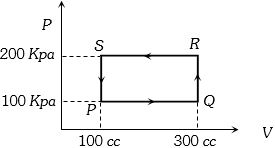
A thermodynamic system is taken through the cycle $PQRSP$ process. The net work done by the system is ....... $J$
  • A
    $20$
  • $-20 $
  • C
    $400 $
  • D
    $-374 $

Answer

Correct option: B.
$-20 $
b
(b) Work done by the system = Area of shaded portion on $P-V$ diagram
$ = (300 - 100){10^{ - 6}} \times (200 - 10) \times {10^3} = 20\,J$

Need a full question paper?

Generate a complete, print-ready paper with questions like this in minutes — across 16+ boards, with answer keys.
Start Generating Free

Similar questions

Keeping the number of moles, volume and temperature the same, which of the following are the same for all ideal gases?
If $\overrightarrow A = 3\hat i + \hat j + 2\hat k$ and $\overrightarrow B = 2\hat i - 2\hat j + 4\hat k$ then value of $|\overrightarrow A \times \overrightarrow B |\,$ will be
Two identical samples of a gas are allowed to expand $(i)$ isothermally $(ii)$ adiabatically. Work done is
A pipe open at both ends produces a note of frequency $f‌‌‌_1$. When the pipe is kept with $\frac{3}{4}$th of its length it water, it produced a note of frequency $f_2$. The ratio $\frac{{{f_1}}}{{{f_2}}}$ is
If the linear momentum is increased by $50\%$, the kinetic energy will increase by ............. $\%$
The fundamental frequency is n of both open end of argon pipe. Keep in vertical and dip in water half length of tubes. So it will full with half water the fundamental frequency of air column.
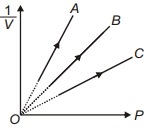
Figure shows the isotherms of a fixed mass of an ideal gas at three temperatures $T_A, T_B$ and $T_C$, then
A string fixed at both the ends is vibrating in two segments. The wavelength of the corresponding wave is
A lead ball moving with a velocity $V$ strikes a wall and stops. If $50\%$ of its energy is converted into heat, then what will be the increase in temperature (Specific heat of lead is $S$)
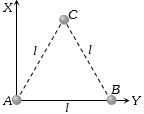
Three particles, each of mass $m\; gram$, are situated at the vertices of an equilateral triangle $ABC$ of side $l\;cm$ (as shown in the figure). The moment of inertia of the system about a line $AX$ perpendicular to $A B$ and in the plane of $A B C,$ in $gram-cm^{2}$ units will be