MCQ
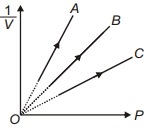
Figure shows the isotherms of a fixed mass of an ideal gas at three temperatures $T_A, T_B$ and $T_C$, then
  • A
    $T_A > T_B > T_C$
  • $T_A < T_B < T_C$
  • C
    $T_B < T_A < T_C$
  • D
    $T_A=T_B=T_C$

Answer

Correct option: B.
$T_A < T_B < T_C$
b
(b)

$\because P V=R T$

$\frac{R T}{V}=P$

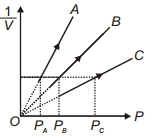
$\because$ For constant $\frac{1}{V} \quad$ So, $P \propto T$

$\because P_C > P_B > P_A$ then

$T_C > T_B > T_A$
Need a full question paper?

Generate a complete, print-ready paper with questions like this in minutes — across 16+ boards, with answer keys.
Start Generating Free

Similar questions

A student is experimenting with resonance tube apparatus in Physics lab to find the  speed of sound at room temperature. He got first two resonating lengths of air column as  $17\, cm$ and $51 \,cm$, using tuning fork of frequency $512\, Hz$. Find speed of sound  at room temperature ..... $m/s$
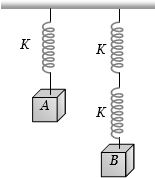
The springs shown are identical. When $A = 4kg$, the elongation of spring is $1\, cm$. If $B = 6\,kg$, the elongation produced by it is  ..... $ cm$
The range of a particle when launched at an angle of ${15^o}$ with the horizontal is $1.5 \,km$. What is the range of the projectile when launched at an angle of ${45^o}$ to the horizontal ........ $km$
Figure shows four paths for a kicked football. Ignoring the effects of air on the flight, rank the paths according to initial horizontal velocity component, highest first
A bullet is fired vertically upwards with velocity $v$ from the surface of a spherical planet. When it reaches its maximum height, its acceleration due to the planet's gravity is $1 / 4^{\text {th }}$ of its value at the surface of the planet. If the escape velocity from the planet is $v_{e s c}=v \sqrt{N}$, then the value of $N$ is (ignore energy loss due to atmosphere)
What happens to the average velocity when a body falls under gravity with terminal velocity?
The acceleration of a body in a non-uniform circular motion is $5\, ms^{-2}$. Which one of the following is correct?
A particle $P$ moving with speed $v$  undergoes a head -on elastic collision with another particle $Q$ of identical mass but at rest. After the collision
A body travels uniformly a distance of $ (13.8 \pm 0.2) m$ in a time $(4.0 \pm 0.3)\, s$. The velocity of the body within error limits is
The figure shows the intensity-wavelength relations of $X-$rays coming from two different Coolidge tubes. The solid curve represents the relation for the tube $A$ in which the potential difference between the target and the filament is $\mathrm{V}_{\mathrm{A}}$ and the atomic number of the target material is $\mathrm{Z}_{\mathrm{A}}$. These quantities are $\mathrm{V}_{\mathrm{B}}$ and $\mathrm{Z}_{\mathrm{B}}$ for the other tube. Then: