Question
A thermos flask is filled with water. The thermos is shaken for some time due to which the temperature of the water increases. Give reasons. (i) Was work done on water? (ii) Was heat given to water? (iii) Will the internal energy of water increases?
Answer

(1) Yes, because the layers of water have to move relative against the viscous force, hence work was done on the water by an external factors.
(ii) No, because the flask is equipped with a heat insulating covers.
(iii) Yes, because due to increase in temperature, uncontrolled movement of molecules results in kinetic energy and due to thermal expansion of water, intermolecular potential energy increases.

Need a full question paper?

Generate a complete, print-ready paper with questions like this in minutes — across 16+ boards, with answer keys.

Start Generating Free

Similar questions

At what temperature will the speed of sound be double of its value at $0^{\circ} \mathrm{C}$ ?
If the earth were made of lead of relative density 11.3 , what then would be the value of acceleration due to gravity on the surface of the earth? Radius of the earth $=6.4 \times 10^6 m$ and $G =6.67 \times 10^{-11} Nm ^2 kg^{-2}$.
Balmer series was observed and analysed before the other series. Can you suggest a reason for such an order?
Under what condition will the distance and displacement of a moving object will have the same magnitude?
When two surfaces are polished, the friction coefficient between them decreases. But the friction coefficient increases and becomes very large if the surfaces are made highly smooth. Explain.
A voltmeter consists of a $25\Omega$ coil connected in series with a $575\Omega$ resistor. The coil takes 10mA for full scale deflection. What maximum potential difference can be measured by this voltmeter?
Estimate the number of collisions per second suffered by a molecule in a sample of hydrogen at STP. The mean free path (average distance covered by a molecule between successive collisions) $=1.38 \times 10^{-5} \mathrm{~cm}$.
A man of mass 50kg starts moving on the earth and acquires a speed of 1.8m/s. With what speed does the earth recoil? Mass of earth = $6 \times 10^{24}kg$.
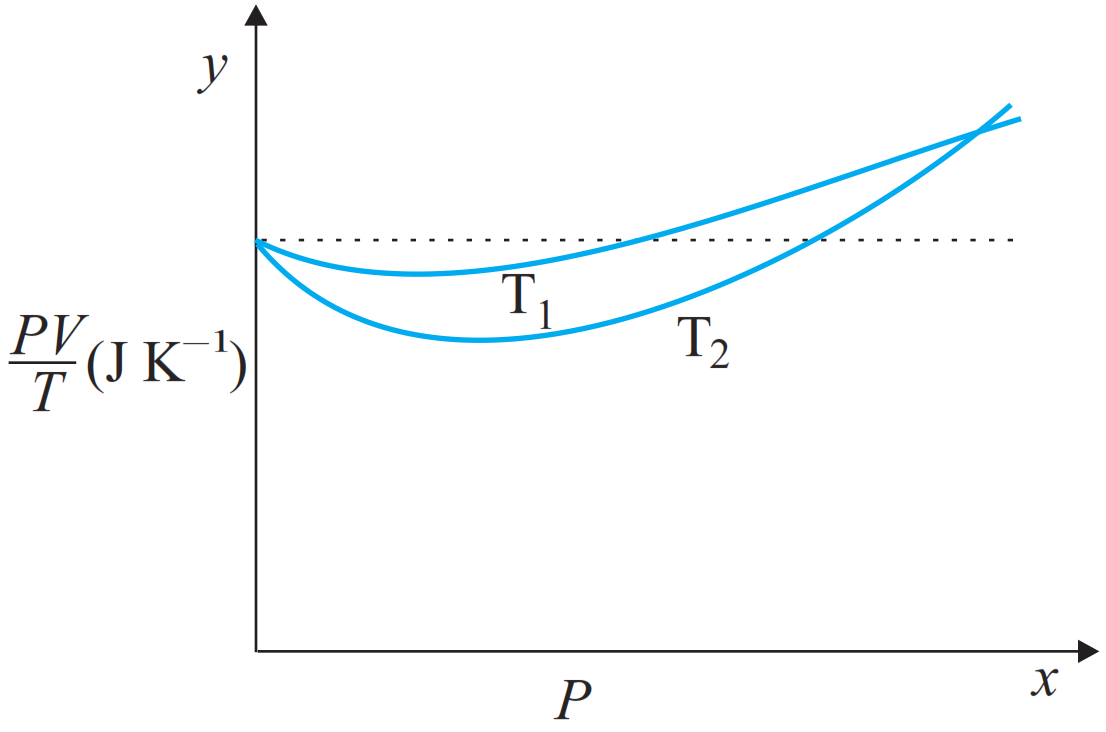
Shows plot of $\frac{\text{PV}}{\text{T}}$ versus P for $1.00 \times 10^{-3} \mathrm{~kg}$ of oxygen gas at two different temperatures. What does the dotted plot signify?
The particle position in one-dimensional motion is
$
x=\left(3+4 t-t^2\right) \text { meter }
$
Draw the displacement velocity diagram for this motion from the time interval $t=0 sec$ to $t=4 sec$.