Question
A thin circular loop of radius R rotates about its vertical diameter with an angular frequency $\omega.$ Show that a small bead on the wire loop remains at its lowermost point for $\omega\le\sqrt{\frac{\text{g}}{\text{R}}}.$ What is the angle made by the radius vector joining the centre to the bead with the vertical downward direction for $\omega=\sqrt{\frac{2\text{g}}{\text{R}}}?$ Neglect friction.
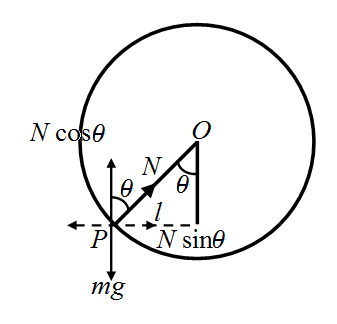 OP = R = Radius of the circle N = Normal reaction The respective vertical and horizontal equations of forces can be written as: $\text{mg}=\text{N}\cos\theta\ ....(\text{i})$ $\text{ml}\omega=\text{N}\sin\theta\ ...(\text{ii})$ In $\triangle\text{OPQ},$ we have: $\sin\theta=\frac{\text{l}}{\text{R}}$ $\text{l}=\text{R}\sin\theta\ ...(\text{iii})$ Substituting equation (iii) in equation (ii), we get: $\text{m}(\text{R}\sin\theta)\omega^2=\text{N}\sin\theta$ $\text{mR}\omega^2=\text{N}\ ...(\text{iv})$ Substituting equation (iv) in equation (i), we get: $\text{mg}=\text{mR}\omega^2\cos\theta$ $\cos\theta=\frac{\text{g}}{\text{R}\omega^2}\ ...(\text{v})$ Since $\cos\theta\le1,$ the bead will remain at its lowermost point for $\frac{\text{g}}{\text{R}\omega^2\le1},$ i.e., for $\omega\le\Big(\frac{\text{g}}{\text{R}}\Big)^{1/2}$ For $\omega=\Big(\frac{2\text{g}}{\text{R}}\Big)^{1/2}\ \text{or}\ \omega^2=\frac{2\text{g}}{\text{R}}\ ...(\text{vi})$ On equating equations (v) and (vi), we get: $\frac{2\text{g}}{\text{R}}=\frac{\text{g}}{\text{R}\cos\theta}$ $\cos\theta=\frac{1}{2}$ $\therefore\theta=\cos^{-1}(0.5)=60^\circ$